
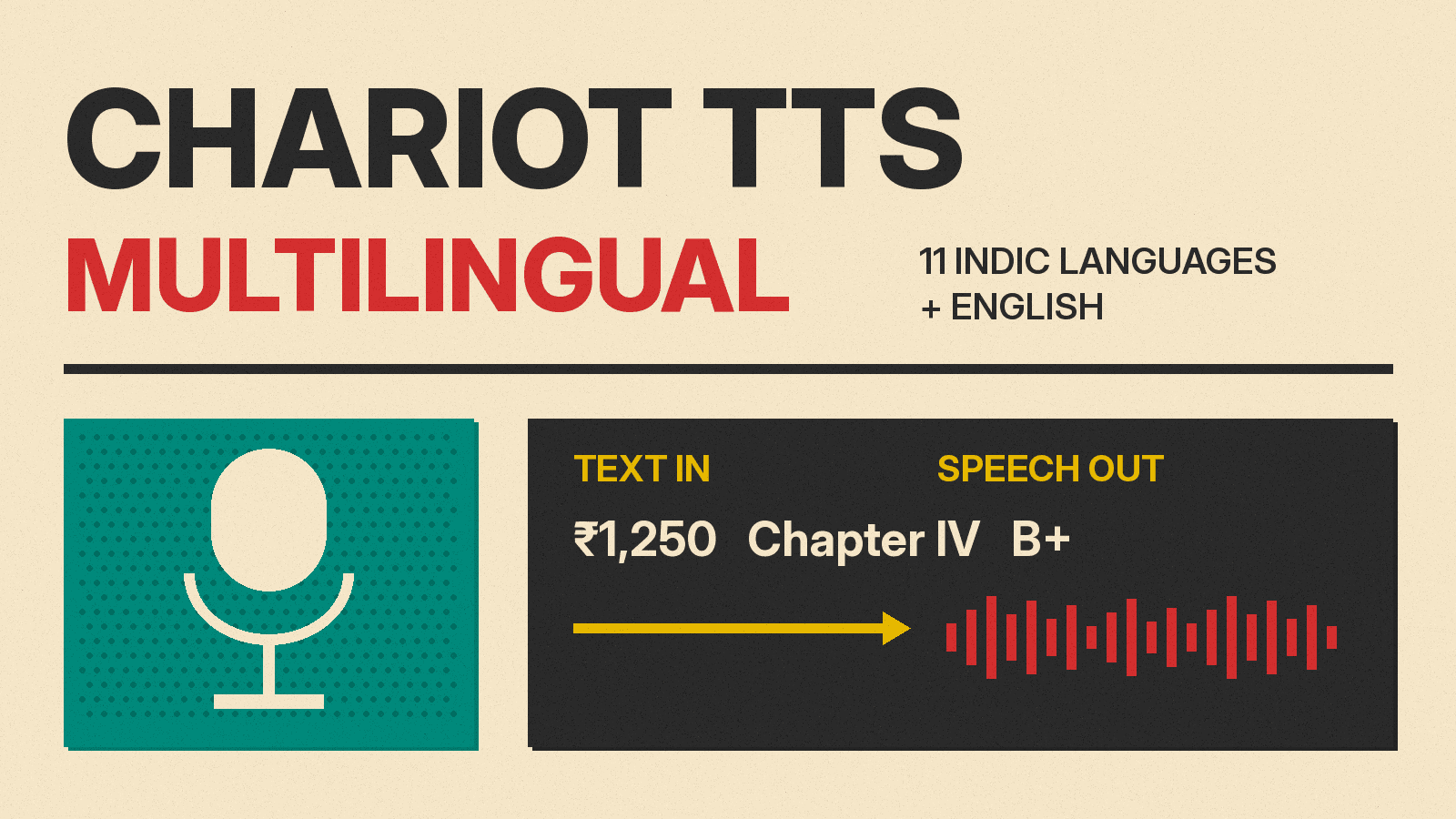
Chariot, a Delhi-based speech AI lab, launched Chariot-1-TTS-Multilingual on 12 November 2026. The text-to-speech model speaks 11 Indic languages and English, can switch languages mid-sentence, and clones a voice from a short recording.
Chariot's launch focuses on reading real-world text correctly: rupee amounts, dates, abbreviations and symbols. Its own benchmark puts the model just ahead of ElevenLabs v3 and Sarvam Bulbul v3, by small margins.
What is Chariot-1-TTS-Multilingual?
In its launch post, Chariot calls the release "a text-to-speech model for the way people actually write and speak." It says the model "can switch languages mid-sentence and use context to read prices, dates, abbreviations and symbols aloud."
The headline features, as Chariot lists them:
- 11 Indic languages and English
- 50+ voices in a voice library
- Code-mixing across all supported language pairs, so one sentence can combine any two supported languages
- Instant voice cloning from "a few seconds of reference audio"
- Up to 1,000 characters per generation
It follows Chariot-1-ASR Realtime, the lab's speech-to-text model, so Chariot now offers models that both listen and speak. It arrives the same week as Zyphra's ZONOS3-Mini, another voice-cloning TTS model.
Which languages does it speak?
The launch post names Bengali, Gujarati, Hindi, Kannada, Malayalam, Marathi, Odia, Punjabi, Tamil, Telugu, Urdu and English. Chariot's text-to-speech product page goes further and says "15+ languages", listing English, German, Chinese, Hindi, Urdu "and nine more Indian languages." The launch post itself names the 12 above.
The product page says English comes in American, British and Indian accents, and that "every voice speaks every language." It also says Hinglish, Tanglish and Hindi typed in Roman letters "are read as written."
On cloning, the two pages give different numbers. The launch post says "a few seconds of reference audio." The product page says to record or upload 30 seconds of your voice, and that the clone is ready about 20 seconds later. Cloning is on paid plans, "from 3 voices on Starter."
How does it read numbers and symbols?
Chariot's home page argues that "traditional TTS models make you do part of the model's job: expand numbers, spell out abbreviations, force punctuation, and add pronunciation hints." Chariot says its model makes those calls itself, "reducing the need to maintain custom normalization rules or write separate prompts to prepare text for speech."
Chariot's own illustrative examples:
- ₹1,250 is read as "One thousand two hundred and fifty rupees"
- "Chapter IV" is read as "Chapter four"
- "Blood group B+" is read as "B positive"
- "A grade of B+" is read as "B plus"
The use cases Chariot names, per CXOtoday's launch report, are voice agents, customer-service systems, learning apps and multilingual content, such as a bank's payment reminders, narration for a learning platform, or a public helpline. For more on where voice agents are heading, see our piece on Fish Audio Live 3.
How does it compare with ElevenLabs and Sarvam?
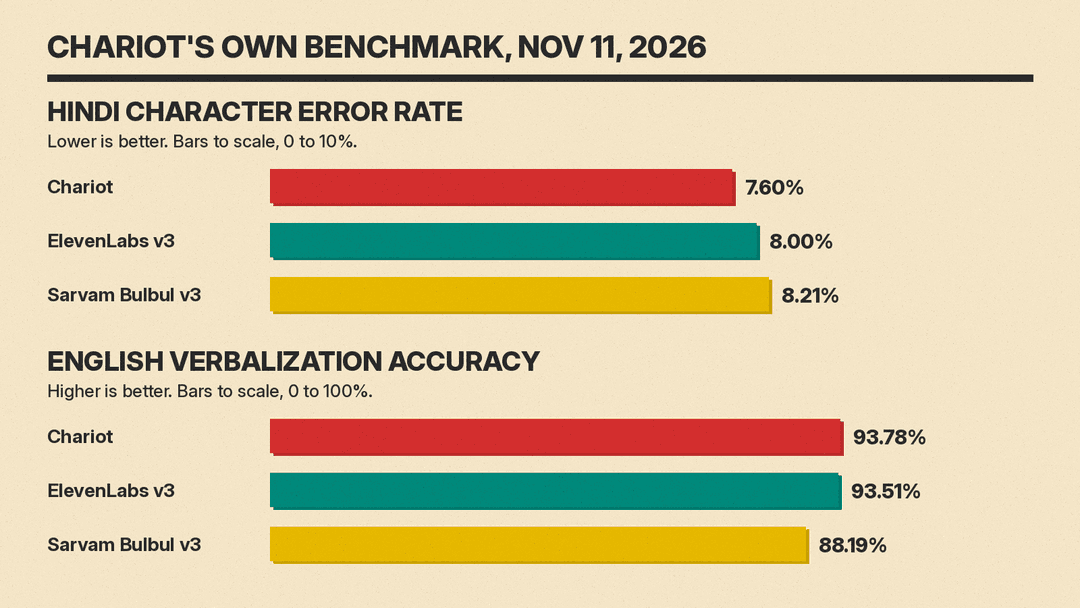
Chariot published an evaluation dated 11 November 2026 and says the model "ranked first on the three metrics below among the configurations compared." This is a vendor benchmark, run by Chariot, not an independent test. Key results:
Hindi character error rate (lower is better, 644 prompts, averaged over three speech recognizers):
- Chariot-1-TTS-Multilingual: 7.60%
- ElevenLabs v3: 8.00%
- Cartesia Sonic-3.5: 8.06%
- Sarvam Bulbul v3: 8.21%
- AWS Polly: 8.40%
- OpenAI TTS-1: 8.90%
- Microsoft Azure MAI-Voice-2: 9.72%
- OpenAI TTS-1-HD: 16.02%
Nine Indic languages (Bengali, Gujarati, Kannada, Malayalam, Marathi, Odia, Punjabi, Tamil, Telugu), three-set mean error rate, among models with complete coverage: Chariot 6.47%, Sarvam Bulbul v3 6.87%, ElevenLabs v3 8.38%. Chariot says it had the lowest average error rate in eight of the nine languages.
English verbalization accuracy (1,029 sentences across 42 categories, including currency, dates, URLs, chemical formulas and stock tickers): Chariot 93.78%, ElevenLabs v3 93.51%, Cartesia Sonic-3.5 89.92%, Microsoft Azure Dragon HD 89.29%, Sarvam Bulbul v3 88.19%, OpenAI TTS-1 72.67%.
Speech quality (NISQA, an automated quality predictor, 1,088 English prompts): Chariot 4.901, ElevenLabs v3 4.896, Cartesia Sonic-3.5 4.860.
The gaps to ElevenLabs v3 are narrow: 0.40 points on Hindi error rate, 0.27 points on English verbalization and 0.005 on NISQA. The clearer lead is on the nine-language Indic suite. The product page shows an earlier October 2026 run that also included xAI Grok, which scored 4.91 on English NISQA, the same as Chariot's 4.91 in that table. For ElevenLabs' own recent updates, see our ElevenLabs Summit NYC report.
How much does Chariot TTS cost?
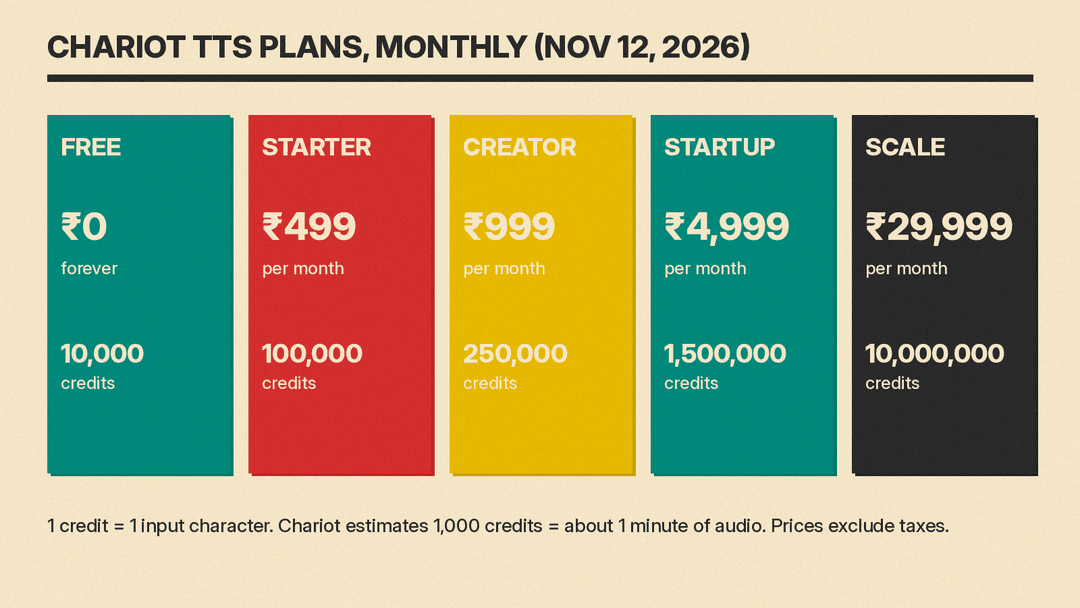
Chariot charges 1 credit per input character, per its API docs, and estimates that 1,000 credits is about 1 minute of audio. Monthly prices on the product page, as of November 12, 2026, before taxes:
- Free: ₹0, 10,000 credits (about 10 minutes), downloads for your first 5 clips, no card
- Starter: ₹499 a month, 100,000 credits, commercial usage rights
- Creator: ₹999 a month, 250,000 credits
- Startup: ₹4,999 a month, 1,500,000 credits
- Scale: ₹29,999 a month, 10,000,000 credits
Developers can use REST, HTTP streaming or WebSocket. The new model is called chariot-multilingual-v1 in the models guide; requests that leave the model out still default to the older chariot-v0, which has a 700-character limit on sync requests. The product page lists a median of about 75 ms to first audio over WebSocket, from Chariot's own October 2026 test.
Why it matters
Chariot says it is one of four teams selected under India's IndiaAI Mission to build the country's foundation models. Its product page says TTS inputs and generated audio are processed in India, under the Digital Personal Data Protection Act.
For Indian banks, helplines and learning apps, that combination of local processing, Indic voices and mixed-language input is what Chariot is offering. The benchmark lead is real but thin and self-reported, so anyone choosing between Chariot, ElevenLabs and Sarvam should test with their own scripts, especially numbers, names and Hinglish.
