
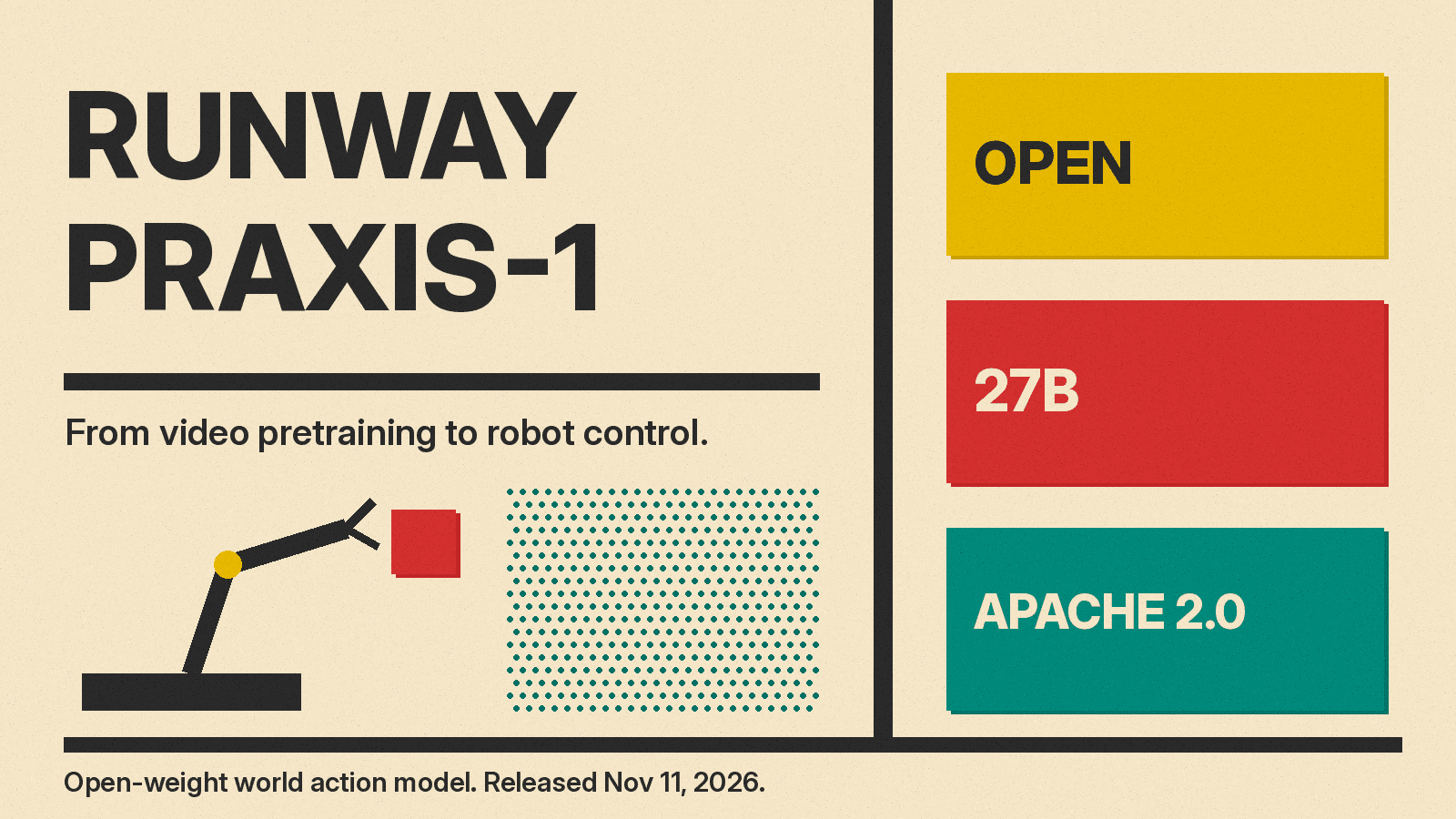
Runway, the company best known for AI video tools, released Praxis-1 with open weights on November 11, 2026. Praxis-1 is not a video generator for creators. It takes Runway's video model and turns it into a model that controls robot arms. The weights and code are under the Apache 2.0 license, which allows commercial use.
The release is a bet that ordinary video, the footage people already record every day, can teach robots more than costly hand-guided demonstrations. It also shows where AI video companies are heading: from making clips to modeling how the physical world moves.
What is Runway Praxis-1?
Runway introduced Praxis-1 in September as its first "world action model". It is built on the same large-scale video pretraining behind Runway's general world models, the line that also produced GWM Worlds 2, Runway's playable world model.
Until now, only launch partners had it. Runway says Noble Machines, Standard Bots and Ultra ran it on their own hardware: a legged humanoid, a six-axis industrial arm and a dual-arm warehouse robot. Now any robotics developer or researcher can download it.
The open release covers the weights, the inference code and the fine-tuning code, with support for both full fine-tuning and LoRA.
How does a video model control a robot?
Praxis-1 is a 27B-parameter mixture-of-experts diffusion transformer that predicts video and actions together. The tech report describes three parts. A video backbone of 26.9B parameters (about 2.8B active for any token) predicts what the scene will look like next. A small action expert of about 314M parameters reads that imagined future and works out the motion that produces it. Thin per-robot projections translate each robot's poses and actions into a shared format, so one model can control different robots.
The loop is simple:
- The robot sends an instruction, its latest camera frames and its current pose.
- Praxis-1 returns a short chunk of predicted video plus 1.6 seconds of actions (24 action rows at 15 Hz).
- The robot carries out the chunk, sends back what its cameras saw, and calls again.
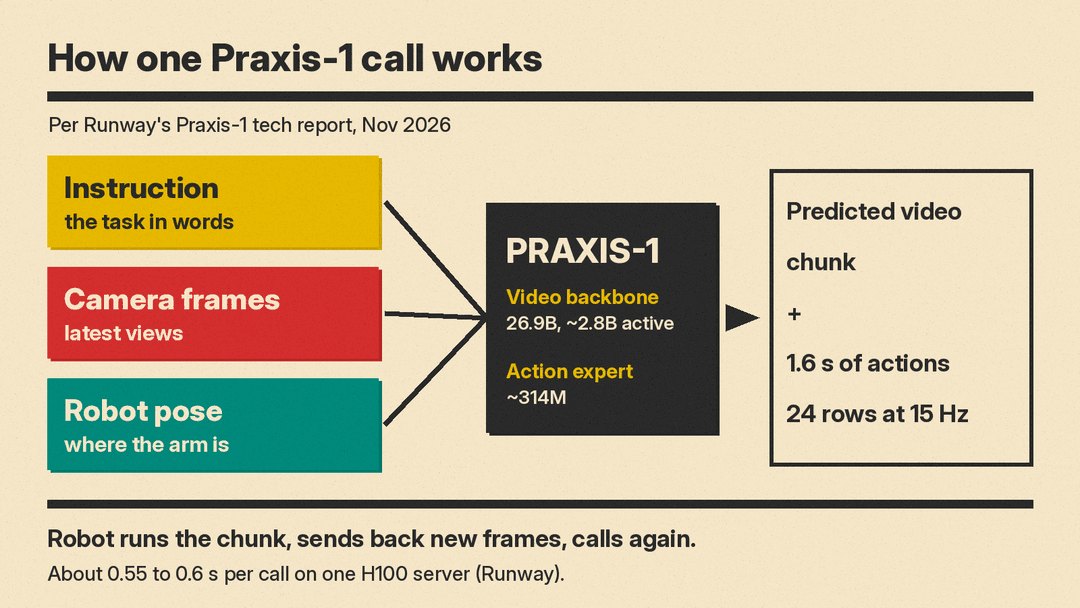
On a single H100 server, Runway says one call takes about 0.55 to 0.6 seconds round trip, about a third of the 1.6 seconds of motion it returns.
The training data is the interesting part. In mid-training, most of the footage is egocentric human video: people cooking, cleaning, assembling and packing. Robot video, general video and a little gameplay fill out the mix. Runway says its research shows web video matches teleoperated robot video as pretraining data for policy performance. If that holds, the limit on a capable robot policy becomes how much general video a model can learn from, not how many robot demonstrations a lab can record.
How well does it work?
Runway reports three main results. All are Runway's own numbers.
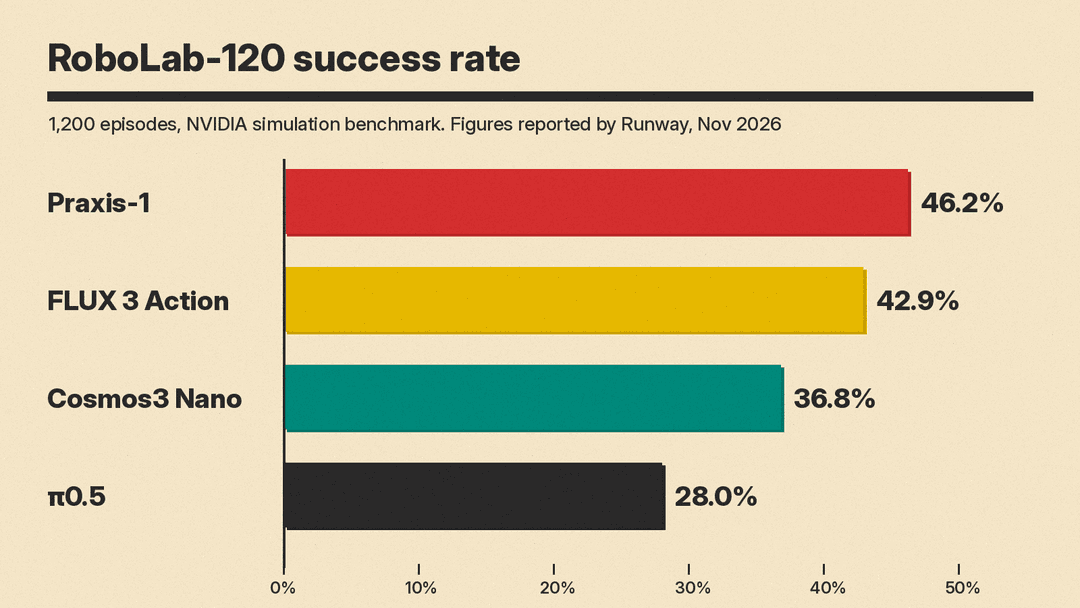
- Simulation. On NVIDIA's RoboLab-120 benchmark (120 tabletop tasks, 10 trials each), Praxis-1 succeeded in 46.2% of 1,200 episodes. FLUX 3 Action scored 42.9%, Cosmos3 Nano 36.8% and π0.5 28.0%. Runway says that makes it the top world action model on the leaderboard and ahead of every open-weight VLA. It is not first overall: the tech report says four entries score higher, two agents that drive a frontier model directly and two closed models trained partly on simulation data.
- Real robot. On a Franka FR3 arm operated by Positronic, Praxis-1 ran FLUX 3 Action's published set of ten single-item tasks, 10 episodes each, on November 2. Praxis-1 succeeded in 88 of 100 episodes, FLUX 3 Action in 80.
- A new robot. Fine-tuned on Google's RT-1 robot, which never appeared in its training data, Praxis-1 reached 80.0% on SimplerEnv, against 52.4% for the original RT-1 policy.
NVIDIA also publishes open world models. We covered Cosmos 3 Nano's open world-sim checkpoints earlier this month, and Cosmos3 Nano is one of the models Praxis-1 is compared against here.
The same day, MBZUAI's Institute of Foundation Models released PAN 2, an open world model that turns a starting scene and an action in words into a video of what happens next.
Who can use it and what do you need?
The checkpoints are in a Hugging Face collection:
- praxis-1-droid, for a single arm with an exterior and a wrist camera
- praxis-1-yam, for two YAM arms
- praxis-1-base, a starting point for fine-tuning a new robot
- NVFP4 versions of the droid and yam checkpoints
The GitHub repository says a checkpoint for the low-cost SO-101 arm is coming.
Praxis-1 also runs in LeRobot and vLLM-Omni, with hosted inference on Reactor. Developers can also try it on Runway Dev. The launch post lists NVIDIA hardware from H100 and B200 data center GPUs to RTX 5090 and RTX PRO 6000 workstation cards and Jetson Thor on the robot itself.
This is not a laptop project. The README says the quick start needs one CUDA GPU with at least 80 GB of memory, and a LoRA fine-tune for a new task also runs on one 80 GB GPU.
What are the limits?
Runway lists three weak spots in the tech report:
- Look-alike objects. The most common real-robot failure is reaching for an object that resembles the target. Runway says the wrong choice is usually already visible in the imagined video.
- Vague instructions. The policy does better when the instruction names a color or size. Vague prompts are noticeably harder.
- Long tasks. Multi-step jobs work when each step gets its own instruction. Chaining several steps from one prompt remains hard.
The benchmark results are also Runway's own. Independent tests on other robots will show how well the claims hold up.
Why it matters
Robot learning has been short on data. Real robot demonstrations are slow and expensive to collect. Video is not. Praxis-1 is an open, downloadable test of the idea that a model trained to predict video already knows a lot about how hands, objects and tasks behave.
Runway frames the open release in terms of U.S. leadership in physical AI. It says Praxis-1 builds on its work as a founding member of the Cosmos Coalition for open world models, and that it and NVIDIA are opening their technology stacks to developers. Google is working on the same problem, as seen in its Gemini 4 Argon robotics demos.
For people who follow AI video, the takeaway is that video models are no longer only about making clips. The same pretraining that renders a scene can now drive a robot arm through it.
