
Tencent used its Global Digital Ecosystem Summit in Shenzhen on October 29 to launch Buddy One, a bundle that puts its office apps behind one account, one pool of AI credits and one agent. At the same event it released Tencent Drive (腾讯网盘), a cloud drive that Tencent calls a "memory space" for AI agents. Together they show how Tencent wants to sell agents to Chinese office workers: not as a separate chatbot, but as the layer that sits on top of the documents, meetings and files people already keep in its apps.
What Buddy One is
Buddy One uses WorkBuddy, Tencent's agent workspace, as the front end. According to IT Home and Yicai, it links Tencent Docs, Tencent Meeting, Tencent Drive and ima (Tencent's knowledge base app) so they share the WorkBuddy agent, one account and one credit pool. IT Home describes it as a cross-app AI system for individual users.
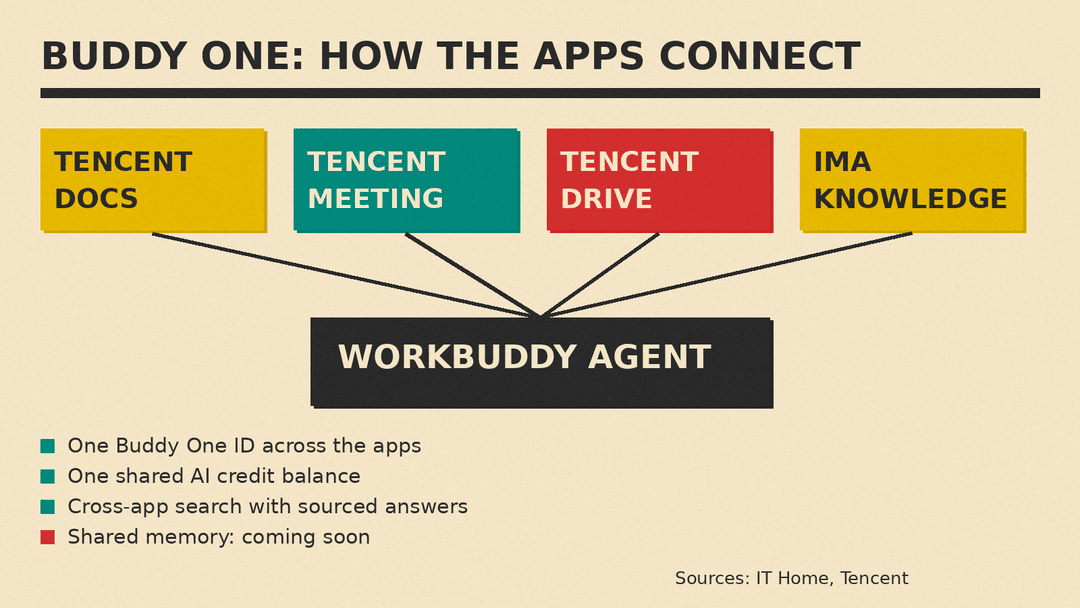
The practical change is in search. On the Buddy One product page, Tencent says that after a user links their accounts, a question in WorkBuddy can find and combine authorized documents, meetings and knowledge base content, and return an answer with sources. IT Home reports that results are labeled with the app they came from, such as ima, Tencent Docs or the WorkBuddy library, and that users no longer need to re-authorize each app or copy and paste context by hand.
Key points from the launch reports and Tencent's page:
- Requirement: the WorkBuddy PC client must be on version 5.9.0 or later, and the user links each app account in settings (IT Home).
- Free tier: Tencent's page says binding a Buddy One ID does not require the paid plan; cross-product search is free. Its FAQ adds that an account cannot be unbound for now, and that existing ima and Tencent Docs credits stay separate and are not merged into Buddy One credits.
- Shared credits: WorkBuddy credits become Buddy One credits by default and can be spent in WorkBuddy, Tencent Docs, ima and Tencent Drive. Plan credits, promotional credits and purchased credits all go into the same balance (IT Home).
- Coming later: shared memory across the apps is marked "Coming Soon" on the product page, and IT Home says more products will join.
The paid plan
Tencent also launched Buddy One VIP. IT Home reports the auto-renewing monthly plan at 700 yuan per month. It bundles WorkBuddy Flagship, Tencent Meeting Pro and Tencent Docs Super Member Plus, plus shared AI credits and 1 TB of storage usable across WorkBuddy, Tencent Docs, ima and Tencent Drive.
Tencent's WorkBuddy pricing page lists Buddy One VIP at 1,399 yuan a month. During the launch period, auto-renewing plans cost 700 yuan a month or 6,720 yuan a year, the same as WorkBuddy Flagship, and a single month costs 999 yuan. The plan includes 50,000 shared credits a month (20,000 base and 30,000 bonus).
A post on Tencent Cloud's developer community, published October 27, gives the same prices and adds a one-year (not auto-renewing) price of 8,400 yuan. It also says Tencent Meeting's own storage is not part of the shared 1 TB. That post is by a community author, and Tencent's own pages do not show these two points.
Tencent Drive: storage built for agents
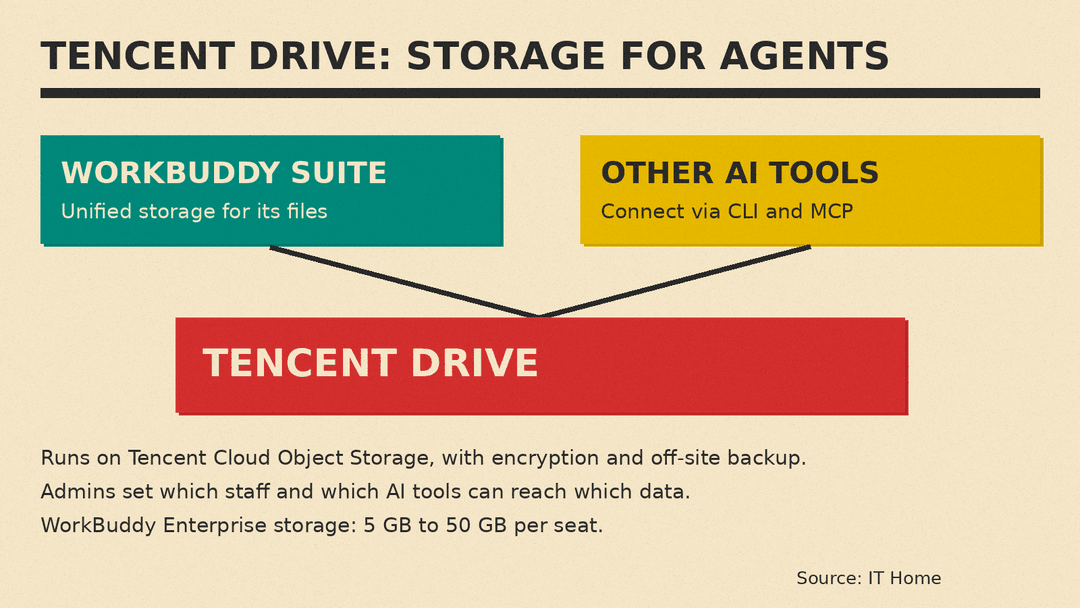
Tencent Drive is the storage layer under the suite. In his keynote, Tang Daosheng, senior executive vice president of Tencent and CEO of its Cloud and Smart Industries Group, called it "a new memory space product for the agent era" that gives WorkBuddy unified storage and lets agents save and reuse the context and output they build up, Sina Tech reported.
According to a Tencent launch release that IT Home republished:
- Tencent Drive connects to supported agents and apps through a CLI and the Model Context Protocol (MCP), so a user can search and call stored work files from other AI tools within the access they grant.
- It already powered the library feature WorkBuddy launched earlier.
- It runs on Tencent Cloud Object Storage, with encryption, off-site backup and VPC deployment for companies, and companies can set which staff roles and which AI tools can reach which data.
- WorkBuddy Enterprise storage goes from 5 GB to 50 GB per seat.
The Tencent Drive site says WeCom, Tencent Meeting and "mainstream AI tools" are connected, so a user can switch device or switch AI and pick up from the last step. It also says Tencent Drive is included in WorkBuddy membership with no separate purchase, and it takes applications to try the product.
The enterprise pitch around it
Tang framed the launches as part of a wider WorkBuddy strategy. In remarks reported by the Economic Information Daily, a Xinhua outlet, he said the biggest problem for companies deploying agents is not weak models but "too many break points," and that connection to people, tools, systems and data is the key. He said WorkBuddy will open its architecture to companies' own agents, third-party agents and third-party chat systems: "Which model to choose, which agent to connect, which IM to use, the choice is in the enterprise's hands."
The same report gives Tencent's adoption figures, which are Tencent's own and not independently verified: since its March launch, WorkBuddy Enterprise is used in more than 50 industries, covers 50% of China's top 500 companies, and has more than 50,000 platform partners and developers and more than 200,000 listed skills. Tang also said that the Hunyuan Hy4 and Hy4 Flash models are coming soon.
Why it matters
Buddy One is a bet that an assistant is only as useful as the files it can see. Tang made the same point for companies: in the Economic Information Daily report, he said WorkBuddy's integration with WeCom lets an agent use a company's chats, documents and meeting records within authorized limits, so firms do not have to switch systems or move data first. Buddy One brings that idea to individual users across Tencent's own apps.
The pricing model is also notable. Tencent still sells per-app plans, but it is moving users toward one credit balance that the linked apps share. The free account link lets any WorkBuddy user try cross-app search; the 700 yuan plan, a launch-period price, bundles the paid tiers.
The open questions are the ones Tencent has not answered yet: when shared memory arrives, and which third-party AI tools Tencent Drive supports by name.
Sources
- IT Home: Tencent launches Buddy One
- IT Home (Tencent release): Tencent Drive launches for the agent era
- Tencent Buddy One product page
- WorkBuddy pricing page (Buddy One VIP)
- Tencent Drive product page
- Yicai: Tencent releases Buddy One
- Sina Tech: Tencent launches Buddy One and Tencent Drive
- Economic Information Daily: Tang Daosheng keynote
- Tencent Cloud developer community: Buddy One VIP details
