
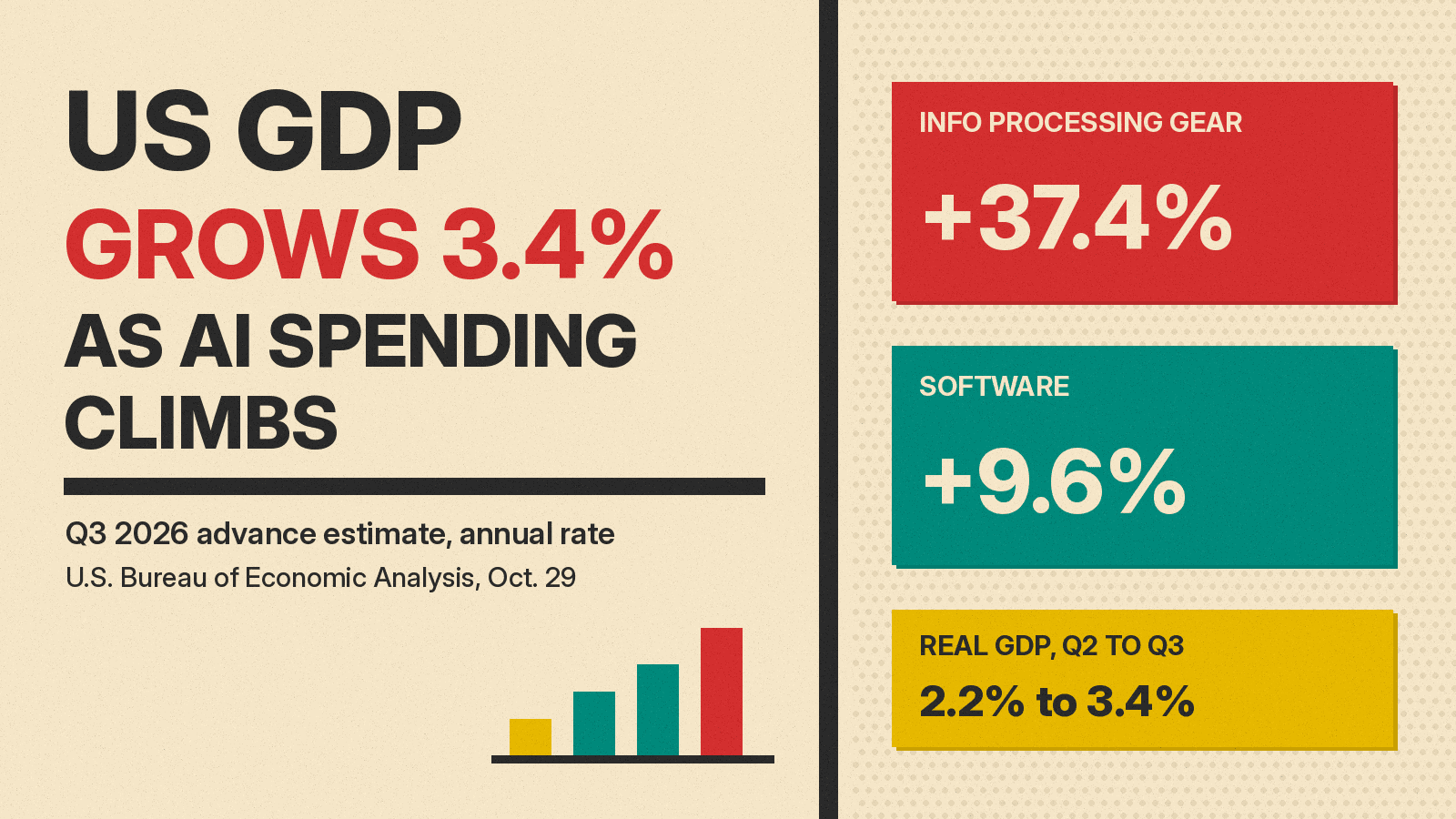
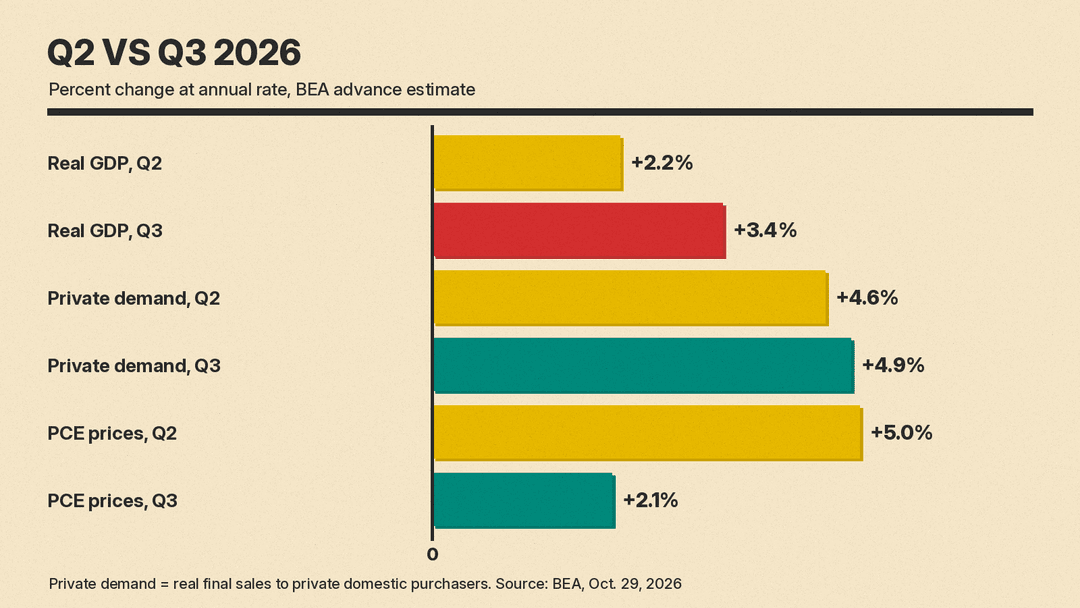
The U.S. economy grew at a 3.4% annual rate in the third quarter of 2026, up from 2.2% in the second quarter, according to the advance estimate from the U.S. Bureau of Economic Analysis (BEA) released on Oct. 29. Investment in information processing equipment was the fastest-growing line that the news reports singled out. The Associated Press tied that jump to an AI investment boom, and CNBC said higher investment from the AI build-out, along with consumer and government spending, has driven growth.
This is the first government read on how the economy did from July through September. It lands the day after big tech earnings put AI spending back in focus, including Microsoft's $45.2 billion in quarterly capex and finance leases and Alphabet's premarket drop over AI spending.
What the BEA reported
The BEA says real GDP "increased at an annual rate of 3.4 percent in the third quarter of 2026 (July, August, and September)." It says the gain came from "increases in investment, consumer spending, and government spending that were partly offset by a decrease in exports," and that imports, which are subtracted in the GDP math, increased.
On investment, the BEA's technical notes say: "The increase in investment primarily reflected increases in private inventory investment and in equipment." It then adds: "Within equipment, the increase was led by information processing equipment (mainly computers and peripheral equipment), based primarily on data for imports from the U.S. Census Bureau-BEA U.S. International Trade in Goods and Services report and the Census Bureau Advance Economic Indicators Report for September."
The BEA does not use the word AI in that description. The link to AI comes from the news coverage.
Other headline numbers from the BEA release:
- Real final sales to private domestic purchasers, the sum of consumer spending and gross private fixed investment, rose 4.9%, up from 4.6% in the second quarter.
- The PCE price index rose at a 2.1% annual rate in the quarter, down from 5.0% in the second quarter. Excluding food and energy, it rose 2.5%, down from 3.3%.
- Current-dollar GDP rose 5.6%.
This is the first of three estimates. The BEA says the second estimate comes on Nov. 25, 2026.
The AI part of the numbers
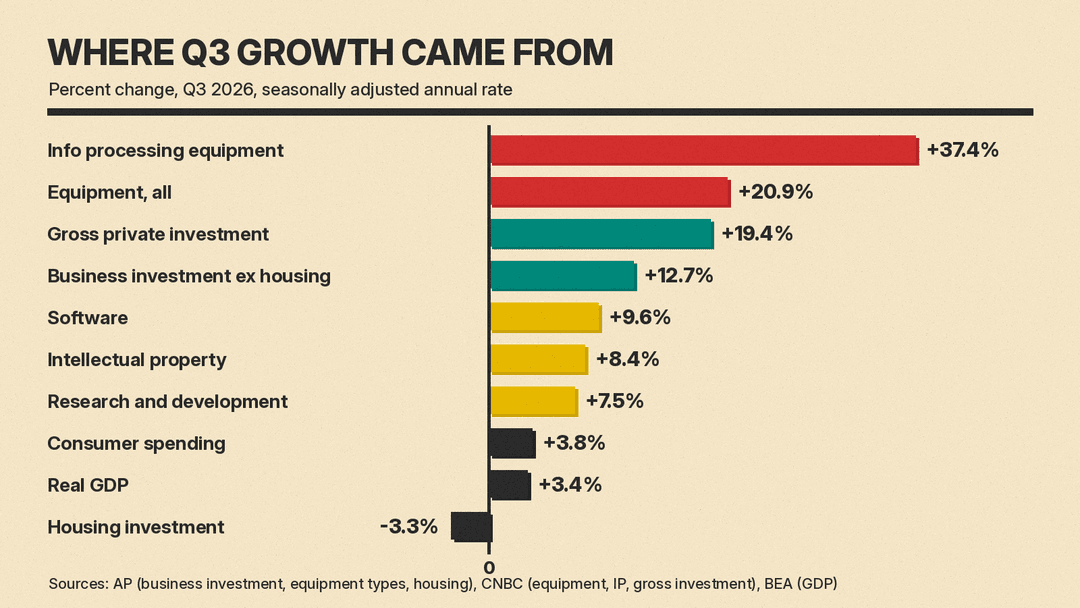
The AP report puts the AI link plainly: "U.S. growth has been lifted by an AI investment boom. Business investment, excluding housing, was up 12.7% in the third quarter. Investment in information processing equipment surged 37.4%, in software 9.6% and in research and development 7.5%."
The AP also reports that housing went the other way: "However, housing investment, hurt by high mortgage rates, dropped 3.3% and has now fallen six of the last seven quarters."
CNBC gives the wider investment figures. It writes that "Gross private domestic investment soared 19.4%, driven by a 20.9% surge in equipment spending and an 8.4% jump on intellectual property products." CNBC also says that "Economic growth has been driven by higher levels of investment from the artificial intelligence build-out, as well as high levels of consumer and government spending."
Consumer spending also grew
Information processing equipment was the fastest-growing line in the reports, but it was not the only source of growth. The AP says consumer spending rose at a 3.8% rate in the quarter, and CNBC notes that this was the same pace as the prior quarter.
The BEA lists health care, mainly hospitals and outpatient services, and food services and accommodations as the leaders in services spending. Within goods, it says prescription drugs led.
The result also beat forecasts. The AP says economists surveyed by FactSet expected 3% growth. CNBC says the figure was "better than the 3.1% estimate" it cited.
Why imports matter for the AI story
GDP measures what is produced in the United States. When companies buy imported servers and chips, the purchase counts as investment, but the imports are subtracted. So a fast rise in equipment investment does not add to GDP one for one.
The BEA's own release points in this direction. It says its estimate for information processing equipment is based primarily on import data, and that "The largest contributor to imports was capital goods, except automotive."
A July 2026 FEDS Note by Federal Reserve Board economists makes the same point in general terms: "Measuring precisely how much recent GDP growth has been boosted by AI-related investment poses a greater challenge given the lack of a dedicated line item in the national accounts and the high import-content of the equipment underlying the buildout." The note adds that the net effect "varies considerably across quarters, as the drag from net exports of computer, peripherals, and parts offsets much of the gross investment in quarters where imports rose sharply."
So the honest reading is this. Spending on computers, software and R&D grew fast in the third quarter, and reporters link that to AI. How much of the 3.4% that spending actually explains, after imports, is not in the advance estimate.
Inflation and the Fed
The same morning, the Commerce Department released September inflation data. CNBC reports that the PCE price index "increased a seasonally adjusted 0.5% for the month, putting the annual inflation rate at 3.6%." It says core PCE rose 0.3% for the month and 3.1% for the year.
CNBC says the reports came "the day after the Fed voted to hold its benchmark interest rate in a range between 3.75%-4%." It quotes Fed Chair Kevin Warsh: "The period right in front of us is information rich. There is a lot that's happening in the world. My colleagues and I are keen to take notice of it."
CNBC also quotes Chris Rupkey, chief economist at Fwdbonds: "Net, net, economic growth is powering ahead despite the uncertainty of geopolitical risks and the damage posed to many sectors of the economy by higher energy costs." Rupkey adds that real GDP "has bounced back above a 3 percent run rate in Q3 2026 for the first time in a year."
What to watch next
The second estimate on Nov. 25 will revise these numbers with more complete data. For AI watchers, the line to track is information processing equipment, alongside the import figures that offset it. Spending also has an energy side: a Sierra Club report covered here looks at how the data center buildout could raise US power emissions by 2030.
