
World, the identity project co-founded by OpenAI CEO Sam Altman, now offers banks and other financial firms a way to prove that the person on a video call is a real, verified human and not a deepfake. On October 18, on stage at Money20/20 in Las Vegas, World co-founder Alex Blania unveiled World ID for banking and finance, a bundle of three products: the World ID app, World ID for Agents, and World ID for Zoom. The Zoom piece is the one most people will see first. It is now available to Zoom's enterprise customers globally through the Zoom Marketplace.
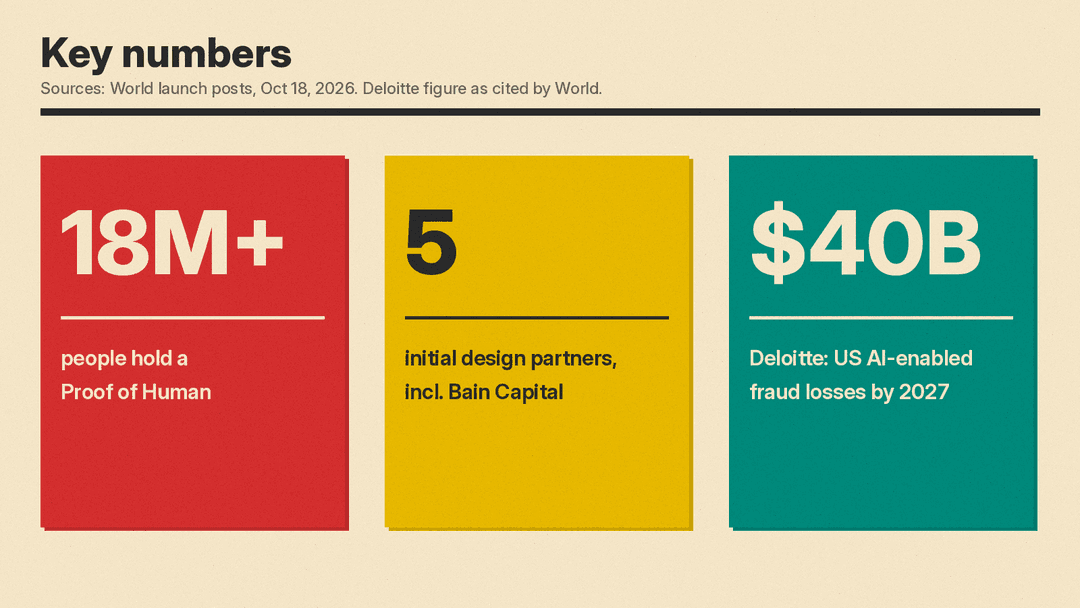
World lists Bain Capital, OpenExchange, Outtake, Pantera Capital, and VanEck Funds as initial design partners. A contributed article on The Next Web says that this is the first time World has built a version of World ID around a specific industry.
Why banks are the first target
The pitch is about fraud on calls and transfers. In its launch post, World points to the early 2024 case in which an employee at engineering firm Arup wired about $25.6 million after a video conference where every other participant was a deepfake. It also cites a Deloitte prediction that AI-enabled fraud losses in the US could reach $40 billion by 2027, up from an estimated $12.3 billion in 2023. In its Zoom post, World cites a 2025 Gartner survey in which 62% of cybersecurity leaders said their organization had faced a deepfake attack in the previous year.
How the Human Badge works
- Claim a Proof of Human. A person visits an Orb, World's iris-scanning device, once. Orbs can be installed at a workplace, brought to a person's door, or found at a growing number of locations.
- Present it in a meeting. The person connects the World ID app to their Zoom account. When prompted during a call, they tap a phone notification and take a selfie in the app.
- Show the badge. Their Zoom tile then displays a Human Badge that every participant can see.
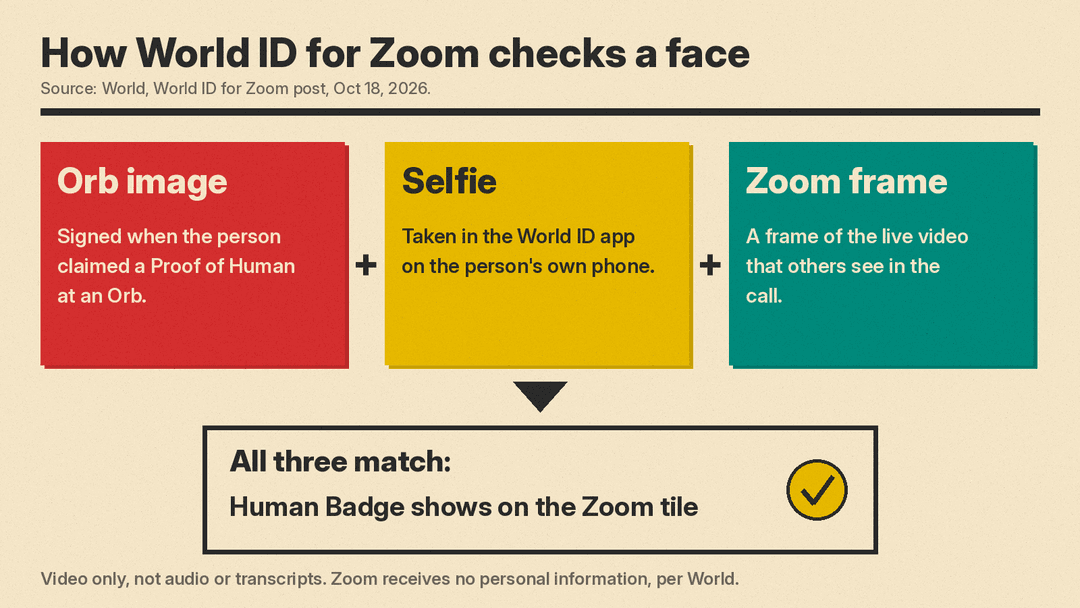
The check matches three images: the Orb image, which was cryptographically signed when the person claimed their Proof of Human; the selfie taken on the person's own phone; and a frame of the live Zoom video that others see. All three must match before the badge appears. World says the integration runs on AWS, is built on Zoom's Realtime Media Streams, and analyzes video only, not audio or transcripts. World also says Zoom does not receive any personal information during the process.
Hosts and organizations can set how long a badge stays active before the person must reauthenticate, and can ask participants to present Proofs during a meeting. A waiting room that requires verification before anyone joins is coming "soon," according to World.
World frames this as a different approach from deepfake detection. Detection tools analyze video frames and try to predict whether an image is fake, which World says can lead to an arms race. World ID for Zoom instead checks the live feed against an image that was signed when the person claimed their Proof of Human.
Three levels of proof
The World ID app, which World says is available in the App Store and Google Play in more than 150 countries, offers three kinds of Proofs:
- Proof of Human: a real, unique human, established with a one-time Orb visit.
- Proof of Presence: a quick liveness check on a phone.
- Proof of Attributes: a single fact, such as nationality or being over a certain age, taken from a government credential.
For banks, World suggests uses such as human-binding approvals for ACH and wire transfers and human-binding requirements for account recovery to prevent account takeover. A company spokesperson told Fortune that the financial firms will keep Orbs in their offices to sign up employees, and that not every verification requires an eye scan. Tools for Humanity, which builds World's technology, has also joined the Zoom ISV Exchange Program, so Zoom business customers can host Orbs in their offices.
Proofs for AI agents
The agent part is in beta. Through AgentKit, a set of developer tools, a person can delegate certain Proofs to an AI agent, which can then transact on their behalf and prove it acts for a real human without revealing private details about that person. World's chief product officer, Tiago Sada, told Fortune the arrangement is similar to a power of attorney and that users will only be able to assign credentials to a single trusted agent.
This lands as sites decide what to do about agents. Fortune notes that Amazon and JPMorgan Chase have begun to block bots altogether, and Sada argued that this limits their ability to compete in agentic commerce. We covered that fight in why your AI agent keeps getting blocked, and the access and payment rails agents use today in how AI agents get into your accounts and how AI agents pay. World is not alone here: Fortune reports that Cloudflare announced its own agent ID tool and an agent wallet in August.
The catch
The system depends on an iris scan at an Orb. Only people who have done that can earn a badge. World says more than 18 million people hold a Proof of Human. Fortune calls the underlying technology controversial and notes that some privacy advocates are uneasy that it is tied to Altman. Sada's answer, as quoted by Fortune: "People understand you don't have to give Sam or any of us your photo…Everything is open-source and auditable."
There are also limits in the design itself. The badge confirms that the face on screen matches an Orb-verified person connected to that Zoom account. Because the check analyzes video only, it says nothing about audio.
What comes next
According to the same contributed article on The Next Web, World will appear at Zoomtopia, Zoom's annual conference, shortly after Money20/20, and will run an activation at Cloudflare Connect. Institutions can contact World to integrate World ID, and organizations can request a demo of the Zoom integration.
Sources
- World: Introducing World ID for banking and finance (October 18, 2026)
- World: World ID for Zoom, Proof of Human technology for trusted video communications (October 18, 2026)
- Fortune: Zoom and big financial firms add Proof of Human badges from Sam Altman's World
- The Next Web (contributed article): Is that really your banker? World brings human verification to Zoom calls
