
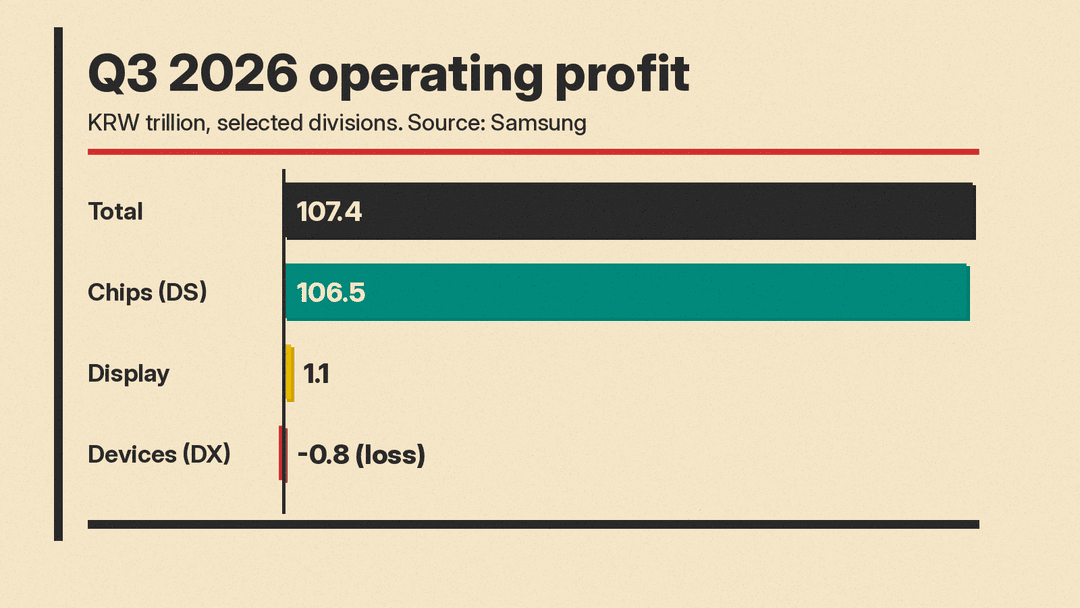
Samsung Electronics says it just crossed a line no tech company had crossed before, and its chip division, led by memory for AI, earned almost all of the profit. The company reported KRW 107.4 trillion in third-quarter operating profit on revenue of KRW 195.3 trillion, and said it is the world's first tech company to pass KRW 100 trillion in quarterly operating profit.
The headline number is big, but the details on high-bandwidth memory (HBM) matter more for anyone tracking AI compute. Samsung told analysts that HBM4 revenue tripled from the previous quarter, that HBM4 is now 60% of its HBM revenue, and that its HBM supply for next year is already sold out.
The numbers
All figures are from Samsung's earnings release and earnings presentation unless noted.
- Revenue: KRW 195.3 trillion, up 14% from the second quarter and up 127% from a year earlier. Samsung calls it another all-time quarterly high.
- Operating profit: KRW 107.4 trillion, up 20% from the second quarter and up 783% from a year earlier.
- Operating margin: 55.0% for the whole company.
- Device Solutions (DS), the chip division: KRW 147.1 trillion in revenue and KRW 106.5 trillion in operating profit. The presentation puts that profit at 72% of the division's revenue.
- Device eXperience (DX), which includes phones, TVs and appliances: revenue up 8% from the second quarter, with an operating loss of KRW 0.8 trillion.
- Samsung Display: KRW 8.0 trillion in revenue and KRW 1.1 trillion in operating profit.
- Capital expenditure: KRW 29 trillion in the quarter, of which KRW 27.2 trillion went to the chip division.
The presentation also says this is the fourth quarter in a row of record revenue and operating profit.
CNBC reported that revenue of 195.25 trillion won (about $124 billion, by CNBC's conversion) came in just under the LSEG SmartEstimate of 195.79 trillion won, and that operating profit of 107.44 trillion won was just under the 107.66 trillion won estimate. CNBC said Samsung shares were trading 5% lower after the announcement.
Reuters reported that the shares opened higher, then fell as much as 6.2% in morning trade in Seoul. It said investors wanted more detail on shareholder returns, and that the chip division's KRW 106.5 trillion profit was short of the LSEG analyst estimate of KRW 107.3 trillion.
Why HBM is the story
HBM is stacked DRAM that sits next to the processor on AI accelerators such as GPUs.
Samsung said on its earnings call, as quoted by MoneyToday (an AI-translated English report):
- HBM4 revenue "increased threefold compared to the previous quarter."
- "HBM4 accounts for 60% of total HBM revenue."
- Its goal of an HBM market share equal to its overall DRAM market share in the second half "appears" to have been reached already in the third quarter.
- "Negotiations for next year's HBM supply volumes have been completed at target price levels considering product competitiveness, and the supply is already sold out."
- Major customers keep asking for more HBM supply.
Samsung did not name the customers in these statements. An Investing.com transcript of the call gives the same points in English: HBM4 sales rose "more than three-fold" from the second quarter, and "our 2027 HBM supply volume is already sold out."
Samsung is one of Nvidia's three suppliers of custom NVHBM, alongside SK hynix and Micron, according to a Seoul Economic Daily report we covered on NVHBM base dies.
A sold-out year means Samsung's 2027 HBM output is already spoken for, even as major customers ask for more. That fits a pattern we have covered on the packaging side, where TSMC's CoWoS capacity and pricing also set the pace for how many AI chips can ship.
What Samsung expects next
Samsung's outlook is blunt about supply. For 2027, the release says the memory business expects AI infrastructure capital expenditure "to reach a historic level," and that "increasing AI-driven demand will far exceed the industry supply in comparison with 2026."
For the fourth quarter of 2026, Samsung expects memory demand to grow around products for new CPU and GPU platforms. It also links "surging QLC SSD demand" to the expansion of personal AI agent services. The plan is to sell more HBM, server DRAM and SSDs, and to increase supply of high-speed server DDR5 and QLC SSDs. For 2027, the company says it wants to build "a stable sales base by securing multi-year contracts." Rival SK hynix said a day earlier that its long-term agreements already cover more than 50% of its 2027 and 2028 capacity, in its record third-quarter results.
Big buyers are already moving that way. Alibaba, Tencent and ByteDance have asked Samsung and SK hynix for long-term server memory contracts, some running to 2035, according to a Maeil Business Newspaper report in our story on the China DRAM deals.
Memory prices rose too. The release says strong server demand "led to higher market prices across all applications," and that Samsung managed its product mix toward AI products "amid capacity constraints."
Foundry and custom chips
Samsung's contract chipmaking business also improved. The release credits HBM base-die sales growth, more advanced-node sales, and "continued order wins centered on 2nm HPC customers, including major hyperscalers." Samsung did not name those hyperscalers.
For the fourth quarter, the foundry business plans double-digit revenue growth, helped by new mobile products, a mass production ramp of 4nm NPUs and more memory product sales. In 2027, Samsung expects growth led by 4nm and 2nm, and says its new fab in Taylor, Texas will begin operations.
The System LSI business, which designs Samsung's own chips, said its custom SoC business "secured projects by establishing new customer partnerships."
Spending to match
Samsung expects full-year 2026 capital expenditure of about KRW 84.4 trillion, with KRW 76.8 trillion for the chip division. The release says the chip money goes to "new fabs and other infrastructure to meet strong AI and HPC demand."
Third-quarter capex of KRW 29 trillion was KRW 12.2 trillion more than the second quarter and KRW 19.8 trillion more than a year earlier.
The other side of the boom
The quarter also shows who pays for expensive memory. The mobile and networks businesses posted a combined operating loss of KRW 0.6 trillion. Samsung says earnings rose from the second quarter on a better flagship sales mix, but fell from a year earlier "due to cost pressures." On the call, Samsung's mobile executive said rising memory prices hurt profitability. The TV and appliance businesses posted a combined operating loss of KRW 0.2 trillion, which Samsung tied to higher costs.
So the same company that sells the memory also buys it for phones and TVs, and its device side lost money while its chip side made almost all of the profit.
Why it matters
AI compute is limited by more than GPUs. Memory, packaging, power and data center space all have to arrive at the same time. Samsung's results say memory will stay tight through 2027: its 2027 HBM supply is already booked, and it expects AI-driven demand to "far exceed the industry supply in comparison with 2026." For AI labs and cloud providers, that likely means memory stays expensive and multi-year contracts become the normal way to buy it.
Sources
- Samsung Electronics Announces Third Quarter 2026 Results (Samsung Newsroom)
- Samsung 3Q 2026 earnings presentation (PDF)
- Samsung Electronics says HBM4 sales tripled quarter-on-quarter, next year's HBM supply fully booked (MoneyToday)
- Samsung Electronics third-quarter earnings (CNBC)
- Samsung sees chip shortage worsening, but keeps investors in suspense on returns (Reuters, via Investing.com)
- Earnings call transcript: Samsung Electronics Q3 2026 (Investing.com)
