
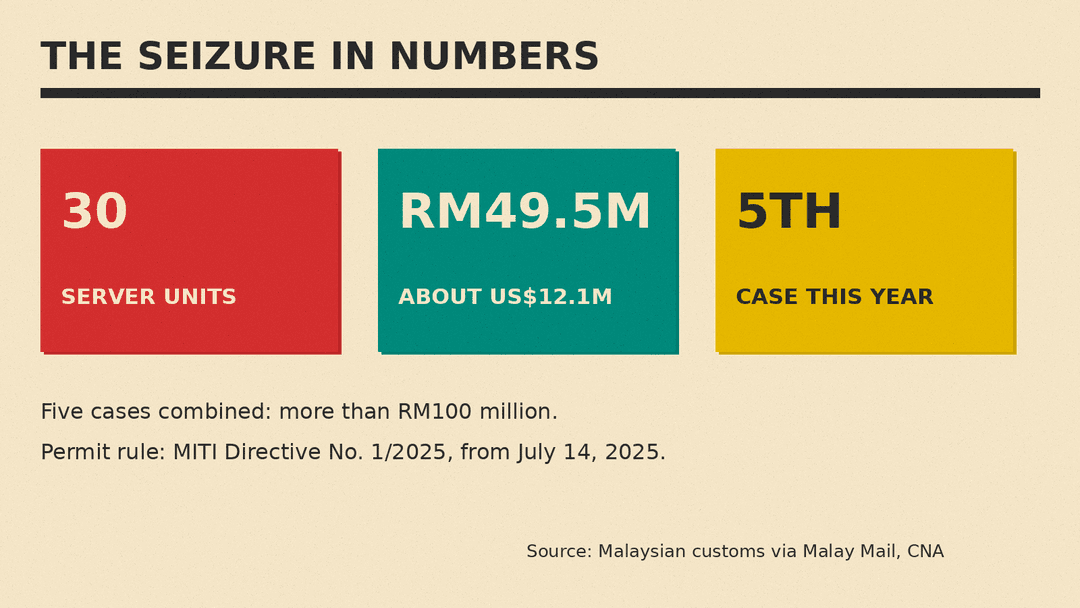
Malaysia's customs department said on Wednesday, October 28, 2026, that it had seized 30 server units containing advanced AI chips at Kuala Lumpur International Airport (KLIA). Officials put the total seizure value, including estimated taxes, at RM49.5 million, or about US$12.1 million. They say the servers were moving through Malaysia toward another Asian country without the required permit.
The case shows chip export controls being enforced at a transit point: a free trade zone where servers pass through a third country on the way to another destination.
What customs found
According to Malay Mail, which carried the Bernama report, the KLIA Customs Enforcement Division found the servers during an inspection of a warehouse in the KLIA Free Trade Zone on October 15 at about 11.30am. The seizure was announced at a press conference 13 days later.
The key facts that officials gave:
- What: 30 server units with advanced AI chips inside.
- Value: the New Straits Times reports the servers were valued at RM45 million, with estimated taxes of RM4.5 million, for a total seizure value of RM49.5 million. CNA, citing Reuters, puts that at US$12.11 million.
- How it moved: KLIA Customs director Aspalila Ag. Tuah said preliminary investigations found the servers came in from an Asian country under a single air waybill and were declared as electronic components, allegedly to evade detection, before a planned re-export to another Asian country.
- Why Malaysia: "The syndicate also used Malaysia as a transit point to ensure there were no restrictions on the export of the servers to their next destination," she told a press conference, as quoted by Malay Mail.
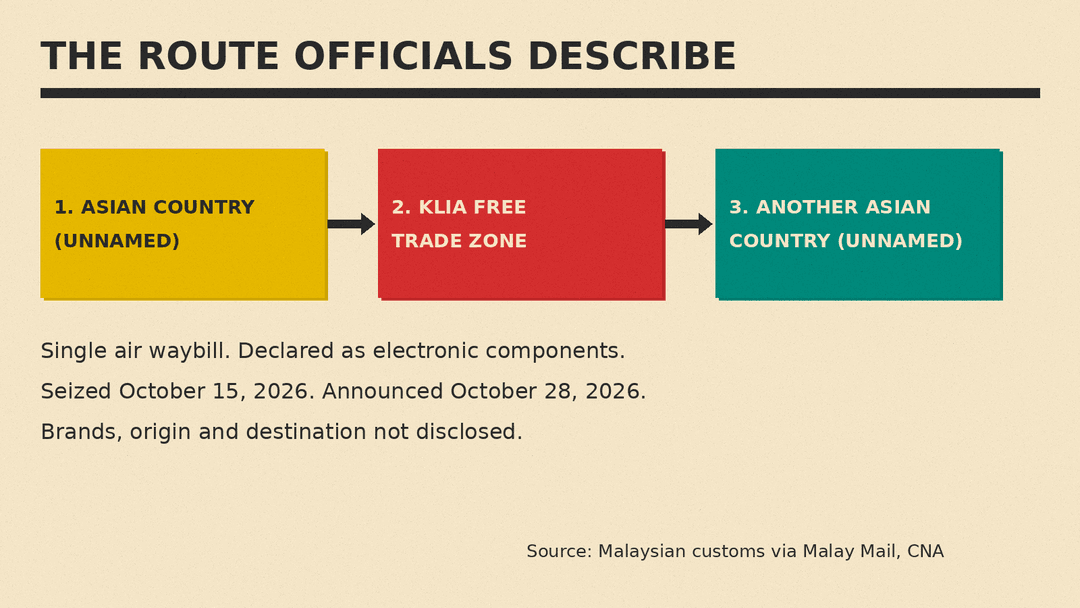
Officials did not name the chip brands, the country of origin or the destination. A senior assistant director at the Strategic Trade Secretariat of the Investment, Trade and Industry Ministry (MITI), Masyita Ismail, said these could not be disclosed because investigations were ongoing, according to Malay Mail. Where the servers were going has not been confirmed.
Fifth case linked to the same network
This was not a one-off. Aspalila said it was the fifth case involving advanced AI chips that customs had detected this year, and that the combined value of the five seizures exceeds RM100 million. Authorities believe the cases could involve the same syndicate, the New Straits Times reports.
Aspalila said the shipment was suspected to have been carried out by a network responsible for a similar smuggling attempt that customs foiled in June, CNA reports. AP reports that in the June case, customs seized 72 servers containing advanced AI chips at the airport's free trade zone.
The freight forwarding company that handled the October shipment has been called in to assist investigations, the New Straits Times reports. CNA and AP describe it as a Malaysian firm that facilitated the shipment. Malay Mail reports that no arrests had been made so far.
Chip diversion cases have also led to charges elsewhere in Asia. In August, prosecutors in Taiwan indicted nine people over Nvidia B300 servers that they allege were sold on to buyers in China, as our post on the Taiwan B300 server case explains.
The rule behind the seizure
Malaysia's rules date from July 2025. In a press statement dated July 14, 2025, MITI said that, effective immediately, all exports, transshipments and transits of high-performance AI chips of US origin are subject to a Strategic Trade Permit. The power comes from Section 12 of the Strategic Trade Act 2010, a catch-all provision. It requires a company or person to notify the authority at least 30 days before exporting, transshipping or moving in transit any unlisted item, if they know or have reasonable grounds to suspect it will be misused or used for a restricted activity.
The detailed rule is Directive of the Strategic Trade Controller No. 1/2025. Its Annex I lists the covered items by category code. For chips (code 3U090), the parameters include a total processing performance (TPP) of 4,800 or more, or a TPP of 1,600 or more combined with a performance density of 3.2 or more, among other combinations. Code 4U090 extends the control to computers and other assemblies that contain such chips. Anyone who intends to export, tranship or bring these items in transit must notify MITI's Strategic Trade Secretariat at least 30 days in advance if they know, or have reasonable grounds to suspect, that the items are intended for a restricted activity, which the directive defines as activity that supports weapons of mass destruction and their delivery systems, or transactions with people engaged in it. They must then apply for a permit after the authority decides whether the activity may proceed. Malay Mail's report summarizes the rule more simply, as a permit that must be applied for 30 days before the chips are brought into Malaysia.
Malay Mail reports that the cases are being investigated under Section 12 of the Act, which provides for a fine of up to RM20 million for a corporation. For an individual convicted of a wilful offence, it provides a fine of up to RM10 million, up to 10 years in prison, or both.
Why it matters for the China AI story
The rule is tied to US policy toward China. CNA, citing Reuters, says Malaysia imposed the controls "following pressure from the United States to stem their flow into China." China is also drafting export controls of its own: in October, its commerce and science ministries proposed adding frontier AI models and chip design technologies to the country's export control list.
Three points stand out.
First, transit hubs are now part of the enforcement map. Washington has sought to restrict China's access to advanced semiconductors, AP notes. In our reading, a server that passes through a free trade zone in a third country can slip past those limits if no one checks it there. MITI describes its permit rule as a way to close regulatory gaps, and this seizure shows customs using it.
Second, the method is simple. Officials describe a single air waybill and a plain "electronic components" label. In our reading, that puts the weight of enforcement on inspections and paperwork checks at points like this one.
Third, the reported numbers measure enforcement, not flow. Five cases worth more than RM100 million combined show that customs is looking. They do not show how much hardware gets through, and the reports do not say how many shipments may have passed undetected.
What to watch next: whether officials name the brands, origin or destination, and whether any charges follow.
Sources
- Malay Mail (Bernama): KLIA Customs seizes RM49.5m in AI chips with potential military uses, fifth case in RM100m syndicate probe
- New Straits Times: Customs foils bid to transit RM49.5mil AI chips through Malaysia, with potential weapons applications
- CNA (Reuters): AI chips worth US$12.1 million seized at Malaysia airport, customs authority says
- AP News: Malaysia seizes AI chip servers at Kuala Lumpur airport
- MITI press statement, July 14, 2025: Export, transshipment and transit of high-performance AI chips of US origin now subject to a Strategic Trade Permit
- MITI: Directive of the Strategic Trade Controller No. 1/2025, Declaration of Unlisted Items under Section 12 of the Strategic Trade Act 2010
