
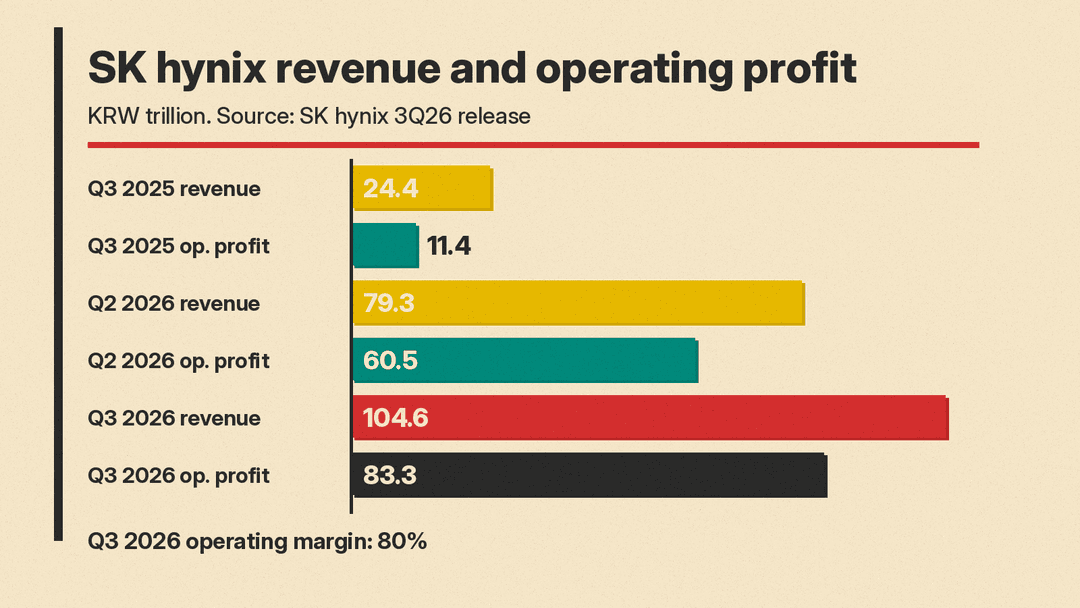
SK hynix reported record third-quarter results on October 28, and for the first time its quarterly revenue passed 100 trillion won. The company reported revenue of 104.6155 trillion won, operating profit of 83.3338 trillion won and net profit of 39.7756 trillion won. Its operating margin was 80%.
The numbers matter beyond Korea. SK hynix makes high-bandwidth memory (HBM), the stacked DRAM used with AI accelerators. Its results, and its outlook, are a direct read on how much memory AI data centers are buying and how long the shortage may last.
The quarter in numbers
According to the SK hynix release, revenue rose 32% and operating profit rose 38% from the previous quarter. In Q2 2026 the company had revenue of 79.3187 trillion won and operating profit of 60.5426 trillion won. From a year earlier, revenue rose 328% and operating profit rose 632%.
The results beat forecasts. CNBC reported that LSEG SmartEstimates had expected revenue of 98.34 trillion won and operating profit of 76.72 trillion won. CNBC converted revenue to $78.86 billion, which works out to about 1,327 won per dollar. At Seoul's October 28 daytime close of 1,337.7 won per dollar, reported by the Korea Herald, revenue is about $78.2 billion. SK hynix shares closed 10.89% higher in South Korea, according to CNBC, and the U.S.-listed shares closed over 13% higher.
Net profit moved the other way. It fell 58% from Q2, when it was 93.9226 trillion won, per the release table. The company's earnings presentation shows a non-operating loss of KRW 32.63T. That includes a foreign exchange-related loss of KRW 11.63T "due to fall in exchange rates" and an investment asset related loss of KRW 22.92T.
What drove it
SK hynix said prices of key products rose "on the back of growing demand for AI memory." In DRAM, sales of server DDR5 increased significantly "while HBM4 shipments began in earnest." In NAND, sales of 321-layer TLC eSSD expanded, along with other data center products.
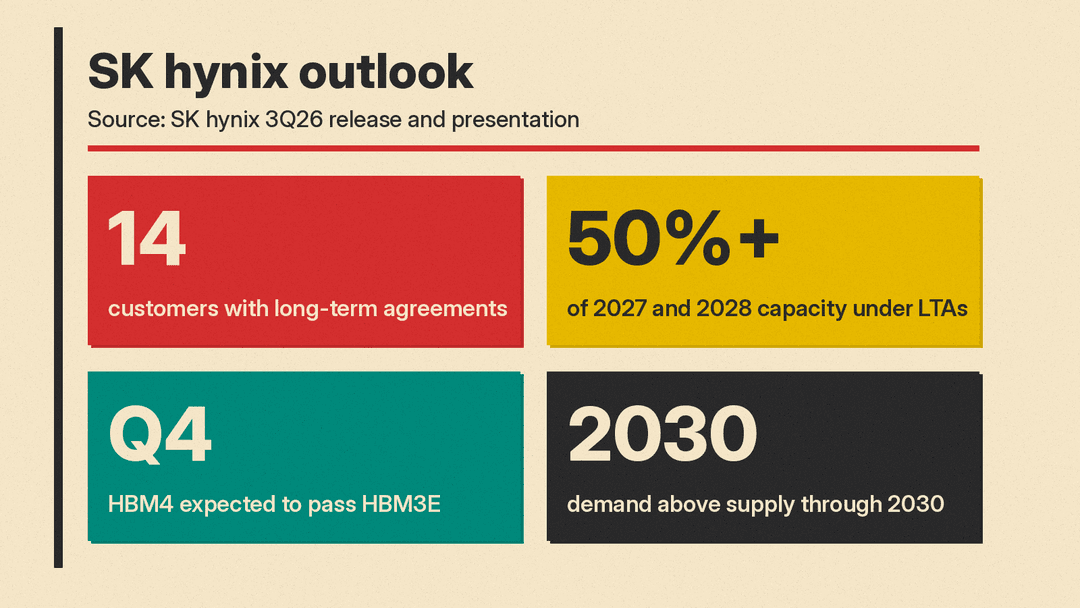
The company expects HBM4 to surpass HBM3E in both shipment volume and revenue in the fourth quarter. To get there, it will ramp up its M15X fab to maximum capacity by the end of the year. The presentation also says "2027 HBM negotiations finalized," and that the profitability gap between HBM and conventional DRAM is "expected to narrow meaningfully."
For Q4, the presentation guides DRAM bit growth to a "Mid-20% increase QoQ" and NAND bit growth to a "Mid-single% increase QoQ," including Solidigm. In NAND, SK hynix plans to raise the 321-layer process to more than half of its domestic production capacity in the fourth quarter.
Shortage through 2030
The main signal for the AI hardware market is the outlook. SK hynix said it expects demand to exceed supply through 2030, citing the "technical difficulty of leading-edge processes and the long lead time required to build new production facilities." The presentation gives 2027 achievable demand bit growth of "+Mid-20% YoY" for DRAM and "+High-Teen% YoY" for NAND.
It also says set shipments are "expected to decrease due to cost burdens from rising memory prices and supply shortages," but that AI infrastructure demand should "more than offset this decline."
Long-term contracts
SK hynix has signed long-term agreements (LTAs) with 14 major customers, including leading global cloud service providers. The contracts typically run five years, and the company is discussing longer terms with a number of customers. The LTA volume secured so far covers more than 50% of total production capacity for 2027 and 2028.
Prices move within a range agreed with each customer, which the company said gives it stable profitability and room to respond to market changes. The presentation lists "Safeguards to ensure contract fulfillment, including deposits."
With that demand in view, SK hynix said investment is expected to increase significantly next year as Yongin Phase 1 enters full-scale operation. It added that it will adjust the scale and timing of that investment flexibly.
Shareholder returns and Solidigm
For fiscal year 2026, SK hynix plans shareholder returns of approximately 100 trillion won. That comprises cash dividends of 30 trillion won or more and share repurchases and cancellations of 60 trillion won or more, including the 40 trillion won buyback announced in August, which was completed last week.
The board approved a third-quarter cash dividend of 14 trillion won and a share repurchase of 20 trillion won. Of that buyback, 10 trillion won will be cancelled, and about 10 trillion won will go to employee compensation, which is not counted in the shareholder return total. The Q3 dividend is 20,000 won per share, half of it a special dividend that shares gains from the company's Kioxia investment.
SK hynix also ended its review of an IPO for Solidigm, its U.S. NAND subsidiary. "After carefully considering recent financial market conditions and other factors, we concluded that proceeding at this time would not be the best way to achieve the originally anticipated outcome," CEO Kwak Noh-Jung said. CNBC reported that Kwak cited financial market volatility and a correction in semiconductor stocks as the main reasons.
Why it matters
SK hynix is not alone: Samsung's Q3 results this week also showed HBM4 revenue tripling. For AI labs and cloud buyers, the SK hynix outlook points to tight memory supply for years, with more than half of its 2027 and 2028 capacity already under long-term contracts. For device makers, SK hynix itself expects rising memory prices to cut set shipments. Memory costs are already pushing up prices elsewhere, as in Nvidia's reported increase in AI server prices.
