
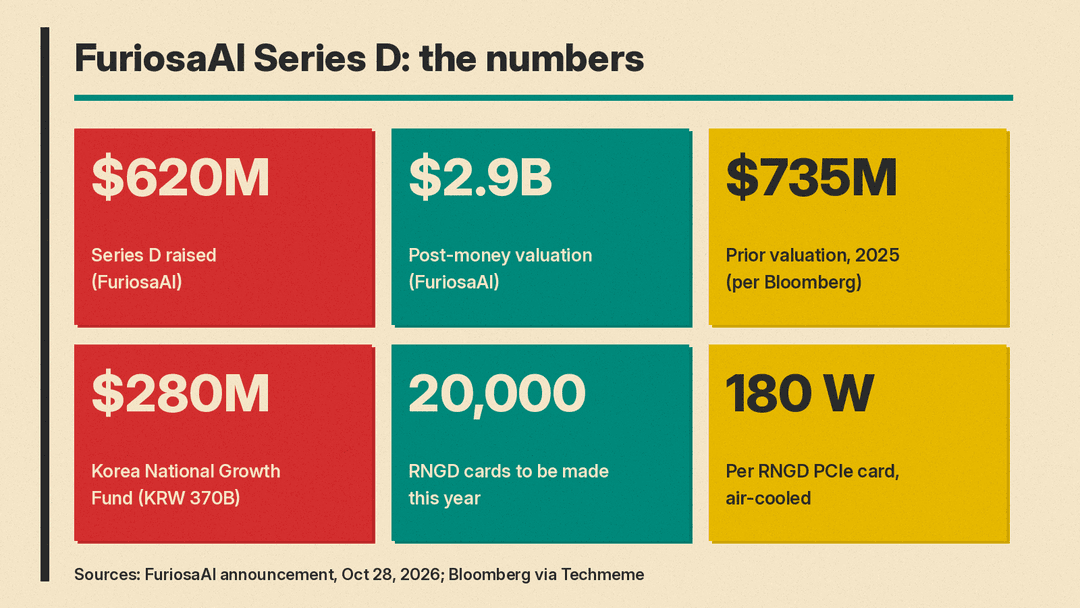
South Korean chip startup FuriosaAI has closed a $620 million Series D at a post-money valuation of $2.9 billion. The company makes RNGD, an inference accelerator that it says is now in mass production. The money goes to two things: more RNGD production and deployments around the world, and a third-generation chip built with Broadcom and other partners.
Bloomberg reports that investors are hunting for alternatives to the Nvidia chips that dominate AI data centers, and that they want more energy-efficient silicon.
The round
FuriosaAI's announcement lists these international investors: Cisco Investments, Infinitum, Jericho Capital, NeoFort Holding, QUDA Capital and Worldline Capital.
Korean money is a large part of the round:
- Korea's National Growth Fund committed KRW 370 billion, which the company puts at about $280 million.
- The Export-Import Bank of Korea, UAMCO and Hanwha Asset Management joined as new investors.
- The three original seed investors came back: NAVER (through NAVER Ventures), DSC Investment and KDB Capital. KDB, Nextrans and Kakao Investment also took part.
Bloomberg reports that international investors put in $110 million and that the round quadrupled the company's valuation. According to Techmeme's summary of the Bloomberg story, the previous valuation was $735 million in 2025. PANews, citing Bloomberg, adds that this is the Export-Import Bank of Korea's first direct investment in a startup.
What RNGD is
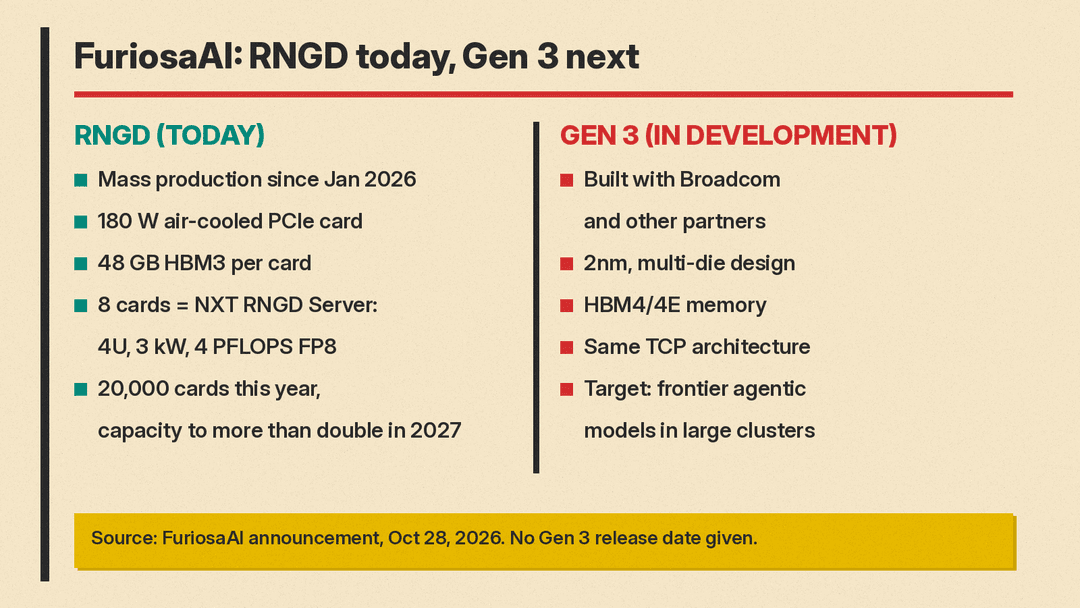
RNGD is a 180-watt, air-cooled PCIe card built only for inference. FuriosaAI says it designed the chip to get the most tokens possible from less than 200 watts. Eight cards make up the NXT RNGD Server: 4U, 3 kW, 4 petaFLOPS at FP8 and 384 GB of HBM3. The company says the server fits the racks and power budgets that enterprises already have, with no cooling retrofit.
Per card, the RNGD product page lists 512 TFLOPS of FP8 compute, 48 GB of HBM3 with 1.5 TB/s of bandwidth, and 256 MB of SRAM.
The company makes two performance claims. It says RNGD matches the throughput of Nvidia's RTX PRO 6000 at the same card count, and serves twice as many users per kW of power. These are FuriosaAI's own numbers; the announcement does not include independent benchmarks.
FuriosaAI is also specific about what the chip is for. It targets models that run at up to about 100 tokens per second per user, which the company calls the speed that matters most for enterprise work. It says RNGD excels at the latest open models, such as Gemma 4 and Qwen 3.8-27B.
Production and customers
The supply numbers may matter more than the valuation. FuriosaAI says RNGD reached mass production in January 2026. It will produce 20,000 cards this year, and it has secured the memory and fab capacity to more than double that in 2027. PANews, citing Bloomberg, says TSMC makes the chips and that the 2027 plan is more than 40,000.
Memory and advanced fab capacity are tight across the industry. Earlier this week we covered a reported TSMC CoWoS price hike. A startup that can say it has locked in supply for next year has a real selling point.
FuriosaAI names two customers:
- Samsung SDS has launched an NPU-as-a-Service offering powered by RNGD.
- LG Group companies are deploying RNGD in their on-premises hybrid cloud environments.
The company says its other customers include AI cloud providers, sovereign AI projects, AI-native companies and enterprises building on-premises and hybrid infrastructure. It does not give their names.
The architecture and Gen 3
FuriosaAI's design is built around what it calls the Tensor Contraction Processor (TCP). The company explains that GPUs and most other accelerators break model operations into fixed-size, two-dimensional matrix multiplications. TCP instead makes tensor contraction, a higher-dimensional operation, the basic unit of work for both the hardware and the software. FuriosaAI says its compiler can plan across a whole model and, with deterministic execution on the chip, cut energy-wasting data movement.
The third-generation chip is aimed at a bigger target: frontier agentic models in large clusters. FuriosaAI says it is in development now with Broadcom and other partners, and will use the TCP architecture with a 2nm, multi-die design and HBM4/4E memory. The company gives no release date.
On software, FuriosaAI says it has shipped four major SDK releases this year. SDK 2026.4 raises token generation per watt across 18 models compared with 2026.3, including by 138% on gpt-oss-120B. Customers can deploy in PyTorch as they would on GPUs, or write their own kernels in the company's Tensor Contraction Language.
Why it matters
Inference is where the bills for AI keep coming, and power is often the limit. FuriosaAI's pitch is that many enterprises do not need a liquid-cooled rack of top GPUs. They need hardware that drops into an existing data center and serves open models cheaply. Other recent deals show the same move toward inference hardware: General Compute's $100M raise and Oracle adding Cerebras and Google TPUs to OCI.
The open questions are practical ones. Twenty thousand cards is a first volume step, and the two named customers are both Korean groups. The Gen 3 chip, built with Broadcom on a 2nm process, will show whether FuriosaAI can move from efficient enterprise inference to large clusters running frontier models. For now, the company has the money and the fab capacity to find out.
Sources
- FuriosaAI: FuriosaAI closes $620 million Series D to scale efficient, production-ready AI inference
- FuriosaAI: RNGD PCIe Card product page
- Bloomberg (via Bloomberg Law): FuriosaAI Quadruples Valuation to $2.9 Billion in Nvidia Chase
- Techmeme: Seoul-based AI chip startup FuriosaAI raised a $620M Series D at a $2.9B valuation, up from $735M in 2025 (summary of the Bloomberg report)
- PANews: South Korean AI chip company FuriosaAI raises $620M at $2.9B valuation
