
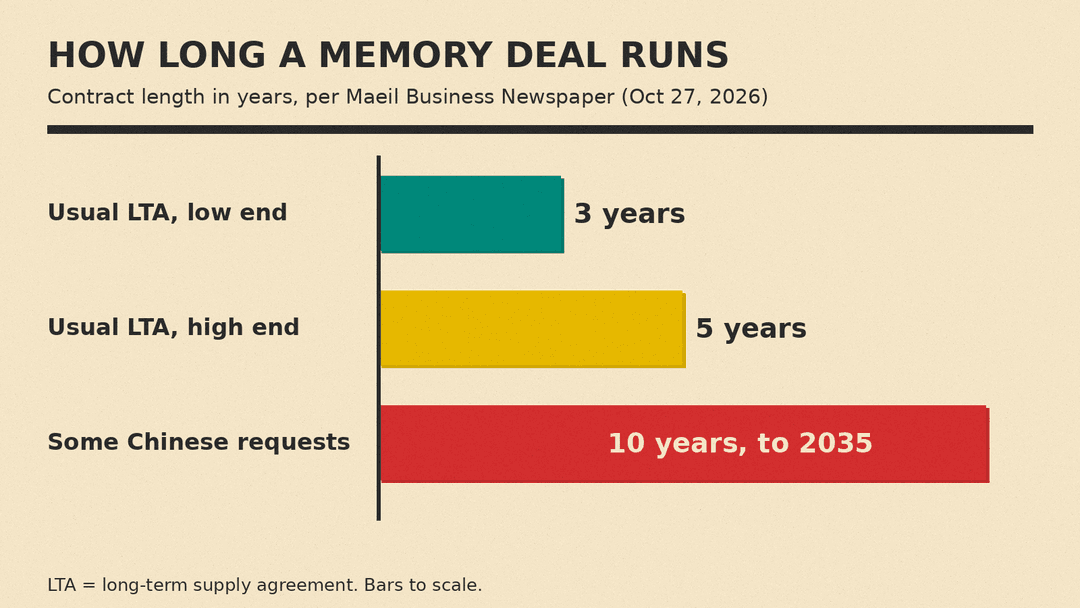
Three major Chinese cloud providers are asking South Korea's memory makers to lock in supply for up to 10 years, according to a South Korean newspaper report. Alibaba, Tencent and ByteDance have approached Samsung Electronics and SK hynix about long-term supply agreements (LTAs) for server memory, and some of them want contracts that run through 2035, Maeil Business Newspaper reported on October 27, 2026, citing industry sources.
A typical memory LTA runs three to five years, according to the report. A 2035 end date would make those contracts about twice as long as the usual upper limit. Neither the companies nor the chipmakers have confirmed the talks in the sources cited here, and the report does not give volumes, prices or a signing date.
What the Chinese companies want
The requests cover two kinds of memory, per Maeil:
- Server DDR, the main memory that lets a server's CPU read and write data quickly.
- LPDDR, a low-power memory used mainly in smartphones. Server makers are reportedly buying it because it can improve the power efficiency of AI servers.
The report says these requests are for volumes separate from the LTAs that Samsung and SK hynix already signed with other customers. A second Maeil report says that, as AI computing demand in China grows, the companies find it hard to secure extra supply through existing distribution channels and short-term contracts alone. A PANews summary of the Maeil story and a Seeking Alpha news item repeated the report on October 27. We found no independent confirmation from another outlet.
Why now: the US companies got there first
Maeil says the fact that US Big Tech companies secured supply first through long-term contracts "appears to be a factor" pushing Chinese cloud providers to move quickly. Samsung has said it completed LTAs with the world's five largest data center customers and is negotiating with five more, Maeil reported. Industry sources named those first five as Amazon Web Services, Microsoft, Google Cloud, Meta and Oracle. SK hynix has said it concluded LTA talks with around 10 customers, including key accounts, per the same report (Maeil's second report says at least 10).
The report cites industry estimates that 70% to 80% of the two companies' planned memory output for next year will be covered by five-year LTAs with global Big Tech companies. In a second Maeil article, KB Securities research head Kim Dong-won estimated that Samsung has already placed about 80% of its planned 2027 memory output under LTAs, and that hyperscalers are still competing for the remaining 20%.
The second article says, citing industry sources, that Apple is the only one of the "Magnificent Seven" US tech companies without an LTA, and that the industry expects Apple to sign one this year.
The export control angle
US export controls already stop Samsung and SK hynix from selling high-bandwidth memory (HBM), the stacked memory that sits next to AI accelerators, to China, according to Maeil's second report. But a large AI data center also needs ordinary server DRAM as main memory, and that is what the Chinese companies are now trying to secure. For background on HBM supply, see our report on Samsung making the base dies for Nvidia's NVHBM.
The report says China's own memory makers are growing but are not yet a full substitute:
- CXMT (ChangXin Memory) is quickly increasing DRAM output. Maeil's first report says CXMT and YMTC are considered to lag the Korean firms in product competitiveness and mass-production scale for high-performance server memory.
- A server company executive told Maeil that server DRAM, especially for AI data centers, must run 24 hours a day and needs more stability than PC or phone memory, and that tests show a large performance gap between CXMT server DRAM and Samsung or SK hynix parts.
- YMTC took a 38.5% share of the mainland China market in the second quarter, overtaking Samsung and SK hynix, according to Omdia data cited by Maeil. Maeil calls it the first time a Chinese company has topped the mainland memory chip market.
Maeil says US memory maker Micron has effectively been pushed out of China's domestic market. It says Chinese regulators began restricting Micron products in 2023 and that Micron announced in 2025 that it was leaving the Chinese market.
How much capacity China is building
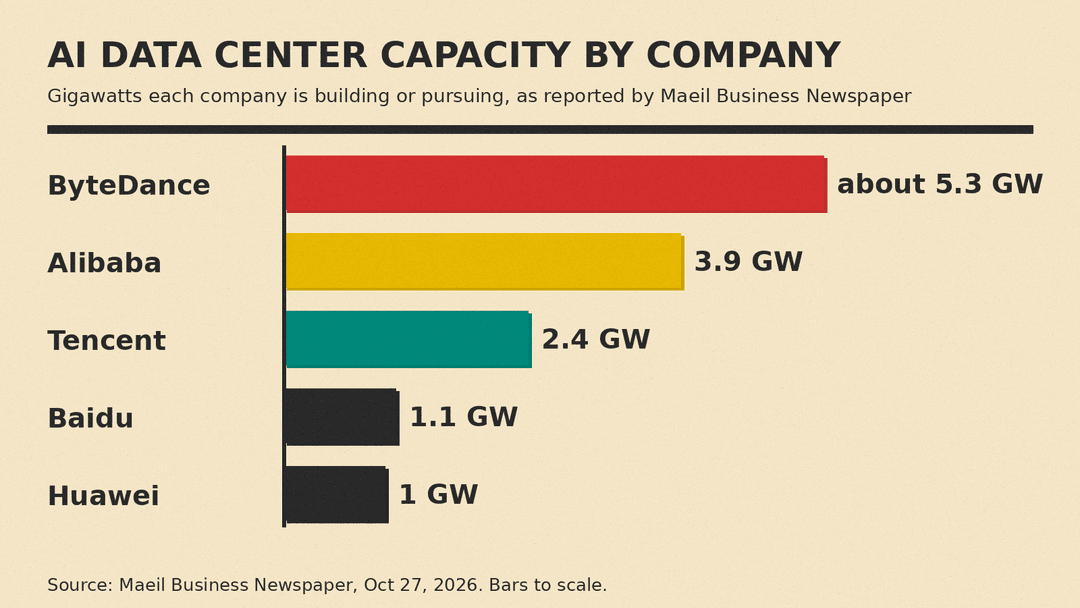
The second article cites a September report from research firm SemiAnalysis that puts China's built AI data center capacity at more than 24 gigawatts, second to the US at 56 gigawatts, with about 20 gigawatts more under construction or planned. Maeil also lists the AI data center capacity each company is building or pursuing:
- ByteDance: about 5.3 GW
- Alibaba: 3.9 GW
- Tencent: 2.4 GW
- Baidu: 1.1 GW
- Huawei: 1 GW
China's three telecom carriers, China Mobile, China Telecom and China Unicom, are also building AI data centers, the report says.
Why it matters
Maeil's second article says Chinese cloud providers still rate Korean memory highly for AI data centers, where stable operation matters most, even as they build up domestic suppliers such as CXMT under Beijing's policy of localizing memory chips. With HBM sales to China blocked by US export controls, the requests cover ordinary server DRAM and LPDDR.
On prices, Daishin Securities expects memory prices to keep rising as server makers pay near server-memory prices to secure LPDDR, which puts them in competition with phone and PC makers for the same supply, Maeil reported. For earlier coverage of memory costs and AI hardware, see our post on Nvidia's AI server price increases.
For Samsung and SK hynix, the second article says they need to keep supplying China's large cloud providers to protect their share of the Chinese market. SK hynix ADRs rose 3% in premarket trading on October 27, the day of the report, Seeking Alpha reported.
What is still unknown: whether any deal is signed, the volumes and prices, which buyer asked for the 2035 term, and whether future US rules could reach ordinary server DRAM sold to China. Until the companies comment, this is a single-outlet report based on unnamed industry sources.
Sources
- Maeil Business Newspaper (English): Chinese Big Tech in a rush to sign long-term DRAM contracts, Oct 27, 2026
- Maeil Business Newspaper (English): "Chinese chips alone are a concern for AI", Oct 27, 2026
- PANews summary of the Maeil report, Oct 27, 2026
- Seeking Alpha: SK Hynix, Samsung in discussions with Alibaba, Tencent on DRAM supply, Oct 27, 2026
