
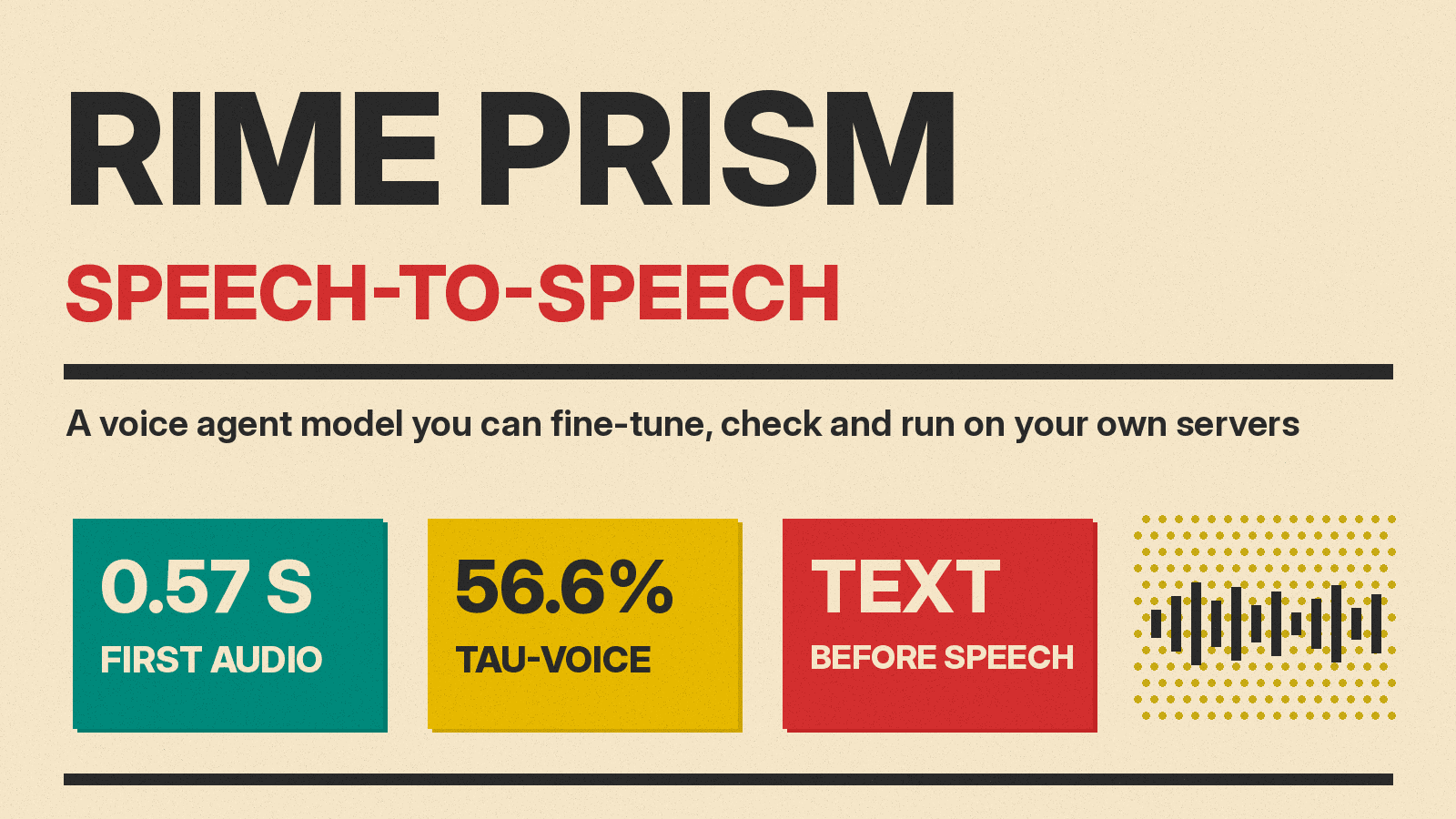
Rime, an enterprise voice AI company whose voices answer customer calls for large brands, launched Prism on October 28, 2026. Prism is a speech-to-speech model: it hears the caller's audio and answers with audio, instead of chaining a transcriber, a text model and a voice. Rime's pitch is that Prism keeps one feature of the older chained design that big-lab speech models drop: it writes out what it is about to say as text, so a company's rules can read every word before the caller hears it.
Rime also says Prism is the first speech-to-speech model that customers can fine-tune on their own calls, and that it can run on a company's own servers. Below is what Rime says Prism does, the numbers it published, and what is still missing.
The problem Prism is aimed at
Voice agents today are built in one of two ways. We covered the trade-off in detail in speech-to-speech vs cascaded voice agents. A cascade turns speech into text, lets a text model decide what to say, then reads the answer aloud. A speech-to-speech model handles audio directly.
In her launch post, Rime co-founder and CEO Lily Clifford describes this as a "Faustian bargain". With the big-lab speech models, she writes, "you get a model that hears, but you lose the ability to read what it's about to say, to rewrite it." With the cascade, "you get control, but the price is that you lose all the intelligence accessible in audio," such as hesitation, anger or laughter. She also writes that eighteen months ago she said speech-to-speech models "were a decade out from real use," and that Rime spent the last six months building Prism.
How Prism works, according to Rime
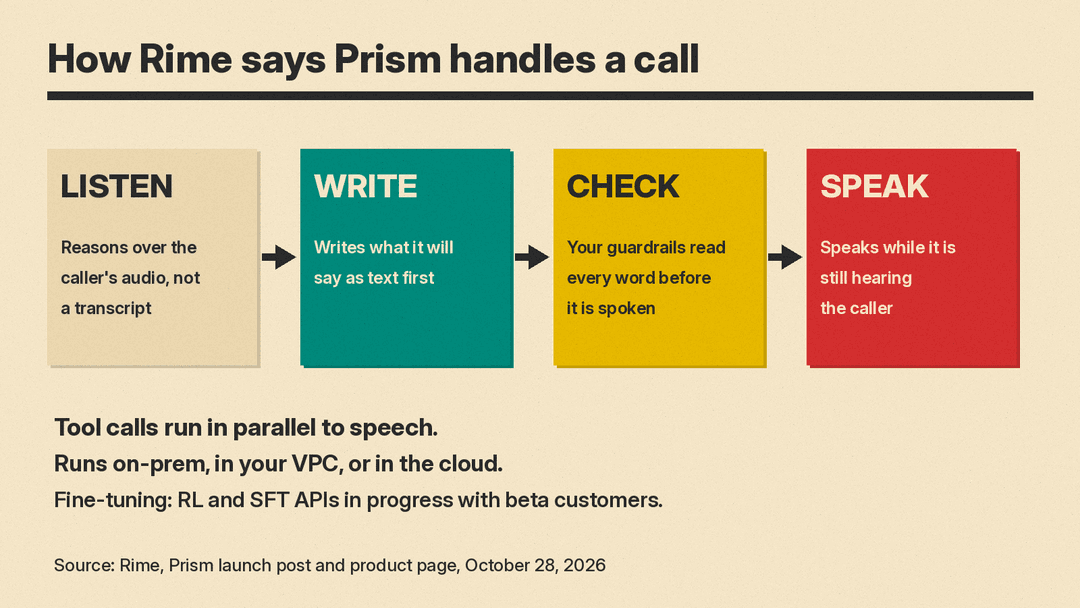
Rime says Prism is "trained end-to-end as one system that does three jobs: it listens, it writes what it's going to say, and when it speaks, it is still hearing the user." The text in the middle is what Rime calls a checkpoint. The decision is made over the audio, so tone is not lost, but the output passes through text that a business can inspect.
Rime lists what that checkpoint makes possible:
- Guardrails, policies and required disclosures that can read every response before it is spoken.
- Rewritable text for action and content tags.
- Phonemic conditioning for names and account terms.
- Tool management for composable agent flows, with tool calls running in parallel to speech.
The product page answers the obvious question directly. Asked whether a text step makes Prism a cascade, Rime says no: "A cascade reasons over a transcript and loses the caller's tone. Prism reasons over the audio and emits text so your rules can review every word before it becomes speech."
Speed and accuracy: Rime's numbers
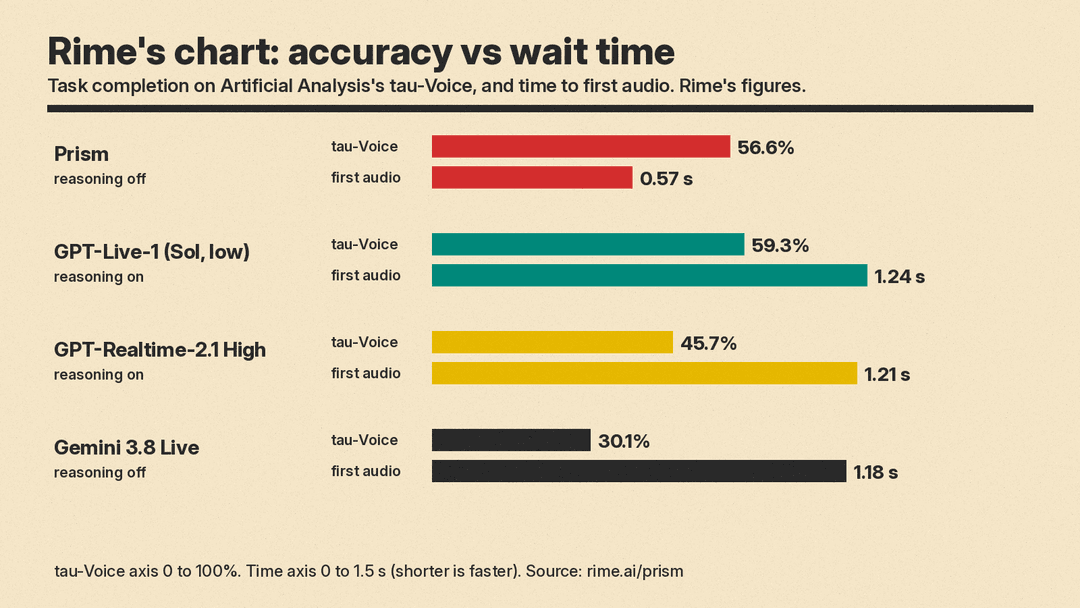
Rime says it ran Prism on the same harness Artificial Analysis uses for its speech-to-speech leaderboard, with no reasoning step before the model speaks. The benchmark is τ-Voice, which Rime describes as Artificial Analysis's test of tool calling and instruction following on simulated customer-service calls in airline, retail and telecom.
The figures Rime published:
- Prism scores 56.6 on τ-Voice, with 0.57 seconds to first audio.
- On Rime's chart, GPT-Live-1 (Sol, low) with reasoning on scores 59.3% at 1.24 seconds, GPT-Realtime-2.1 High with reasoning on scores 45.7% at 1.21 seconds, and Gemini 3.8 Live with reasoning off scores 30.1% at 1.18 seconds.
- In telecom, the domain Rime says has the most account and phone numbers to get right, Prism scores 82.5 against 45.6 for GPT-Live-1.
Rime says the models that beat Prism on τ-Voice "get there by reasoning before they speak" and take 1.24 to 1.35 seconds to start talking. These are Rime's own runs, not entries posted by Artificial Analysis, so treat them as vendor claims until an independent leaderboard lists Prism.
Fine-tuning on your own calls
Clifford's argument is that live calls leave no time for chain-of-thought reasoning, so "the intelligence in the weights is the intelligence you get." Her answer is to let customers train their own copy. Rime says it is building self-serve reinforcement learning (RL) and supervised fine-tuning (SFT) APIs with its beta customers. The launch post does not say when those APIs will open to everyone.
Rime gives one example. Revmo runs an ordering agent on OpenAI. Rime says it took 10 hours of Revmo's production calls, tool traces and transcripts, built an RL environment around them, and trained a Prism model. On those calls, 94% of orders went in only after the caller said yes to "shall I place it?", against 57% for OpenAI. Rime's press release reports other figures from the same trial: order confirmations and pickup methods rose from 68% with OpenAI to 100%, and calls without dead air rose from 66% to 88%.
Where it runs, and who is testing it
Rime says Prism runs on-premises, in a customer's virtual private cloud, or in the cloud, and the page lists HIPAA and SOC 2 compliance. Rime's pricing page lists the VPC and on-premises options, and fine-tuning on your own calls, only on its Enterprise plan; the Free, Flex and Scale plans run in Rime's cloud. Rime contrasts this with "frontier realtime APIs," which it says are cloud-only.
The product page quotes two partners. Shezan Kazi, VP of AI Products at Dialpad, says Dialpad "has been a design partner on Prism from the start." Nicholas Reid, Sr. Director, Product Management at Twilio, says Prism's "interactivity, interruption handling, and latency is terrific." The press release says Prism's base model was trained on millions of hours of human conversations recorded in Rime's own studios.
What is still missing
- Enterprise pricing. Rime lists Prism at $0.08 per minute of audio on its pay-as-you-go Flex plan, and every account gets $50 of free usage a month. The Enterprise plan, the one with fine-tuning and on-premises deployment, uses volume pricing with no public rate.
- Documentation. The product page says "Prism docs are coming soon." For now Rime points people to a free account at app.rime.ai.
- Languages and voices. The page lists languages and voice counts for Rime's Coda and Mist text-to-speech models, but not for Prism.
- Independent results. All benchmark and trial figures come from Rime.
Why it matters
Rime frames the choice for voice agent builders as control versus naturalness. Recent voice launches on our beat include Mistral's Voxtral 3, ElevenLabs' Eleven Realtime and Deepdub Phantom Z 4.0. Rime pitches Prism on a different question: whether a regulated business can read, audit and train the model that talks to its customers. If Rime's numbers hold up in independent tests, the regulated teams that Rime says could only pilot speech-to-speech may be able to deploy it. Enterprise pricing and the promised docs are the next things to watch.
