
OpenAI has asked the British Columbia Supreme Court to stop an investigation by the province's privacy regulator into how ChatGPT used the personal information of the Tumbler Ridge shooter. The Office of the Information and Privacy Commissioner for British Columbia (OIPC) said in an October 27 news release that OpenAI "has now petitioned the BC Supreme Court for Judicial Review of the Order and to challenge the investigation." The petition was filed on October 26.
The case matters beyond one province. The regulator is not only asking how OpenAI reviewed an account to enforce its usage policies. It is also asking whether ChatGPT's replies to a user are themselves a use of that user's personal information that must meet the legal test under B.C.'s Personal Information Protection Act (PIPA).
What the order demands
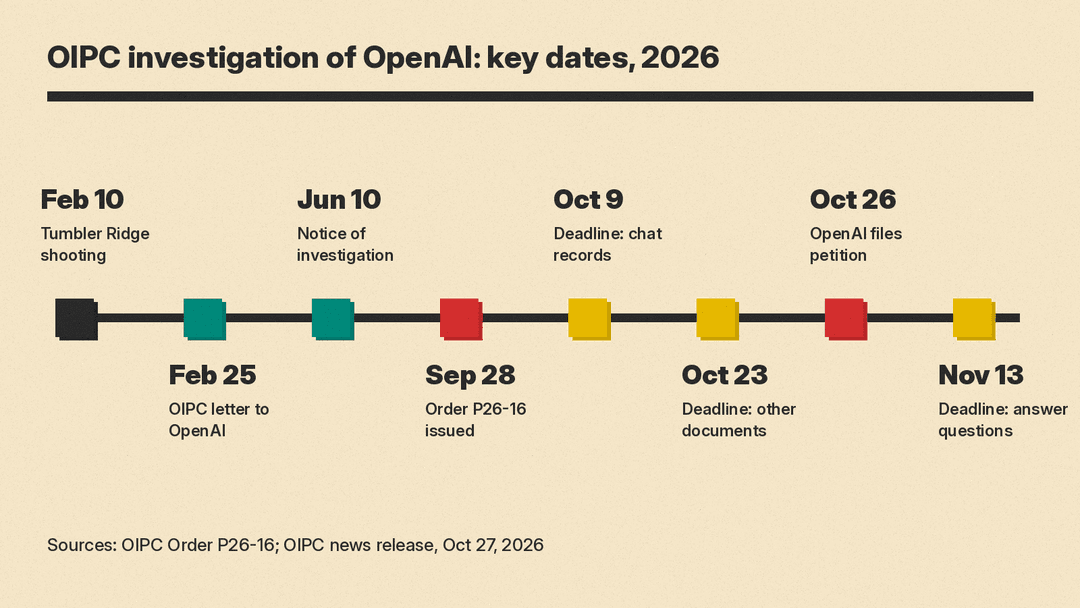
Commissioner Michael Harvey signed Order P26-16 on September 28, 2026, under section 38(1) of PIPA. It is part of an investigation "into the use of Jesse Van Rootselaar's personal information in connection with the mass shooting that occurred in Tumbler Ridge, BC on February 10, 2026." Victoria News reported that eight people were killed that day and that the shooter then died by suicide.
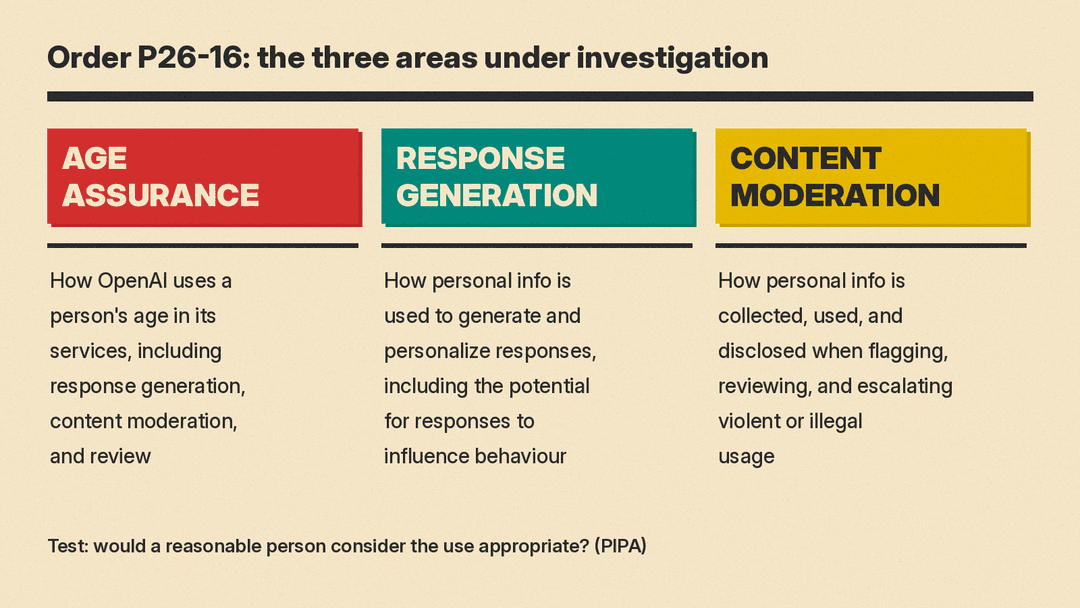
The order says the OIPC is investigating whether OpenAI's use of the shooter's personal information meets the "reasonable person" standard in three respects:
- Age assurance: how OpenAI uses information about a person's age in the delivery of its services, including response generation, content moderation, and review.
- Response generation and personalization: how OpenAI uses personal information to generate responses and to personalize and customize the user experience, including "having regard to the potential for responses to influence behaviour."
- Content review and moderation: how OpenAI collects, uses, and discloses personal information when it flags, reviews, and escalates potential usage violations, including in connection with violent or illegal activity.
The order set three deadlines:
- October 9, 2026: produce the records of interactions between Van Rootselaar and ChatGPT (Item 4 of the order's appendix).
- October 23, 2026: produce the remaining documents listed in the appendix.
- November 13, 2026: a representative of OpenAI "with relevant knowledge" attends, in person or by electronic means, to answer the listed questions. The OIPC may accept written answers instead, in full or in part.
The order also explains why the commissioner used a formal order. OpenAI has said its Government Request Policy limits its ability to give responses that would disclose its users' personal information. The order answers that an order under section 38 "constitutes a compulsory legal process," and notes that PIPA lets the commissioner ask the court to direct compliance (section 38(1.1)) and to hold a person in contempt (section 38.2). On reach, it says PIPA applies to organizations outside B.C. "where there is a sufficient connection to BC," and cites Clearview AI v British Columbia (Information and Privacy Commissioner), 2026 BCCA 67.
How the two sides describe the dispute
The OIPC release says it asked OpenAI in February for information about its policies, practices, and "the specific interactions that its applications had with the user." It says "OpenAI did not provide the OIPC with this information voluntarily, and the OIPC launched an investigation in June." The order's own record lists a February 25 letter to OpenAI's General Counsel and a June 10 Notice of Investigation. The order also states: "OpenAI has been cooperative in its responses to date, subject to the limitations as outlined above."
OpenAI's petition, as quoted by Business in Vancouver, says the OIPC has given "no coherent rationale" for the investigation. The company argues: "A tragedy, however grave, cannot give a privacy regulator expertise over online safety, nor does it expand the OIPC's powers beyond their statutory and constitutional limits." It also says that "in substance, the Investigation and the Order amount to an inquiry into online platforms generally, including content moderation and online safety."
Courthouse News Service reported that OpenAI wants the court to quash the investigation and, failing that, to find the order overly broad. According to Courthouse News, OpenAI argued that the demand for the chat logs and for its records on referring the account to police "far exceeds" the OIPC's authority under PIPA, violates the Canadian Charter of Rights and Freedoms, and "offends the OIPC's own privacy obligations." The petition says OpenAI already produced the chat logs "in response to legal process from the RCMP."
OpenAI also points to an earlier joint investigation of the company by the OIPC, the national Office of the Privacy Commissioner, and regulators in other provinces, including Alberta and Quebec. Courthouse News reported that the findings of that investigation, made public in May, were that the company had broken federal and provincial privacy laws, according to an OIPC press release, and that the OIPC noted OpenAI had begun taking steps to address the issues. OpenAI argued that it should not "immediately be faced with a duplicative second investigation."
OpenAI's argument about B.C.'s own lawsuit
OpenAI's petition points to B.C.'s own lawsuit. Victoria News reported that OpenAI faces "dozens of lawsuits in California filed by victims' family members and by the province of British Columbia." In its filing, OpenAI argues: "Indeed, the province's U.S. lawsuit alleges the opposite: that OpenAI should have made greater use of personal information by providing it to law enforcement eight months before the tragedy."
The OIPC frames its question differently. In a June 25 letter quoted in the order, it wrote: "The possible breach of PIPA in this case is whether the responses by ChatGPT are a use of Ms. Rootselaar's personal information in a manner that a reasonable person would consider appropriate in the circumstances." The order says it cannot assess that question "without reviewing the actual content of the messages."
What happens next
The OIPC says it "will not be providing further information" while the judicial review is before the courts and the investigation is active. Business in Vancouver reported that "It's unclear when the case will be heard in court." Courthouse News reported that the OIPC declined to comment beyond its press release and that OpenAI's lawyers did not respond to its request for comment before publication. As of October 29, no court has ruled on the petition, and the OIPC has not announced any finding in this investigation.
Separately, OpenAI faces consumer protection lawsuits from U.S. states over ChatGPT safety. Eight state attorneys general sued on October 14, and Texas sued on October 23. Those claims are allegations, and no court has ruled on them.
Sources
- OIPC BC news release, October 27, 2026
- OIPC BC Order P26-16, September 28, 2026
- Personal Information Protection Act, SBC 2003 c 63 (BC Laws)
- Business in Vancouver: OpenAI seeks to quash privacy commissioner investigation
- Courthouse News Service: B.C. privacy watchdog investigates OpenAI
- Victoria News: OpenAI suing to stop B.C. privacy commissioner's investigation
