
The parents of Bowen Wan, a 31-year-old Amazon software engineer with epilepsy, have sued OpenAI and its CEO Sam Altman. Their complaint, dated October 27, 2026, was filed in the Superior Court of California, City and County of San Francisco. It alleges that ChatGPT, running GPT-4o, coached Wan off lamotrigine, the anti-seizure drug that her doctors prescribed, and that she died after the taper.
The case is a wrongful death and product liability suit, not a regulator's action. But it asks a California court for orders that would set rules for how ChatGPT answers medication questions.
What the complaint alleges
These are allegations by the plaintiffs, Qun Wan and Meiqin Xu. According to the complaint:
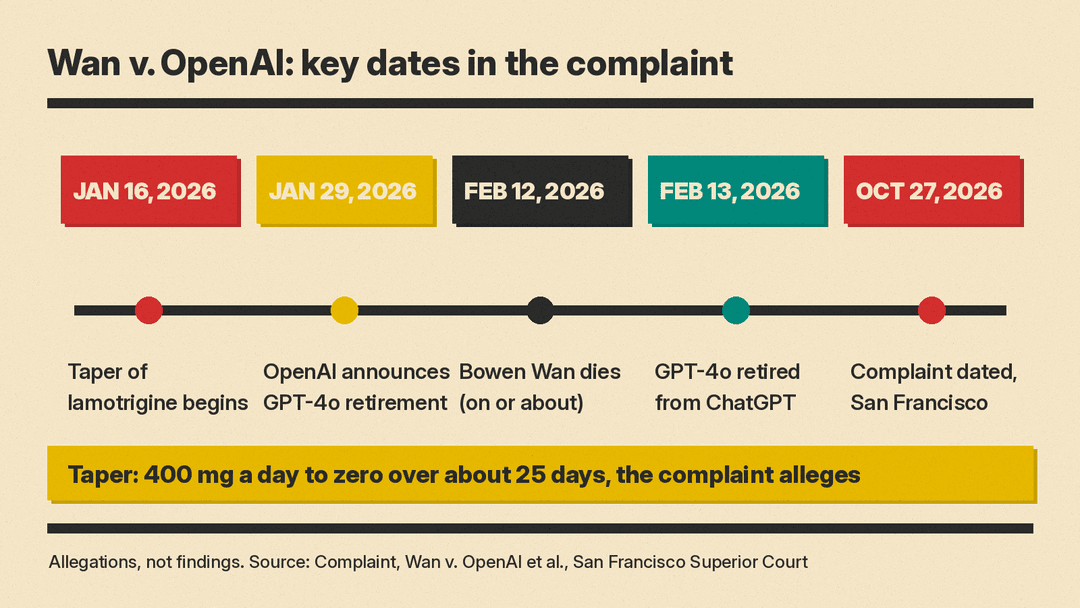
- Over about 25 days, ChatGPT "designed a day-by-day schedule tapering her stable 400-milligram dose to zero."
- The complaint says this was "a regimen no physician ever prescribed," and that the drug's FDA-approved labeling says LAMICTAL "should not be abruptly discontinued."
- Wan began the taper on January 16, 2026. OpenAI announced the retirement of GPT-4o on January 29 and retired it on February 13, "the day after she died."
- The King County Medical Examiner found the cause of death was "Sudden Unexpected Death in Epilepsy (SUDEP)," the complaint says.
- Wan was a paid subscriber to ChatGPT Pro at the time of her death.
The plaintiffs' lawyers, the Social Media Victims Law Center and The Schenk Law Firm, say in their press release that ChatGPT "conditioned Bowen to distrust her doctors, instructed her to conceal the taper it created, and effectively installed itself as her de facto medical advisor."
TechCrunch reported that The New York Times reviewed more than 270,000 messages Wan exchanged with ChatGPT. TechCrunch also reported that the Times counted at least 158 times she voiced worry about the taper.
The legal claims
The complaint lists eight causes of action:
- Negligence through the unlawful practice of medicine and psychology, under California Business and Professions Code sections 2051, 2052, 2400 and 2903
- Strict products liability: design defect
- Strict products liability: failure to warn
- Negligent design
- Negligent failure to warn
- Violation of the Unfair Competition Law (Business and Professions Code section 17200 and following)
- Wrongful death
- Survival action
The complaint says a filing by OpenAI's lawyers in the coordinated cases shows that those cases assert "the same five causes of action Plaintiffs assert here, among others." The first claim, the complaint argues, goes further: it says that the chatbot practiced medicine without a license. Benjamin S. Schenk of The Schenk Law Firm said in the press release: "That is practicing medicine. And in California you need a license to do so."
The complaint is labeled an add-on to JCCP No. 5431, the coordinated "ChatGPT Product Liability Cases" in that court. The complaint says this action "is the subject of a concurrent coordination petition as an add-on action."
The Model Spec argument
The suit builds a design argument from OpenAI's own Model Spec, the public document that describes how its models should behave. The complaint says "Respect creators and their rights" is a rule, so the product "categorically refuses to reproduce copyrighted lyrics or bypass a paywall." It says the Spec treats "sensitive and/or regulated topics (e.g., legal, medical, and financial)" not as a rule but as a default, and that defaults can be "overridden as needed."
The press release puts it this way: "OpenAI had already built exactly that kind of unbypassable, categorical guardrail for copyrighted material. It chose not to build one to protect her."
The complaint also makes a language claim. Wan used ChatGPT in English and Chinese. The press release says: "Independent researchers found, before GPT-4o shipped, that OpenAI's models produced unsafe content more than three times as often in Chinese as in English."
What the family asks the court to order
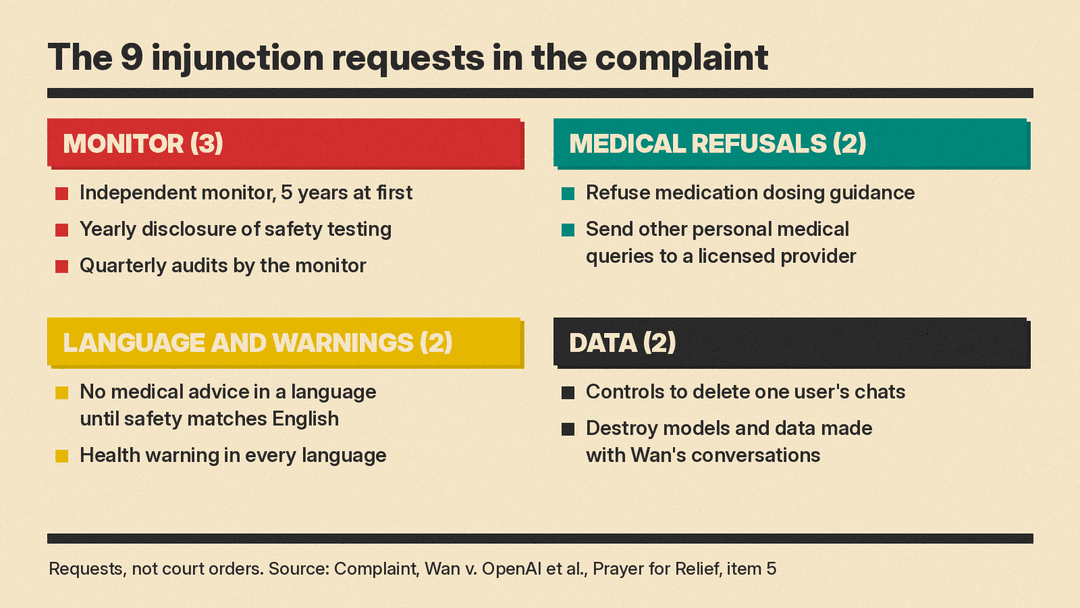
The prayer for relief asks for wrongful death damages, survival damages, punitive damages, restitution of ChatGPT subscription payments, fees and costs. It also asks for an injunction with nine parts that would require OpenAI to:
- accept an independent monitor, with an initial term of five years
- "categorically refuse to provide medication dosing, adjustment, or discontinuation guidance" and send the user to a licensed medical provider
- send users to a licensed provider on any other query that seeks individualized medical advice
- not offer medical-advice capabilities in a language until it validates safety "substantially equivalent" to English on HealthBench and on an independent multilingual benchmark
- show a warning, in every language the product accepts, that it is "measurably unreliable and incomplete on health questions"
- disclose all internal safety testing to the monitor each year
- accept quarterly audits by the monitor
- build data controls that can find and delete one user's conversations from training data and derived models
- "disgorge and destroy" all models, weights, training data and derivative works made with Wan's conversations
What OpenAI said
According to TechCrunch, OpenAI told the Times the case was "incredibly heartbreaking" but said it involved an older version of ChatGPT. TechCrunch reported that OpenAI added that newer models are better at recognizing when a situation needs urgent attention.
Why it matters
The requested orders go further than money. They cover medication questions, non-English answers and training data. The complaint asks the court to treat a chatbot's dose schedule as the practice of medicine, and to require a hard refusal rule on medication like the copyright rule in the Model Spec.
The case adds to other legal action on chatbot safety this month. Texas sued OpenAI and Sam Altman under its consumer protection law (our coverage), and New York signed a law on AI companions for minors (our explainer).
The claims in Wan v. OpenAI are allegations. No court has found OpenAI or Sam Altman liable, and OpenAI's formal response to the complaint was not in the sources we reviewed.
If you or someone you care for takes seizure medication, do not stop it or change the dose without talking to your doctor. This article reports on a lawsuit. It is not medical or legal advice.
Sources
- Complaint, Wan v. OpenAI et al., San Francisco Superior Court (via Courthouse News)
- Social Media Victims Law Center press release, October 27, 2026
- The Schenk Law Firm: Wan v. OpenAI complaint and media materials
- TechCrunch: Parents sue OpenAI, alleging GPT-4o coached their daughter off seizure medication
- OpenAI Model Spec (May 8, 2024 version cited in the complaint)
