
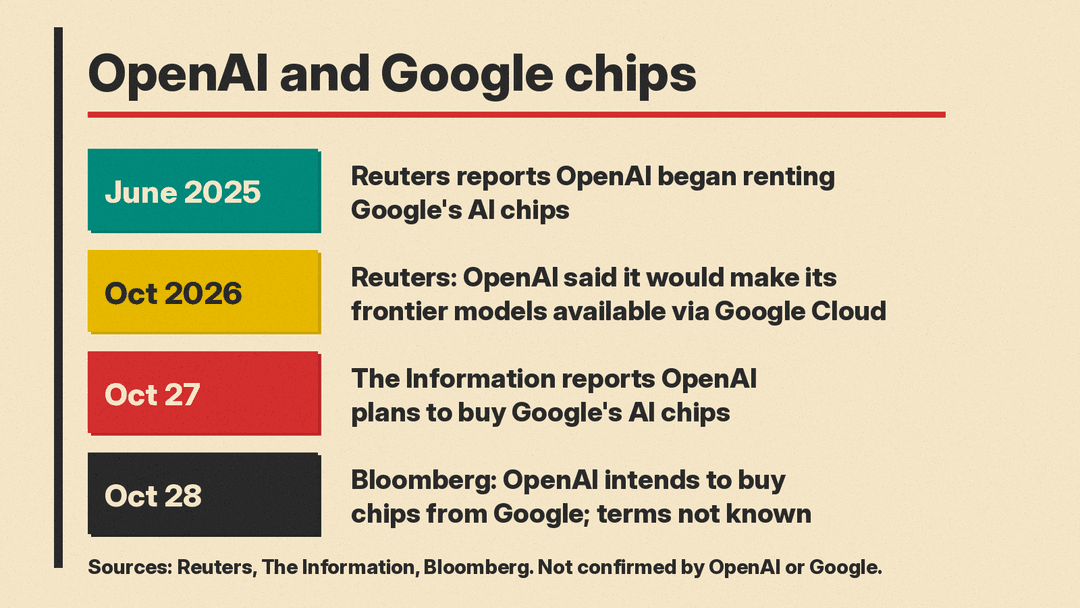
OpenAI plans to buy Google's AI chips, according to reports from The Information and Bloomberg. The Information reported the plan on Tuesday, citing a person familiar with the matter, according to a Reuters summary of that report published that evening, U.S. time. The Information's story is paywalled, so details from it here come from Reuters or from its free headline. On Wednesday, Bloomberg reported that OpenAI "intends to buy artificial intelligence computing chips from Alphabet Inc.'s Google," also citing a person familiar with the matter.
Neither company has confirmed it. Bloomberg says OpenAI and Google declined to comment. Reuters says OpenAI declined to comment and Google did not immediately respond to a request made outside regular business hours.
What the reports say
The chips are Google's Tensor Processing Units, or TPUs. If you want the basics on what those are, see our explainer, What Is a TPU? Google's AI Chips Explained in Plain English.
The reports are short on detail. Here is what they do and do not say:
- It is a plan, not a closed deal. Bloomberg reports, citing its source, that "final terms of any deal aren't yet known." The person asked not to be named because the discussions are private, Bloomberg says.
- No money figures. Reuters says The Information's report "did not disclose financial terms or other details."
- It goes past renting. Reuters reported in June 2025 that OpenAI had begun renting Google's AI chips. Reuters now says the reported purchase plan "would deepen ties" between the two companies.
- Bloomberg frames it as part of a wider build-out. It calls the move part of OpenAI's "multipronged bid to quickly add more AI processing power."
So there is no word yet on how many chips, what they cost, when they would arrive, or what OpenAI would run on them.
Why this matters
Start with Nvidia. Reuters describes OpenAI as "already among the largest buyers of Nvidia's graphics processing units (GPUs), which it uses to train and deploy AI models." The Information's headline calls OpenAI "a longtime Nvidia customer."
Buying TPUs would add another supplier. That fits a pattern. Bloomberg notes OpenAI "has already announced plans to start using its own chips to support its artificial intelligence models later this year." Reuters says OpenAI unveiled its first custom AI chip designed with Broadcom in June, and "said it planned to deploy the processor by the end of this year as part of a multi-generation chip program." We covered that chip, called Jalapeño, in OpenAI Unveils Jalapeño Custom Inference Chip.
There is a Google link inside OpenAI's own chip effort too. Bloomberg reports that the Jalapeño chips "were created with help from Google veterans," and that Richard Ho, who runs OpenAI's internal chip team, "was previously involved in the development of Google's semiconductors."
It is also an odd pairing. Reuters points out that OpenAI and Google "compete in AI products and search but have increasingly struck commercial deals." One of those deals is recent. Reuters says that last week, OpenAI said it would make its frontier AI models available through Google Cloud. Our explainer on that move is OpenAI Models on Google Cloud Explained.
Google is selling more TPUs
For Google, OpenAI would be another outside buyer. Bloomberg says Google began working on TPUs "more than a decade ago," first to speed up its web search engine, and that the chips "have emerged in recent years as an alternative to Nvidia's much-prized graphics processing units."
Reuters adds that Google began selling TPUs directly to some customers this year, and that deals with customers including rival Anthropic "have fueled demand." Reuters also reports that Alphabet expects to begin recognizing a small percentage of revenue from TPU sales agreements by the end of this year, with the vast majority expected in 2027, according to earlier comments from CFO Anat Ashkenazi.
The Information's report came out on Tuesday, the same day Oracle said TPUs would be available through its cloud, per Bloomberg. "The next generation of AI will require a diverse range of compute," Google executive Amin Vahdat said in a statement announcing that deal, as quoted by Bloomberg. We wrote up the Oracle side in Oracle Brings Google TPUs, Cerebras and Jalapeño to OCI.
The bigger spending picture
All of this sits inside a very large compute race. Reuters reports that Amazon, Microsoft and Alphabet plan to spend as much as $600 billion combined this year on AI infrastructure, "as investors increasingly question when such spending will translate into meaningful returns."
Bloomberg ties the Google plan to OpenAI's push to add processing power quickly, and places OpenAI among "a stampede of companies working to develop homegrown AI chips and challenge Nvidia Corp.'s dominance in the field."
What to watch
- Confirmation. So far this rests on one unnamed source in each report. An announcement from OpenAI or Google would settle what is actually being bought.
- Terms and scale. Neither report gives a dollar figure, chip count or timeline.
- Workloads. The reports do not say whether OpenAI would use TPUs for training, for serving ChatGPT and the API, or both.
- How it fits with Jalapeño and Nvidia. OpenAI uses Nvidia GPUs, plans to deploy its own Jalapeño chip by the end of this year, per Reuters, and may add Google TPUs. How it would split work across them is not public.
We will update this post if OpenAI or Google confirms the deal.
