
OpenAI has released a new public dataset on how people use ChatGPT for work. The release, published on October 26, 2026, is part of OpenAI Signals, which OpenAI describes as its "ongoing effort to share evidence about how people use AI." The citation lists this version as OpenAI Signals v3.0.
The short version: work use of ChatGPT became less concentrated in the most common activities over the period covered, and the mix of work people bring to ChatGPT looks quite different from the mix of work done across U.S. jobs.
What OpenAI released
According to OpenAI's announcement, the data "explores 165 work activities across nearly 100 countries, revealing how consumers use ChatGPT for work." The examples OpenAI gives range from preparing instructional materials and developing marketing content to programming and analyzing business data.
The 165 categories are Intermediate Work Activities, or IWAs. These come from O*NET, a standardized framework that groups occupation-specific tasks into broader categories of work activities shared across occupations. OpenAI says IWAs are "commonly-used categories of tasks for the kinds of work people do across occupations."
The data is quarterly. It runs from the first quarter of 2025 through the third quarter of 2026. OpenAI also published an interactive chart that lets readers pick a country, move from broad activity groups to more specific activities, and see how those change over time. A data download and a data dictionary with the methodology are on the Signals data page.
OpenAI says researchers can use it to explore how ChatGPT use for work differs across countries, track changes over time, and match the data to other economic indicators.
Finding 1: work use is less concentrated in the top ten activities
The headline number is about concentration. OpenAI writes: "Across 74 countries observed in every quarter, the ten most common activities represented an average of 51.1% of each country's classified work messages in Q3 2026, down from 56.0% in Q1 2025."
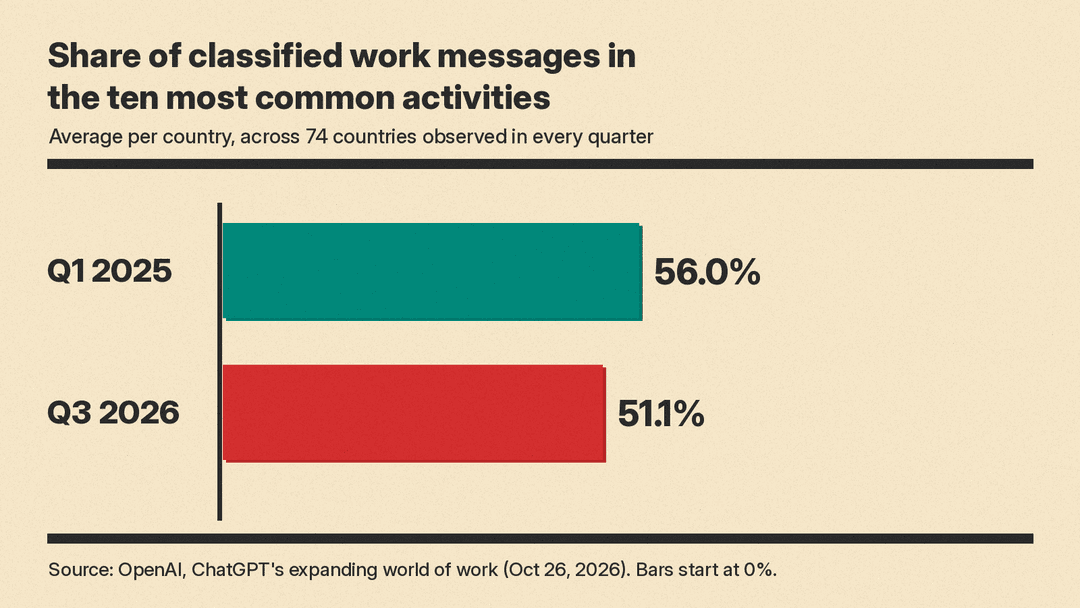
In plain terms, the ten most common activities took a smaller average share of each country's classified work messages in Q3 2026 than in Q1 2025.
OpenAI's reading is that "countries tended to specialize in their work over time, and different countries specialized in different types of work." It is careful about the cause. The differences "might reflect variation in the kind of work done across countries or varying access to AI tools." OpenAI presents this as one example of the questions researchers can pursue, not as a settled answer.
Finding 2: ChatGPT work is not the same as the U.S. economy
Because the data uses the same O*NET categories that describe U.S. jobs, it can be compared with the work actually done in the U.S. economy. OpenAI says the two distributions "differ substantially."
OpenAI says this is largely because of a group labeled Other IWAs. About 43% of the employment-weighted task mix for mapped U.S. occupations falls into Other IWAs, outside the individually reported categories. OpenAI's examples include moving materials, operating vehicles, and maintaining health or medical records. These categories did not meet OpenAI's threshold for consistent representation in the original U.S. ChatGPT sample.
That gap is a useful reminder. A large part of the work done in the U.S. economy, measured by this task mix, sits outside the categories reported individually for ChatGPT use.
What the data does not cover
The limits matter as much as the findings:
- Individual plans only. The data covers work-related messages on individual ChatGPT plans. It does not include enterprise messages or Codex use.
- Consumers, not companies. OpenAI frames the release as showing "how consumers use ChatGPT for work."
- Classified messages. The shares are of each country's classified work messages, so they depend on how the automated system sorts messages into categories.
- Correlation, not cause. OpenAI's own explanation of the country differences is hedged with "might reflect."
How privacy is handled
OpenAI describes several protections. Researchers do not read individual conversations. Automated systems classify messages after identifying information is removed. OpenAI publishes aggregated statistics, withholds results for small groups, and adds statistical noise to protect individual messages.
Why it matters
For workers, the release gives a rough public picture of what kinds of work people bring to an AI chatbot, and how that is shifting. If you want ideas for where ChatGPT fits in daily tasks, our 50 best ChatGPT prompts for work covers common use cases.
For researchers, the value is the common framework. Linking ChatGPT use to O*NET categories means it can be set beside other occupational and employment data instead of standing alone. OpenAI says it invites researchers to "investigate what these patterns mean for workers and businesses."
The scope limit is worth keeping in mind: this dataset covers individual ChatGPT plans, not enterprise messages. For background on how OpenAI's consumer and enterprise products fit together, see our explainer on how OpenAI makes money.
