
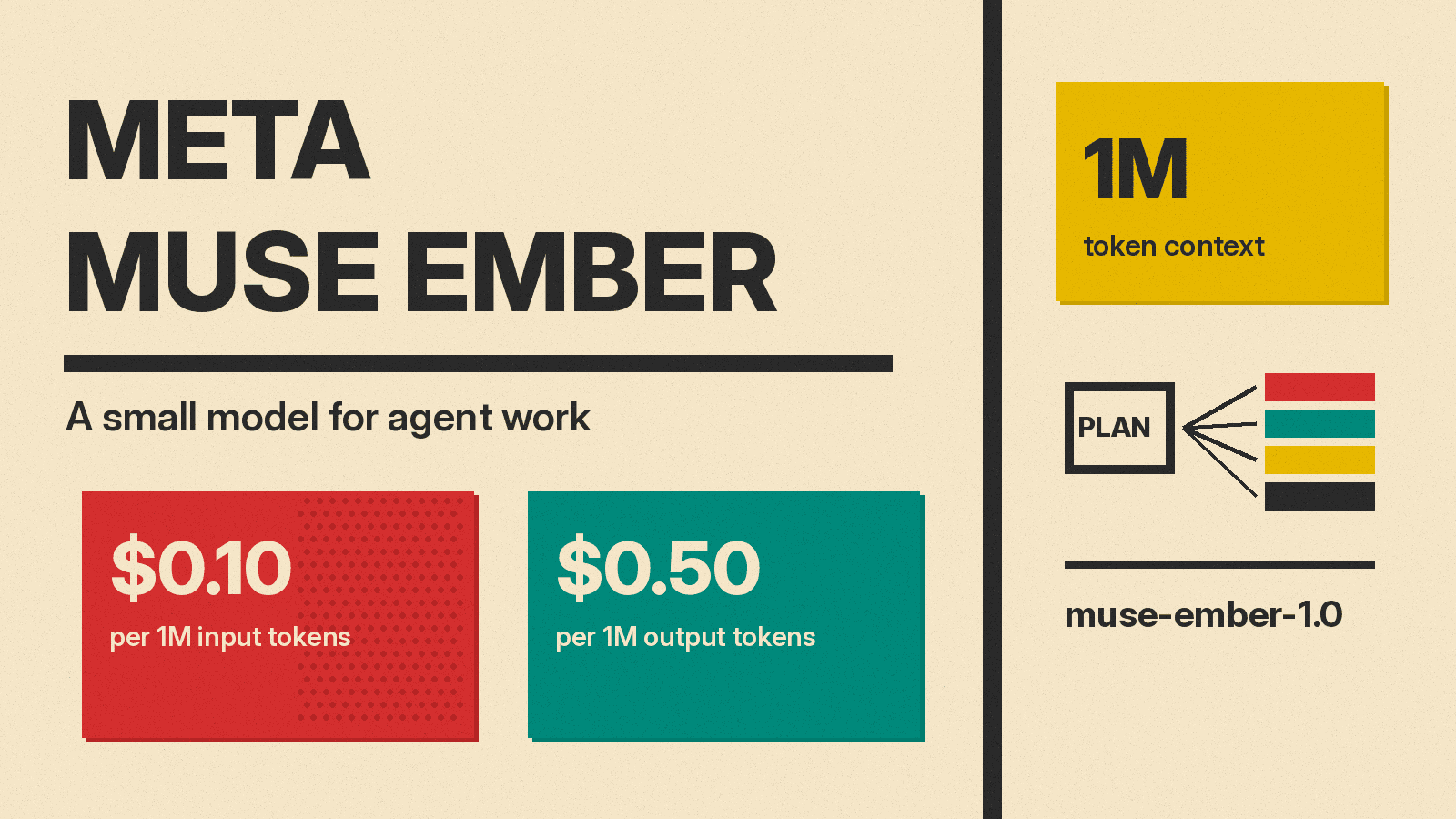
Meta released Muse Ember on November 9, 2026, a model it calls its smallest and most efficient. It is built for the small, repeated jobs that AI agents (programs that use a model to carry out tasks step by step) do all day, and it costs $0.10 per million input tokens. Meta says it beats Claude Haiku 5.5 and GPT-6 Luna on value for money, based on its own published results.
What is Muse Ember?
In its announcement, Meta describes the model this way: "Today, we're introducing Muse Ember, our smallest and most efficient model designed for complex reasoning execution and the work agents repeat all day: tool calls, coding subtasks, routing, extraction, and long document parsing."
Muse Ember is the small, cheap member of the Muse family. Meta's developer docs say to pair it with Muse Spark or Muse Wonder: the larger model plans, and Muse Ember handles the volume. The docs list the jobs it is meant for:
- Subagent tasks, meaning the focused coding tasks, terminal commands and lookups that a main agent hands out.
- Tool calls inside a larger workflow, where cost and latency per call add up.
- Routing: sorting requests and sending each one to the right handler or model.
- Running the same task over thousands of images, files or records, such as captioning and sorting photos, extracting fields, or classifying tickets.
The model takes text, image, video, audio and PDF input and writes text, per the docs. Its context window (how much text it can read in one request) is 1,048,576 tokens, and it can write up to 524,288 tokens in one reply. A token is a small chunk of text, roughly part of a word. Reasoning effort runs from "minimal" to "max", and the default is "max".
Meta says Muse Ember is the first model it trained using Muse Wonder Full. For background on that larger model, see our Muse Wonder explainer.
How much does Muse Ember cost?
Muse Ember is available on the Meta Model API and in Muse Code as muse-ember-1.0. Meta's pricing page lists two tiers per million tokens:
- Up to 200K input tokens per request: $0.10 input, $0.004 cached input, $0.50 output.
- Over 200K input tokens: $0.30 input, $0.012 cached input, $1.50 output. The pricing page says a request over the line "is billed at the long-context rates in full, not only for the tokens past 200K."
Meta's announcement compares it with its own Muse Spark 1.3. On Artificial Analysis numbers at max reasoning, Muse Ember scores 36 on the Intelligence Index against 37 for Spark 1.3. Its cost per Intelligence Index task is $0.14, against $2.39 for Spark 1.3. Spark 1.3 lists at $1.25 per million input tokens and $4.25 per million output tokens.
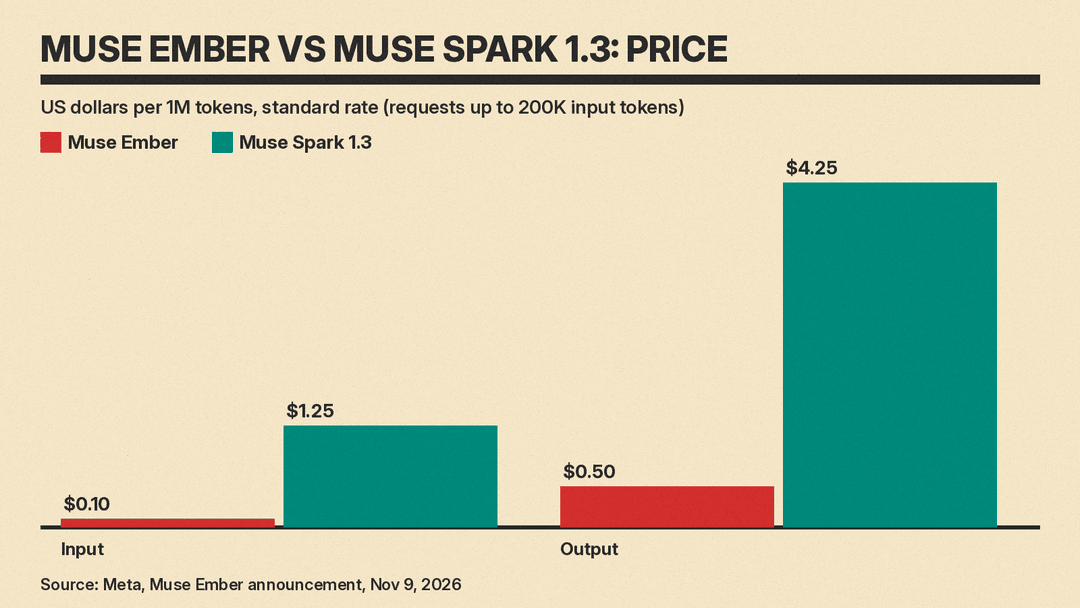
TechCrunch wrote: "At 10 cents per million input tokens, Ember is significantly cheaper than frontier competitors like Haiku and Luna." TechCrunch added that it is also cost-competitive with DeepSeek V4.1 Flash and GLM 5.3 Flash.
How Muse Ember compares with Claude Haiku 5.5 and GPT-6 Luna
Meta's headline claim is about value: "Muse Ember delivers more intelligence per dollar than Claude Haiku 5.5 or GPT-6 Luna at any reasoning setting: it matches Haiku's best score at about a third of the cost and beats every Luna setting."
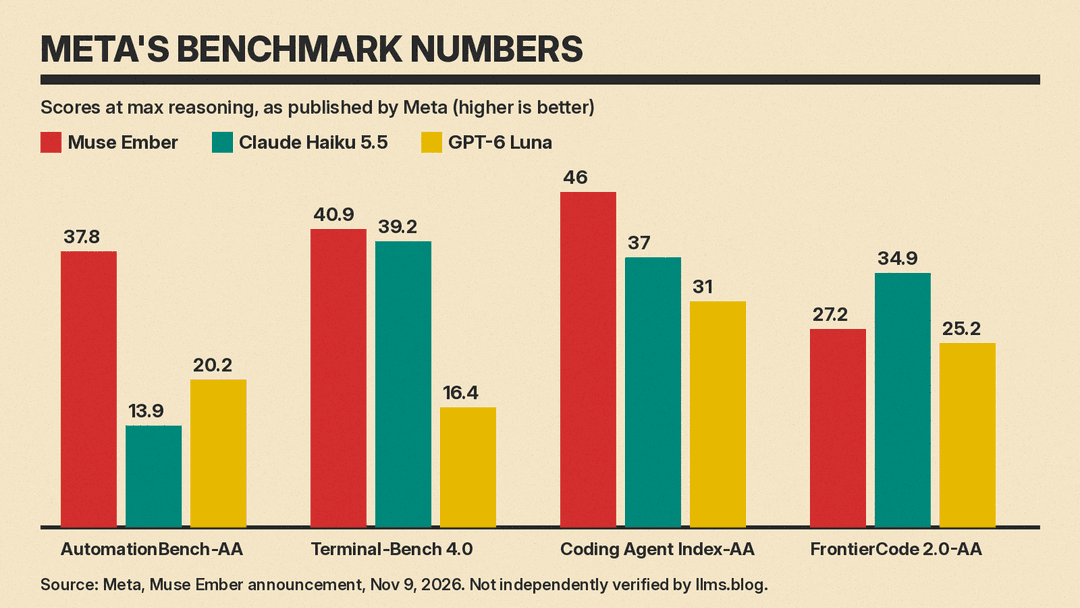
The numbers below are from Meta's announcement, all at max reasoning effort. Some come from Artificial Analysis (Intelligence Index v5, as published November 9, 2026), which we cover in our Intelligence Index v5 post. Others are Meta's internal evaluations. Independent tests may differ.
- AutomationBench-AA: Muse Ember 37.8, Claude Haiku 5.5 13.9, GPT-6 Luna 20.2.
- Terminal-Bench 4.0: 40.9, 39.2 and 16.4. Each model ran in its best published harness: mini-swe-agent for Muse Ember, Claude Code for Haiku, and Codex for Luna.
- Coding Agent Index-AA: 46, 37 and 31.
- FrontierCode 2.0-AA: 27.2, 34.9 and 25.2. Haiku leads here.
- Agents' Last Exam (Meta internal, Linux subset): 61.6, 57.0 and 57.1.
- OSWorld 2.1, computer use with partial credit (Meta internal): 69.5, 68.9 and 50.5.
- Artificial Analysis Index: 36, 36 and 28.
Meta also reports a Personal Superintelligence Index score of 46.8, against 36.1 for Haiku and 37.0 for Luna. That is an internal composite of eight evaluations, so outsiders cannot rerun it. For more on the Anthropic model in this comparison, see our Claude Haiku 5.5 explainer.
What early partners said
Meta lists Box, Cline, Oracle, Cloudflare and You.com as early testers and quotes each of them in the announcement. Three of the quotes:
- Saoud Rizwan, founder of Cline: "Muse Ember is purpose-built for, and excels at, subagent work like coding and document analysis."
- Dane Knecht, CTO of Cloudflare: "What stood out in our testing was speed. Muse Ember ran up to 30% faster at the tail than the comparable model we tested, and it handled broad, multi-repo investigation tasks well."
- Chak Pothina, inference lead at You.com, said Muse Ember completed every coding quest in You.com's testing with a p95 latency of 2.2 seconds, which he put at about 4x to 13x faster than leading open-weight models, with 36 to 48 percent fewer output tokens.
Safety testing
Meta says it evaluated Muse Ember under its Meta Superintelligence Scaling Framework, including chemical and biological, cybersecurity, and loss-of-control risks. According to Meta, "Across the categories assessed, our evaluations found that Muse Ember remained below the framework's high-risk thresholds." Meta also says it tested how the model acts on a user's behalf, including whether it "resists instructions hidden in web pages, documents, or tool outputs that try to redirect it, and seeks human input before high-impact actions."
Why it matters
Meta pitches Muse Ember as the worker under a larger planner. In the announcement's words: "Muse Wonder plans, Muse Ember handles the volume." TechCrunch gives a customer-support example: a heavier model sets the rules for handling an issue, then a lighter model applies them across tens of thousands of cases. Meta's own framing of the cost case: "Agents spend most of their tokens on many small, structured steps, and Muse Ember is built for exactly that."
The docs say Muse Ember accepts the same request body as Muse Spark, "so switching most examples is a model ID change." It supports the Responses, Chat Completions and Messages endpoints.
TechCrunch notes that Ember is the fourth model under Meta's Muse brand, after Spark in April, its open-source twin Glimmer in August, and Wonder in October. Meta's announcement ends with a hint of more: "We have even more efficient models in training and look forward to sharing what's next."
For what developers and analysts said on launch day, see our roundup of what people are saying about Muse Ember.
