
AI agents that learn from experience often save lessons to memory. They use these lessons to solve future tasks. But this process can backfire. A new paper from KAIST and DeepAuto.ai, "Don't Just Trust Your Memory," posted to arXiv on November 10, 2026, by Yukyeong Lee, Yumin Choi, Jinheon Baek and Sung Ju Hwang, describes a problem called "memory-induced degradation." This happens when an agent fails on a task it would have solved without any memory at all. The researchers propose WikiTrace, a system that links every lesson to its original source run. This allows the agent to check the evidence before acting.
What is memory-induced degradation?
Memory-induced degradation occurs when stored lessons actively harm performance. The authors analyzed failures on tasks where the agent succeeded without memory. They found that 52% of these failures traced back to a specific memory item the agent followed. Most often, the item itself was wrong (20% of the failures). An LLM judge labeled these causes. Other causes included applying a valid item outside its intended scope, misusing an item, or following an item while a better one existed in memory.
The root cause lies in how lessons are created. Existing systems distill lessons from past runs labeled only as success or failure. One label does not indicate which of many actions caused the outcome. Therefore, the lesson builder must guess. These systems hand the agent the lesson without the run it came from. The agent cannot verify the claim.
For example, the paper cites a rule from the ExpeL method. It stated that an ALFWorld lamp task ends once the object sits next to the lit lamp. However, the source run contradicted this. The agent had actually picked up the object. Following the flawed rule, the agent failed a task it solves correctly without memory.
How does WikiTrace work?
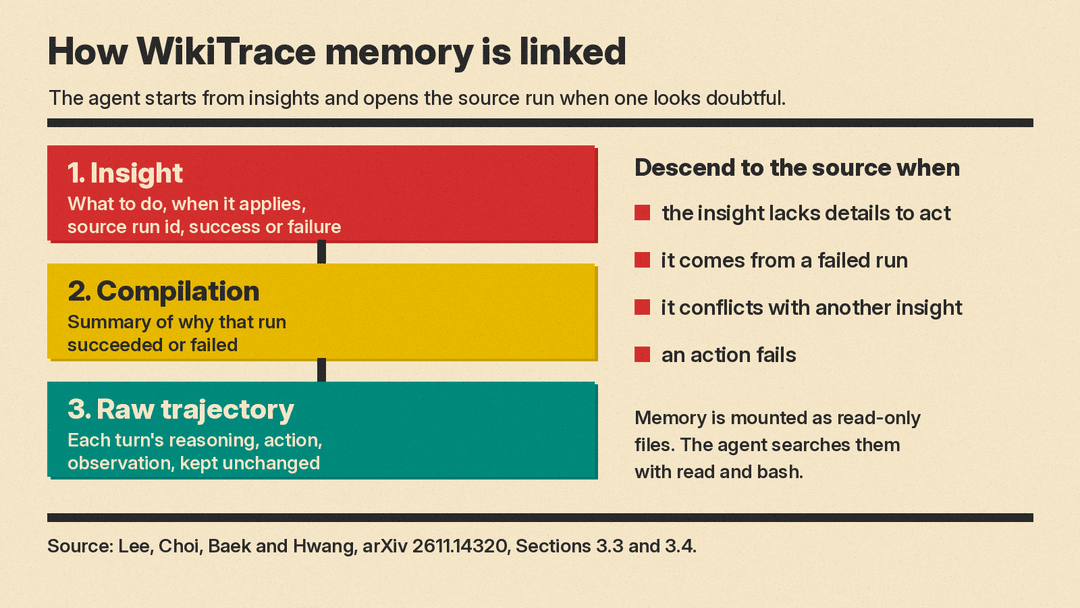
WikiTrace structures memory into three linked layers. First, there is an insight. This is a short lesson stating what to do and when it applies. Each insight records which run it came from and whether that run succeeded. The system stores at most three insights per run. Insights are never edited or deleted, so they may conflict with each other.
Second, there is a compilation. This is a summary explaining why the run succeeded or failed. Third, there is the raw trajectory. This keeps the original data unchanged. It includes each turn's reasoning, action, observation, and outcome.
At test time, the agent receives all insights up front. It also gets the three most similar past runs. The prompt instructs the agent to "descend" from an insight to its source run under specific conditions. This happens if the insight lacks details needed to act, comes from a failed run, or conflicts with another insight. The agent descends again whenever an action fails. Memory is mounted as read-only files. The agent searches them using standard read and bash tools.
Does linking evidence improve scores?
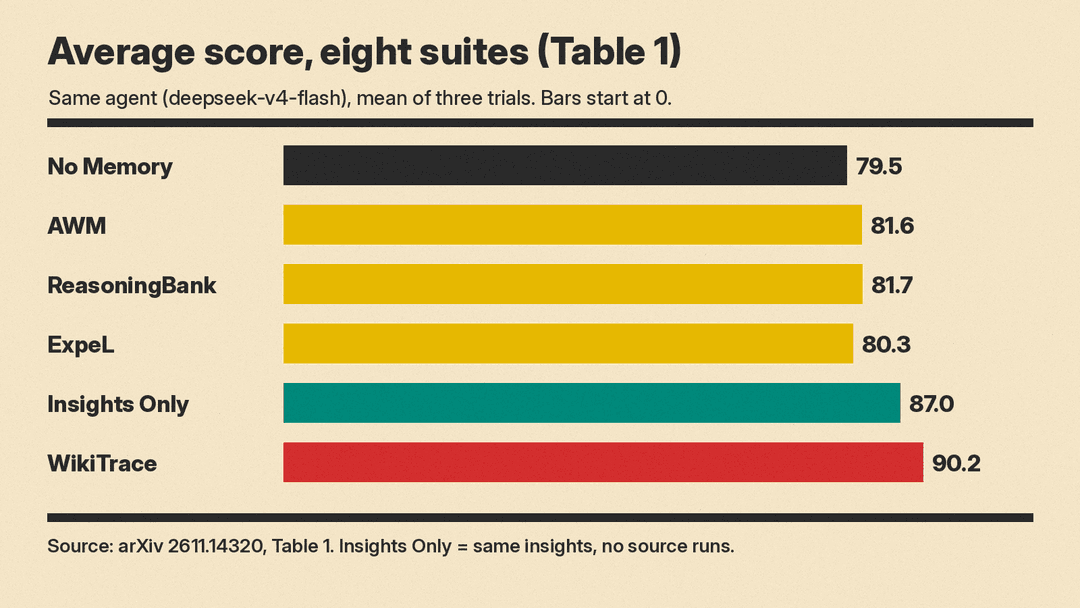
The researchers tested WikiTrace against several baselines. These included No Memory, AWM, ReasoningBank, ExpeL, and "Insights Only." The Insights Only baseline received the same lessons as WikiTrace but lacked source runs and descent prompts. All methods used the same Pi terminal agent with deepseek-v4-flash at high reasoning effort. Tests ran across eight suites covering five benchmarks, including household tasks, science experiments, Minecraft crafting, customer conversations, and app API tasks.
WikiTrace achieved the highest average score across all eight suites. It scored 90.2, compared to 87.0 for Insights Only and 79.5 for No Memory. WikiTrace was the only memory method that matched or beat No Memory on every single suite. In contrast, Insights Only scored below No Memory on the tau3-bench Retail suite.
Here is every suite, as No Memory / Insights Only / WikiTrace:
- ALFWorld seen: 94.4 / 96.7 / 98.7
- ALFWorld unseen: 94.3 / 97.3 / 98.8
- ScienceWorld: 83.7 / 94.9 / 96.1
- PlanCraft seen: 72.3 / 88.7 / 93.3
- PlanCraft unseen: 56.3 / 73.0 / 81.3
- tau3-bench Retail: 86.8 / 85.1 / 88.2
- AppWorld Test-Normal: 75.4 / 86.8 / 89.5
- AppWorld Test-Challenge: 72.7 / 73.7 / 75.8
The biggest gaps are on PlanCraft, the Minecraft crafting benchmark. PlanCraft unseen also has a wide spread across the three trials (plus or minus 8.5 points for WikiTrace), so read that single number with care. The older memory methods averaged 80.3 to 81.7, only a little above No Memory.
How much does checking evidence cost?
Opening old runs costs extra tokens. At test time, WikiTrace costs 1.17 times as much per task as Insights Only. In return it scores 3.2 points more on average. The agent also checks more when tasks are hard. It descends to source runs in 22% of Easy tasks but 44% of Hard ones. When it descends, the evidence changes its plan in 43% of those runs. This includes revising an insight (24%), adding a missing detail (14%), or supplying a fact no insight covers (4%).
Regression rates also dropped. The paper calls this Regression: the failure rate on tasks that No Memory solves. It fell to 4.5% for WikiTrace, compared to 6.5% for Insights Only. Simply rerunning the agent without memory resulted in a 9.7% regression rate. Relative to Insights Only, wrong or out-of-scope items caused half as many regressions in WikiTrace.
Testing with a second model, GLM-5.3-flash, confirmed these trends. On three PlanCraft and ScienceWorld suites, WikiTrace averaged 92.7. This was 1.8 points above Insights Only and 21.5 above No Memory.
What are the limitations?
The paper notes several constraints. Memory is built from binary outcomes, so a compilation's diagnosis may be wrong. A link lets the agent check an insight but does not automatically verify it. Every insight goes into the first message, so the prompt grows with memory size. Retrieval strategies for very large memories remain open questions. Additionally, failure causes were labeled by an LLM judge reading the agent's reasoning, so the labels describe what that reasoning states, not what actually produced the outcome.
What it means for people building agents
Coding agents and assistants now often keep memory files of lessons. This paper suggests keeping the raw logs linked to each lesson instead of discarding them, and telling the agent to check a lesson that looks doubtful before it follows it. The authors released their code on GitHub. The results so far cover one agent harness, two models and five benchmarks.
