
On November 11, 2026 (Pacific time), the official Claude account on X posted a short video about the Japanese artist Mariko Mori. The post says that for her retrospective All That Shines, Mori "used Claude to write code for a computer-generated animation, presented as a new video installation." By early November 12 the post showed about 288,000 views and 4,500 likes on X. This distinction is important. She did not ask an image generator for a picture. She used an AI model to help write the program, and the program renders the animation.
What Mori made with Claude
The work is a new video installation titled All That Shines (2026). It is presented on a large-scale LED screen at the Mori Art Museum in Tokyo. According to the museum's structure page, the installation captures real events beyond the museum space. These include views of Primal Rhythm: Sun Pillar, Ring: One with Nature, and the ocean seen from Yuputira, which is Mori's studio on Miyako Island.
The museum's information page says Anthropic, the company behind Claude, is a partner of the exhibition and "has provided technical support for the creation of All That Shines (2026) through its AI model Claude and its applied AI team." Anthropic is also listed among the show's corporate sponsors. The museum's structure page, which describes the artwork, does not mention Claude, and the Claude post does not name the artwork's title. We give both facts as each source publishes them.
Code, not a prompt-to-picture image
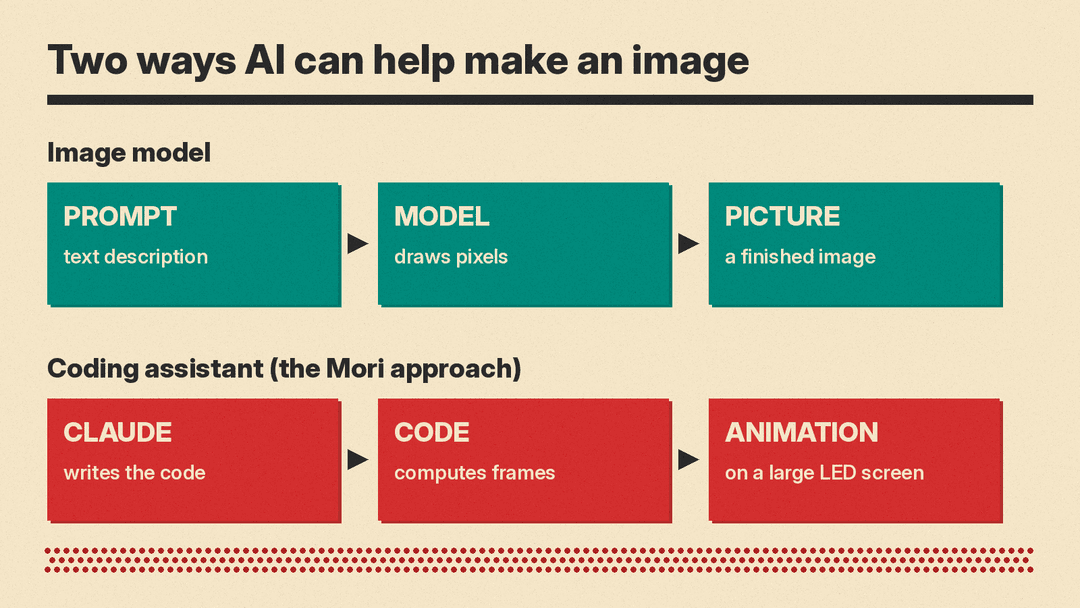
Much of the talk about AI art is about text-to-image models. Users type a description, such as "a cyberpunk city," and receive a finished visual file. The AI acts as a renderer. The user does not see or control the underlying logic.
Mori's process is different. She used Claude, Anthropic's AI model (its newest versions are covered in our Claude Fable 5.2 explainer), to write programming code. That code then runs on a computer and computes the animation. In this workflow, the AI is not creating the final image directly. It is writing the script that creates the image.
This method can give an artist more structural control. A text-to-image prompt can be vague. A code script defines exact behaviors, timing, and data inputs. For generative art, where visuals are often driven by algorithms or live data feeds, writing code is a standard practice. Using an AI assistant to speed up or assist with that coding step is a practical application of current tools.
Why this fits Mori's three decades of tech art
Mariko Mori has long integrated technology into her artistic practice. Her history shows a consistent interest in using systems to translate invisible forces into visible forms.
Her work Wave UFO (1999-2002) is described by the museum as the first artwork to use brainwave bio-feedback. Participants enter a pod, and their brain activity is translated into projected imagery. Another key piece, Tom Na H-iu (2006), is a sculpture lit by data from Super-Kamiokande, Japan's neutrino observatory. The museum says it responds in real time to neutrinos and turns those events into flashes of light.
In the mid-1990s, her "Cyborg" series already relied on computer graphics. Using Claude to write code for All That Shines follows this trajectory. In our view, the AI model is one more tool in a long line of technical collaborators, much like the brainwave interface and the observatory data in her earlier work.
What artists and designers can take from it
The example of Mori and Claude offers general lessons for creators working with digital tools. These points are observations about the workflow, not details of Mori's specific private process.
First, consider AI as a collaborator for logic, not just for aesthetics. Language models excel at writing and explaining code. Artists who do not specialize in programming can use these assistants to build complex interactive installations or animations. They can ask the model to explain what a line of code does or to fix errors.
Second, maintain artistic control over the concept. The AI writes the code, but the artist decides what the code should do. Code written by an assistant still needs a clear idea of what the work should look and feel like.
Third, iterate quickly. Writing code from scratch is slow. Using an assistant allows for faster testing of ideas. An artist can describe a desired effect, get a code snippet, run it, see the result, and refine the request. This loop helps bridge the gap between vision and implementation.
Questions about authorship and AI art are also still open in law; see our report on the Getty v. Stability AI appeal. For a hands-on example of code-driven images, see how to make pixel art with AI.
What we do not know yet
Several details about the production of All That Shines remain unclear. The Claude post and the museum page do not specify which version of the model was used. They also do not say how much of the code was written by Claude versus how much was edited or written by human developers.
There is no information on the timeline. We do not know how long the coding process took or how many iterations were required. The extent of the "technical support" provided by Anthropic's applied AI team is also not detailed. Whether they wrote the entire script or assisted Mori's own team is unknown.
Visiting the exhibition
Mariko Mori: All That Shines is currently on view at the Mori Art Museum. The exhibition runs from October 31, 2026, to March 28, 2027. It is located on the 53rd floor of the Roppongi Hills Mori Tower in Tokyo.
This is Japan's first major retrospective of Mori's work since Pure Land in 2002. The show features forty works spanning more than three decades. It is organized by the Mori Art Museum in collaboration with The Solomon R. Guggenheim Foundation. Co-curators are Alexandra Munroe from the Guggenheim and Kataoka Mami, Director of the Mori Art Museum.
