
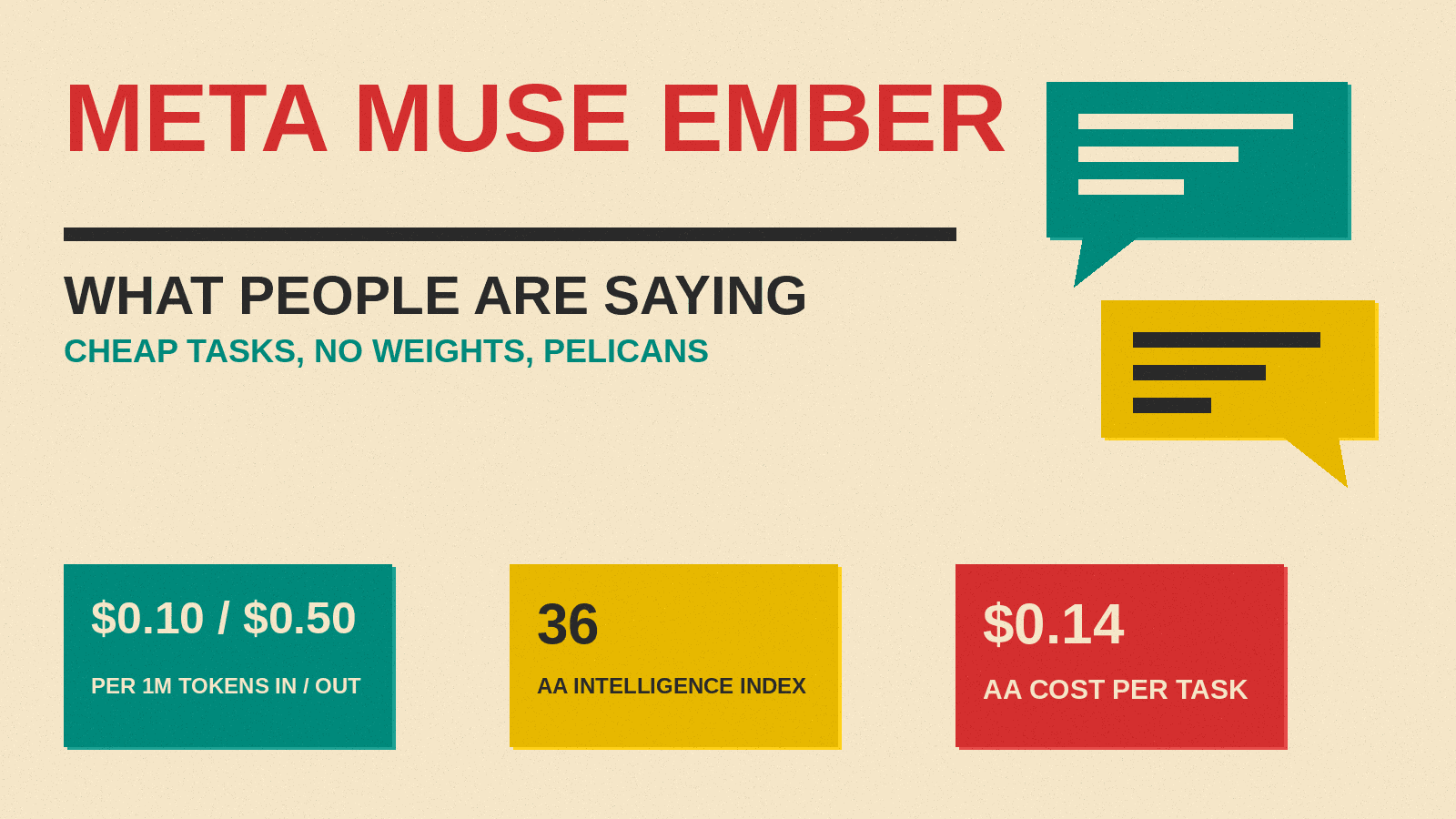
Meta released Muse Ember on Nov 9, 2026. It is the company's smallest and cheapest model, priced at $0.10 per million input tokens, and it targets the routine work inside agent systems: tool calls, coding subtasks, routing, extraction and long document parsing. Early posts on X and Hacker News compared cost per task, asked what happens above 200,000 input tokens, and asked why there are no downloadable weights. This post collects those reactions with links. For specs and pricing, see our launch explainer. Engagement counts are as of 1:30 PM PT on Nov 9.
What Meta launched
Per Meta's announcement, Muse Ember is Meta's smallest and most efficient model. The model id is muse-ember-1.0, served on the Meta Model API and in Muse Code. Pricing is $0.10 per 1M input tokens, $0.004 for cached input and $0.50 per 1M output tokens. The context window is 1M tokens, with up to 512K output tokens, and the model accepts text, image, audio and video input. Meta says it is the first model trained using Muse Wonder Full, and it frames the two models as a pair: "Muse Wonder plans, Muse Ember handles the volume."
Meta published no parameter count, and the model is not open weights.
One detail on Meta's pricing and rate limits page came up in replies. A request with more than 200K input tokens is billed in full at long-context rates: $0.30 input, $0.012 cached input and $1.50 output per million tokens. Muse Wonder and Muse Spark carry no long-context premium.
The cost-per-task argument
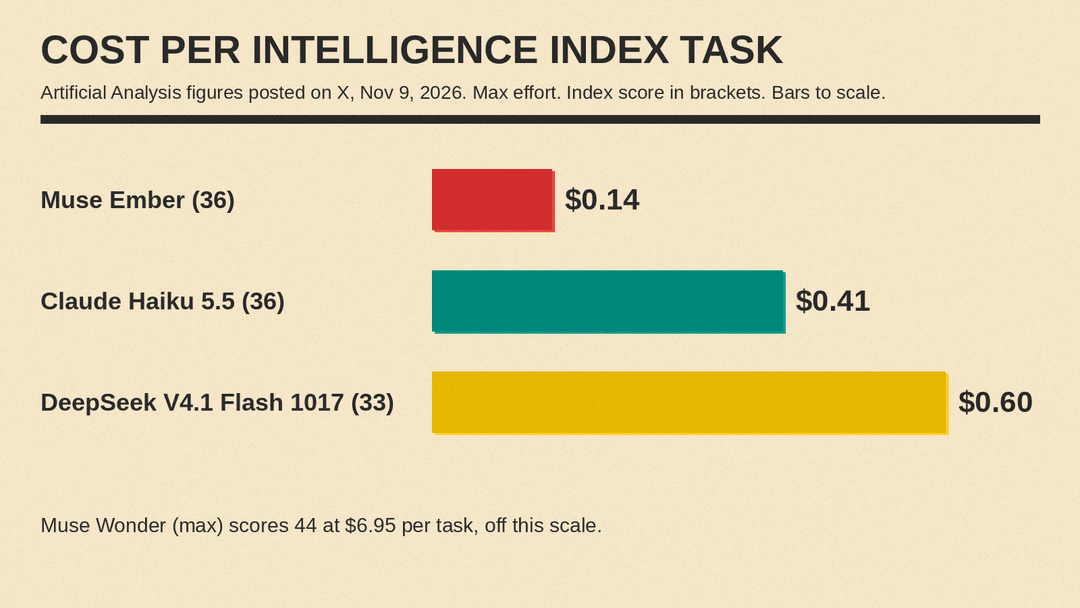
The cost-per-task figures come from Artificial Analysis, whose thread had 653 likes. In its runs, Ember scores 36 on the AA Intelligence Index, "matching Claude Haiku 5.5 (max) at a third of the Cost per Task": $0.14 per task against $0.41 for Claude Haiku 5.5 (max). It is also about 4x cheaper than DeepSeek V4.1 Flash 1017 (max), which scores 33 at $0.60 per task. Within Meta's own line, Muse Wonder (max) scores 44 at $6.95 per task.
@alexandr_wang announced the release in a post with 1,486 likes: "today we released our smallest model yet: Muse Ember" and "Muse Ember offers nearly Muse Spark 1.3 (max) intelligence at a 17x cheaper price point (per AA)".
Why is Ember cheaper per task when its token prices match Haiku and Luna? Artificial Analysis explained that Ember's "cached input, most of the cost in our agentic evaluations, is 60% cheaper", and that Ember "uses roughly a third as many output tokens as Claude Haiku 5.5 (max)". On Hacker News, minimaxir made a similar point: "Notable cache cost of 4% input, compared to Luna/Haiku's 10% of input."
@chriscoyoli warned against reading too much into index scores: "the real test is cost per finished task, not the benchmark score."
Praise: speed and price
Two early testers singled out speed. @0xMoeCode wrote "while testing I found it was working at an average of ~300 tok/s???" and "Did better than expected I must say." @MrAhmadAwais wrote "Shipped it live @CommandCodeAI" and "Love how fast it is."
@pidashai said it had early access over the weekend and ran 10 Muse Code agents on Ember to rewrite raw SQL into SeaORM, about 178,000 lines of production code in a day. That is the company's own claim and has not been independently checked.
@ValsAI posted legal and finance rankings: "It ranks #2 on Harvey's Legal Agent Benchmark, behind only Gemini 4 Argon, and is #4 on the Legal Index." It added: "On the Finance Index, it ranks #10 while being the cheapest and fastest model on the board."
Distribution widened the same day. @OpenRouter listed Ember as live and pitched the pairing Meta describes: "Use a frontier model like Muse Wonder to plan, then fan the bounded sub-tasks out to Muse Ember". @vercel_dev said Ember is now on Vercel's AI Gateway. On Hacker News, slopnt, who uses Haiku and Luna for support on software tasks, wrote that "the fact an even cheaper model for comparable intelligence is out there now is great news".
Complaints: no weights, knowledge gaps, long-context pricing
The Hacker News thread had 169 points and 70 comments at 1:30 PM PT, and at least four comments raised the lack of downloadable weights. Pragmata wrote "No weights? Shame". Retro_Dev wrote "I can't find any weights, how sad", and loeg answered: "Spark Open was just October. Give it time." segmondy asked: "What makes it small?" Meta has not given a parameter count. In replies to Wang, @confidencechaos wrote "I want to try it locally, privately, offline." @zkToha took a longer view: "If the frontier model becomes the main way you build the small ones, the gap between tiers should keep shrinking."
Artificial Analysis named knowledge as Ember's main weakness. It measured AA-Omniscience accuracy at 21.1%, against 34.7% for Haiku 5.5 (max), and said that "it declines to answer 64% of questions, which keeps its hallucination rate at 17.4%, half of Claude Haiku 5.5's (max)". @naumowf pushed back on that framing: "That is a benchmark tradeoff, not proof refusing alone cuts hallucinations." On Hacker News, gopalv asked a scoring question: "Model refusals should be a -ve score, not zero?"
Then there is long-context pricing. @cryoutloud1234 asked Vals whether its cost per test accounts for the fact that Ember "becomes 3x more expensive at >200k context". We saw no reply as of 1:30 PM PT. Separately, @jeffrey_check wrote "I hope it gets better cache hit %", adding that their Muse Spark 1.3 Contributor usage had low cache hits and that they retired it over costs.
Some skepticism was about Meta, not the model. caaqil argued Meta had become almost irrelevant in the LLM race, and achandra03 replied: "Isn't Muse Wonder at or at least very close to the frontier?" cheesecompiler wrote: "Kind of burnt out on all the model updates at this point."
Benchmarks people ran and checked
Meta's own table shows Ember behind Claude Haiku 5.5 on FrontierCode 2.0-AA, 27.2 against 34.9. Meta describes that benchmark as real engineering tasks judged on mergeability. @MikelEcheve joked about the split: "it beats Haiku 5.5 and GPT-6 Luna on almost everything." Then: "Except the one benchmark that checks if the code would actually get merged lol".
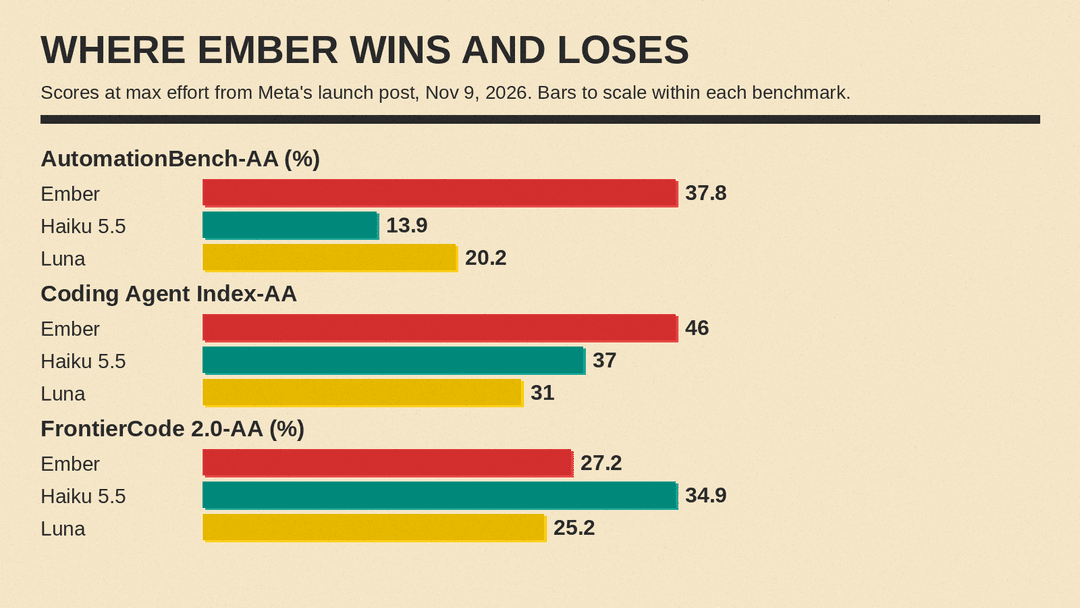
Terminal-Bench 4.0 numbers depend on the setup. Meta's chart uses each model's best published harness and lists Haiku 5.5 at 39.2. Artificial Analysis lists Haiku 5.5 at 32.8% in its own runs, with Ember at 40.9%. On the AA Coding Agent Index, Ember in Muse Code scores 46, Haiku 5.5 in Claude Code 37, and GPT-6 Luna in Codex 31.
simonw ran his pelican SVG test at all six effort levels. The "high" setting did not return a complete SVG, and he wrote that "more reasoning tokens doesn't seem to produce an obviously better SVG." meric_ replied "Wow, minimal seems to be the best here interestingly." small_model replied that "a single SVG is hardly a measure of a models capability."
open-paren believes Ember was the "crouton alpha" stealth model on OpenRouter and, in a follow-up, listed matching context window size, reasoning effort levels, max output size and knowledge cutoff. Meta has not confirmed this.
What to watch
The open questions are about real bills. Cost-per-task figures so far come from benchmark runs, and nobody we found has published numbers for requests above 200K input tokens, where Ember's rates triple. Coding teams will want to see whether the FrontierCode gap matters for subagent work, since that is the one coding score where Ember trails Haiku. Knowledge-heavy users will want to know whether declining 64% of AA-Omniscience questions means fewer errors in practice or just more unanswered prompts. And open-weights fans are waiting to see whether Meta follows Spark Open with a downloadable small model.
Sources
- Meta: Introducing Muse Ember
- Meta: pricing and rate limits
- Artificial Analysis benchmark thread
- Artificial Analysis follow-up on cost
- @alexandr_wang release post
- @ValsAI
- @MikelEcheve
- @naumowf
- @chriscoyoli
- @cryoutloud1234
- @0xMoeCode
- @MrAhmadAwais
- @pidashai
- @OpenRouter
- @vercel_dev
- @jeffrey_check
- @confidencechaos
- @zkToha
- Hacker News thread
- simonw pelican test on HN
- open-paren on crouton alpha
- open-paren follow-up
- minimaxir on cache pricing
