
Meta released Muse Wonder on October 12, 2026, calling it its most capable model and pitching it at personal and professional AI agents. It comes in two versions, Muse Wonder and Muse Wonder Full, sold through two channels: a pay-as-you-go API and a subscription coding tool called Muse Code. This explainer covers what Meta says the models do, what Active Memory is, what they cost, and who can use them today.
What Muse Wonder is
Meta describes Muse Wonder as "Meta's most capable model, built for complex software engineering and long-horizon agentic work" in its model documentation. According to the docs, it plans tasks, delegates to sub-agents, calls tools in parallel, recovers from errors across many steps, and can drive a desktop through computer use. It also handles chat, image, video and audio understanding, tool calling, structured output and search grounding.
The technical basics, per the same page:
- Input: text, image, video, audio and PDF. Output: text.
- Context window: 1,048,576 tokens.
- Reasoning effort: adjustable from "minimal" to "max".
- Status: in preview.
In its launch post, Meta says both models were trained at its gigawatt-scale Prometheus data center and build on the scaling approach it outlined with Muse Spark. The post frames the release as the result of a "ground-up overhaul" of Meta's AI efforts that began fourteen months earlier, and as a step toward what Meta calls "personal superintelligence."
Muse Wonder vs Muse Wonder Full
The two versions differ mainly in where you can get them.
- Muse Wonder (model ID
muse-wonder-1.0) is available on the Meta Model API and in Muse Code, on pay-as-you-go and on every Muse Code subscription plan. - Muse Wonder Full is the higher-capability variant. It is available only in Muse Code, and only on the two top subscription plans. It is not on the API.
The docs add a detail that matters for developers: setting reasoning effort to "max" on Muse Wonder does not select Muse Wonder Full. They are separate models. Meta's developer blog says Muse Wonder "brings comparable performance to Muse Wonder Full."
On benchmarks, Meta claims "state-of-the-art results across key benchmarks for personal and professional agents, memory, and coding," and its model page compares both variants with Claude Fable 5.1, GPT-6 Astra and Claude Opus 5.5. These are Meta's own figures. Independent results will take time, and Meta's full evaluation details sit in its separate report.
What Active Memory and Active Focus mean
Meta pairs the launch with two named capabilities.
Active Memory is Meta's term for "carrying important context about you across conversations and actively retrieving the details relevant to the task at hand," according to the launch post. The post argues that reliable memory is one of the most important steps toward useful agents, because a model needs to remember what matters and recognize when earlier information becomes relevant.
The launch post describes Active Memory as a capability and lists memory among the benchmark areas where Meta claims leading results. It does not explain how users view, edit or delete what the model remembers. That is a practical question for anyone weighing a personal agent, and one to watch as Muse Wonder reaches the consumer Muse app.
Active Focus describes how the model keeps working toward a hard goal: trying other approaches, working through blockers and adapting to new information. Meta says the model asks for clarification when needed and checks in before taking important actions. Meta evaluates this with FocusBench and with SWE-Marathon, which it describes as a test of work on long-running software projects.
The launch post also highlights domain tasks in law, finance and health, citing Harvey's Legal Agent Benchmark (LAB) as one example, and shows demos such as building a running plan in a browser, designing and ordering custom swag from Instagram photos, and making a wedding seating chart.
Muse Wonder pricing
API pricing
On the Meta Model API, Muse Wonder is priced per million tokens, according to Meta's pricing page:
- Input: $4.00
- Cached input: $0.20
- Output: $20.00
Other pricing details from the same page:
- There is no long-context premium. The rate is the same whether the context window is nearly empty or nearly full.
- Web search grounding costs $2.50 per 1,000 search queries, on top of token costs.
- Meta injects a small system prompt and scaffolding into every request, and those tokens are not billed.
- Rate limits for
muse-wonder-1.0are 3,000 requests per minute and 4,000,000 tokens per minute, applied per team rather than per API key.
For comparison within Meta's own lineup, Muse Spark 1.3 in Standard mode is listed at $1.25 input, $0.15 cached input and $4.25 output per million tokens. Muse Wonder costs a little over three times as much for input and a little under five times as much for output.
Muse Code subscription plans
Muse Code is Meta's terminal-based coding agent. Its subscription plans charge a flat monthly rate instead of per token:
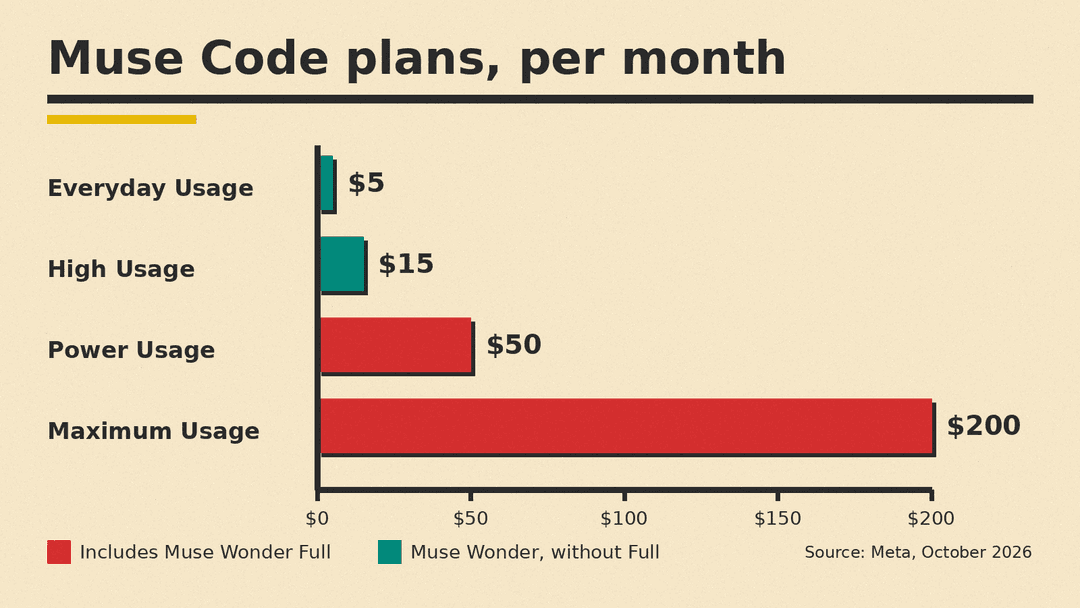
- Everyday Usage, $5 per month: Muse Spark, Muse Wonder and Muse Image, 10 to 50 prompts every 5 hours, voice mode and web search.
- High Usage, $15 per month: 5x the Everyday Usage limit and more multimodal inputs.
- Power Usage, $50 per month: adds Muse Wonder Full, 20x the Everyday Usage limit, early access to new features and higher file uploads.
- Maximum Usage, $200 per month: 80x the Everyday Usage limit. Meta's developer blog says this plan is new with the Muse Wonder launch and has the same five-hour and weekly resets.
A subscription works only through the Muse Code command line tool while signed in with a Meta Model API account. Any other API keys on the account are billed pay-as-you-go. When you hit a plan's limit, you can upgrade or wait for the limit to refresh. On the Maximum Usage plan, waiting is the only option.
Contributor mode: cheaper usage in exchange for your data
Meta offers two modes on some products. In Standard mode, your prompts, code, files, context and the model's responses are not used to train Meta models. In Contributor mode, you get discounted prices or more usage in exchange for letting Meta use that content to train future models, the pricing page says.
For Muse Wonder, the rules differ by channel:
- On the API, Contributor mode is not available for Muse Wonder. API usage is Standard mode only.
- In Muse Code, subscriptions default to Contributor mode. Users can turn it off at any time in settings, after which future content is not used for training unless they turn it back on.
Anyone using a Muse Code subscription for client or company code should check this setting, because the default is on.
Who can use Muse Wonder today
According to Meta's docs and help center:
- Developers on the API can use Muse Wonder now, pay-as-you-go.
- Muse Code subscribers get Muse Wonder on every plan, and Muse Wonder Full on the Power Usage and Maximum Usage plans.
- Age: you must be 18, or the age of majority in your country, to subscribe to Muse Code.
- South Korea: Muse Wonder and Muse Wonder Full are not currently available there, on the API or in Muse Code.
- Consumers: Muse Wonder is not yet in the Muse app. Meta's launch post says it "will soon power experiences in Muse, and will roll out first to subscribers." The post gives no date.
Meta also says it will use Muse Wonder to develop specialized models for everyone using Muse.
Safety claims
Meta says the Muse Wonder family was trained for robustness to adversarial instructions and careful handling of private information, which matters for an agent with access to messages, calendars and documents. The launch post says Muse Wonder offers Meta's strongest safeguards to date against chemical, biological, radiological, nuclear and cyber misuse, while preserving access to frontier cyber capabilities for defensive use under Meta's Superintelligence Scaling Framework. It calls Muse Wonder Meta's "most aligned model to date" and says "a full report with additional safety evaluations will be available soon."
Until that report is out, the safety claims rest on Meta's description alone.
Why it matters for Meta's business
Muse Wonder shows how Meta is now selling its AI. The most capable variant, Muse Wonder Full, is not downloadable and not on the API. It sits behind a $50 or $200 monthly subscription to a Meta coding tool. The standard model is a paid API product priced per token. Meta still publishes open weights in parallel: its docs list Muse Spark Open and Muse Glimmer as open-weight models that run on your own hardware. Its top model, however, is a paid, hosted product.
The pricing structure also shows what Meta wants in return. Contributor mode trades lower cost or higher limits for training data, and it is on by default for subscribers. For developers, that makes the subscription cheaper per unit of work, at the cost of sharing code and prompts unless they opt out.
The consumer side is still ahead. Muse Wonder's pitch is personal agents that remember context and act on your behalf, but the consumer rollout in Muse has no date, and the controls for Active Memory are not yet described in the launch materials. How Meta handles those two points will decide whether the model reaches the billions of people who use its products, which is the stated goal.
Sources
- Meta: Muse Wonder: A Frontier Model For Personal & Professional AI Agents (launch post)
- Meta Model API docs: Models
- Meta Model API docs: Pricing and rate limits
- Meta AI Developer Help Center: What is a Muse Code subscription
- Meta developer blog: Put your ideas to work with Muse Wonder and Muse Wonder Full
- Meta: Muse Wonder model page
