
NVIDIA has published the training-data half of Nemotron 3.5 Parse, the 0.631-billion-parameter document parser it released in October. The follow-up, posted on Hugging Face on November 26, open-sources three synthetic datasets totaling roughly 18.9 million image/annotation pairs, shares the fine-tuning recipe used to build the model, and details a speculative-decoding path that raises parsing throughput by up to 7.62x.
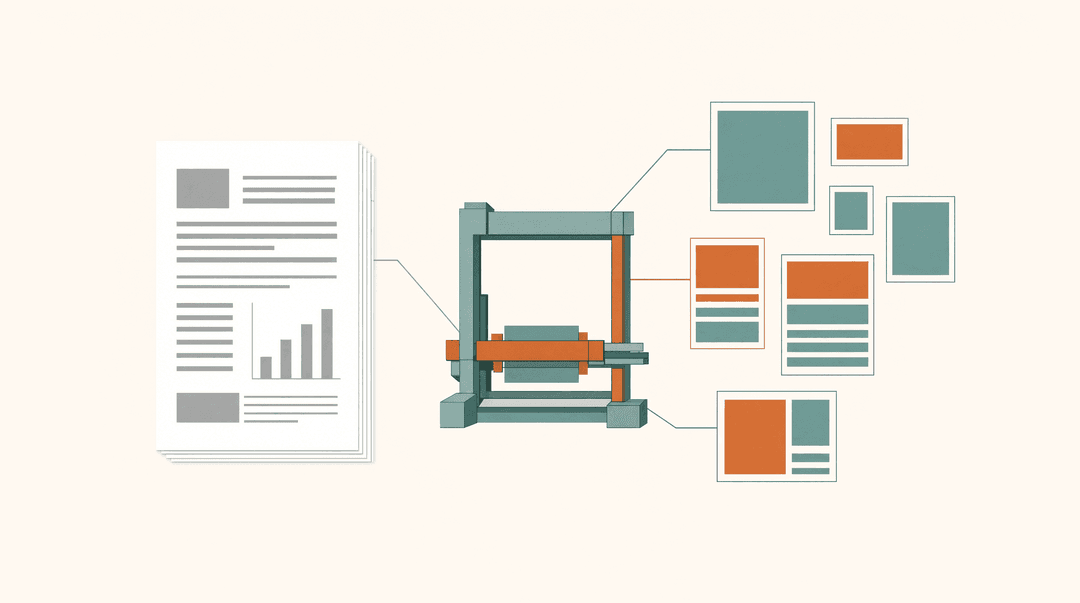
Parse is a narrow tool with a wide blast radius. It turns page images into structured data: text in reading order, semantic classes such as headings, paragraphs, tables and charts, and bounding boxes that locate each block. Tables and charts come out as records that downstream retrieval-augmented generation (RAG) and agent pipelines can query directly. Document parsing sits under most enterprise RAG stacks, and it is one of the few vision-language niches where a sub-billion-parameter specialist competes on accuracy.
What the datasets contain
NVIDIA is releasing three training sets, all in the same format:
- Synthetic Charts V1: 9,980,000 pairs across 998 WebDataset shards, covering bars, lines, scatter plots, areas, pies, matrices and compound charts rendered from 116 library/type combinations drawn from Altair, Chart.js, Matplotlib, pandas, Plotly, Plotnine, Seaborn, scikit-learn and Vega-Lite.
- Synthetic Tables V1: about 1 million pairs of rendered HTML tables with targets that preserve rows, columns, headers and cell relationships.
- OCR Synthetic Multilingual v2: 7,907,809 pairs in 12,686 shards, covering synthetic document pages rendered across 28 scripts with varied fonts, layouts and text directions.
Every record pairs an image with a JSON annotation holding block_boxes, block_classes and block_text in pixel coordinates, aligned block by block. Each dataset ships a generation guide, a streaming reader and a shard manifest with record counts, byte sizes and SHA-256 checksums, so users can read one shard without downloading the full set. The datasets are public and require no authentication to read.
One caveat sits in the fine print. NVIDIA has not assigned a dataset-wide reuse license yet, and says upstream text and asset terms still apply. "Open" here means downloadable and documented, not unencumbered. The model itself carries more definite terms: use of Nemotron 3.5 Parse is governed by NVIDIA's OpenMDW License Agreement v1.1, with the tokenizer under MIT.
Why synthetic, and what it buys
The reason for rendering fake charts and forms instead of scraping real ones is ground truth. NVIDIA renders a chart from known values, then trains the model to reverse the process. That matters on the hard cases: a bar chart with no printed values, where the model infers 18, 27, 39 and 54 from axis positions and bar heights in one published example, or a table where one shifted row changes the meaning of every cell.
The release also documents how the two training phases interact. Supervised fine-tuning (SFT) across text, layout, tables, charts and multilingual pages establishes the capability. Reinforcement learning with verifiable rewards (RLVR), using Group Relative Policy Optimization (GRPO), then scores sampled extractions against rewards for correct series and values, usable structure, and clean completion. Because a difficult page can have several valid representations, the checks allow more than one correct token sequence while discouraging loops and truncated output.
In a matched comparison on development checkpoints, adding GRPO after SFT cut loop-flagged outputs from 126 to 29 pages, about 77 percent fewer, and outputs that hit the 9,000-token generation limit from 185 to 35. Overall score rose from 66.24 to 71.38, including 5.18 points on tables and 4.15 on charts. NVIDIA notes these are internal checkpoints, separate from the released model.
The speed work, which is the other half of the story
A parser emits a lot of tokens per page, so throughput is a cost story. Parse 3.5 moved from a fixed 2048x1664 input canvas to dynamic rectangular NaViT inputs, replaced encoder-decoder cross-attention with compressed visual tokens fed to the decoder as a causal prefix, and switched the decoder to grouped-query attention with 16 query heads and 8 key/value heads to shrink the attention cache. The model combines a C-RADIOv4-SO400M vision encoder with a 10-layer mBART decoder.
On top of that, an 89.3M-parameter DFlash2 drafter proposes up to 32 tokens ahead, and the target model verifies them in one step, averaging about 14 accepted draft tokens per verification. Measured on a single H200 in BF16 across 2,078 pages, DFlash2 delivered 7.62x throughput at concurrency 1 against speculation disabled. At concurrency 512, Parse 3.5 reached 20.44 pages per second with DFlash2 versus 13.48 without speculation and 2.98 for Parse 2.0, which is 6.86x and 4.53x the older model respectively.
Accuracy claims are tied to that speed budget. The model card reports 75.20 on ParseBench with triple-pass parsing, the highest overall score among systems in NVIDIA's reported comparison. Multi-pass parsing is the explicit throughput-for-accuracy dial: a single full-page pass, a second pass that re-crops table and chart regions at higher detail, and a third pass that runs the model in detection mode to verify nothing was missed. Double and triple pass add 2.18 and 2.46 ParseBench points over single pass.
The recipe, and who is already forking
The published fine-tuning recipe walks through paired-data generation, NeMo Automodel SFT and NeMo RL GRPO with vLLM generating candidate answers. The worked example is a synthetic dental form with an odontogram: the base model transcribed tooth numbers but missed the procedure table, while after SFT it matched all six chart rows. Sampled pass@1 on 256 held-out forms, with eight samples per page, went from 0.00 percent for the base model to 95.85 percent after SFT and 96.58 percent after RLVR. Adapting it to another document type means supplying image and label pairs plus a verifier. NVIDIA ships reward components for text fidelity, bounding boxes, tables, chart facts and completion.
Community adaptations are already listed on the blog: Thai, Persian and Arabic OCR models built on Parse. The model has logged 27,130 downloads on Hugging Face in the past month.
The strategic read is that NVIDIA is not just shipping a parser. It is shipping the data pipeline, the reward design and the serving stack that let someone else build a parser for their own forms, in their own language, on one GPU. Whether the licensing gap on the datasets gets filled will decide how far that offer actually reaches.
Sources
- Building on Nemotron 3.5 Parse: Open Data, Fine-Tuning, and Faster Inference (NVIDIA on Hugging Face, Nov 26, 2026)
- nvidia/Nemotron-3.5-Parse model card
- nvidia/Synthetic-Charts-V1 dataset
- nvidia/Synthetic-Tables-V1 dataset
- nvidia/OCR-Synthetic-Multilingual-v2 dataset
- Parse fine-tuning recipe (NVIDIA-NeMo/Nemotron docs)
