
Z.ai released GLM-5.4 on 23 November, the first commercial flagship built on a Loop Transformer architecture: a group of 28 weight-shared layers from the GLM-5 base model, executed twice per forward pass. The company says the model reaches "intelligence levels comparable to 2T-3T parameter models" while carrying roughly 750 billion parameters.
The claim is Z.ai's own. There is no model card, no published benchmark table and no API rate card as of launch day, a pattern the company has broken from its otherwise documentation-heavy GLM-5.x releases.
How the loop works
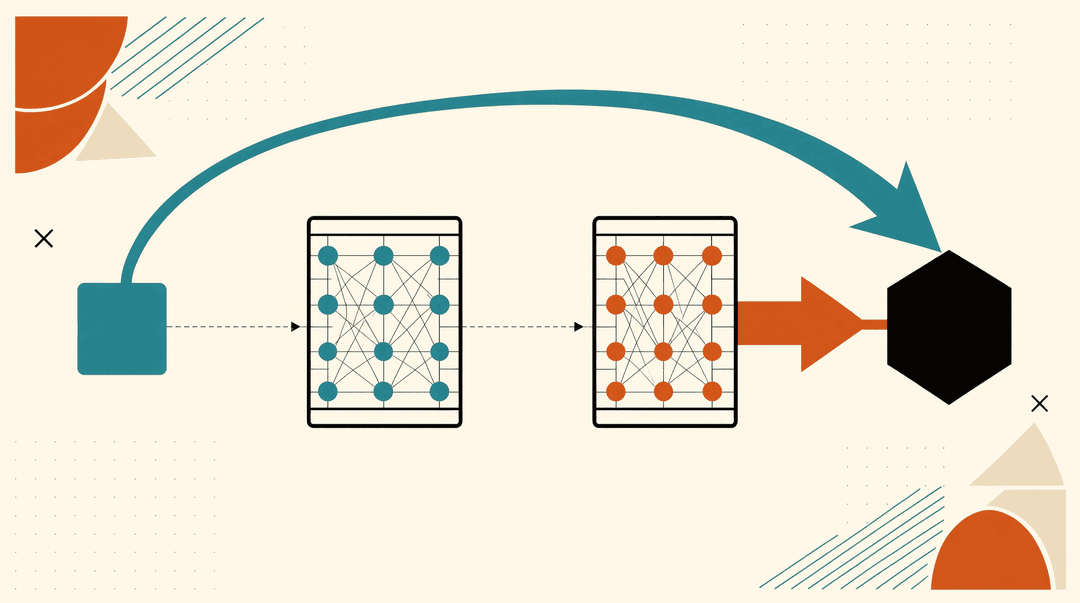
In a standard Transformer each layer runs once per forward pass. GLM-5.4 runs one block of layers for two iterations, refining the hidden states from the first pass before handing them downstream. Depth grows; parameter count does not.
The idea traces back to the 2018 Universal Transformer and more recent recurrent-depth work. What those lines of research also found is uncomfortable for a flagship vendor: looped models trained from scratch lag behind unshared models at the same pre-training compute budget. Z.ai sidestepped that by converting an already pre-trained GLM-5 base into a Loop Transformer through continued training, which the company describes as raising the intelligence ceiling at a relatively small compute overhead.
Three engineering changes make the loop deployable at 750B scale:
- Gated progressive updates. Independent per-token gates control how much of each iteration's candidate update writes into the residual stream. A naive overwrite blows up activation norms across passes. After training, the first pass writes conservatively to build global context; the second opens the gates for fuller refinement, with step sizes that adapt to token difficulty.
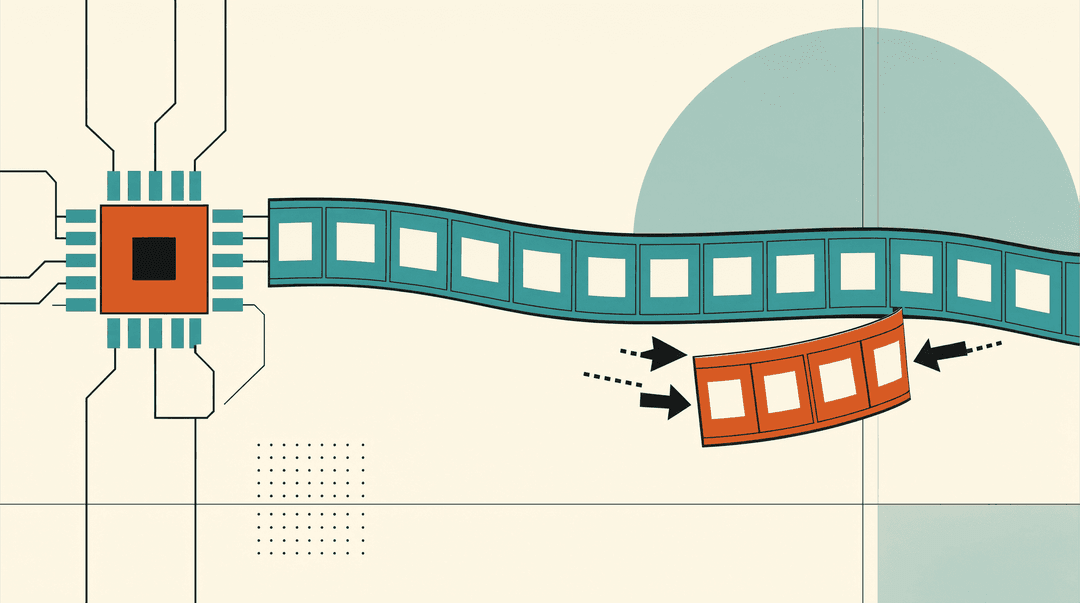
- Hybrid KV cache. The second loop reuses the sparse KV entries selected in the first and keeps only newly generated entries in a local sliding window. An extra loop costs one window of cache rather than a second full-context cache, which is what keeps the 1M-token context economically viable relative to GLM-5.3.
- Sparse attention index reuse. The second pass reuses the first pass's attention indices, adding zero indexing overhead and performing nearly identically to recomputing them.
What Z.ai measured
The company validated the architecture on 1B, 4B and 30B bases before committing the flagship. The headline ablation is a 30B iso-parameter comparison: identical parameters, about 10% more total training compute for the looped version, evaluated after 200K long-context SFT with thinking enabled. Z.ai reports the largest gains in math, scientific reasoning and long-context tasks, and average output lengths 10-14% shorter across most benchmarks, with part of the reasoning shifted from explicit chain-of-thought tokens into the loop's internal depth.
Reported inference throughput is up to 200 tokens/s off-peak and 70-80 tokens/s at peak load. The acknowledged flaw: the model falls into "marathon thinking" loops, extended internal reflection that Z.ai says usually improves accuracy beyond the parameter count but not always promptly.
Availability at launch is limited to the Coding Plan subscription (model name glm-5.4), Z.ai Chat and the ZCode desktop agent. OrcaRouter notes the plan-side changes: image input added to the flagship line, which GLM-5.3 lacked, and a 50% weekly quota increase at unchanged prices. The API is listed as "coming soon," weights are promised "responsibly, after safety hardening," and the 1M context figure is a tag in the Coding Plan interface sourced from Chinese press rather than a documentation page.
The predecessor is a caution on cost-per-task. GLM-5.3 defaults to maximum reasoning effort and, on Artificial Analysis's evaluator, ran roughly $5.01 per Intelligence Index task despite a $1.40/$4.40 rate card, more per task than Grok 4.7's measured $3.74. A subscription that hides token counts makes the same arithmetic impossible to check for GLM-5.4 until someone outside Z.ai runs the suite.
Z.ai closed the post by saying it is pursuing both loop depth and model size at once: "our next, significantly larger model will carry forward everything we learned here. It will be ready soon."
