
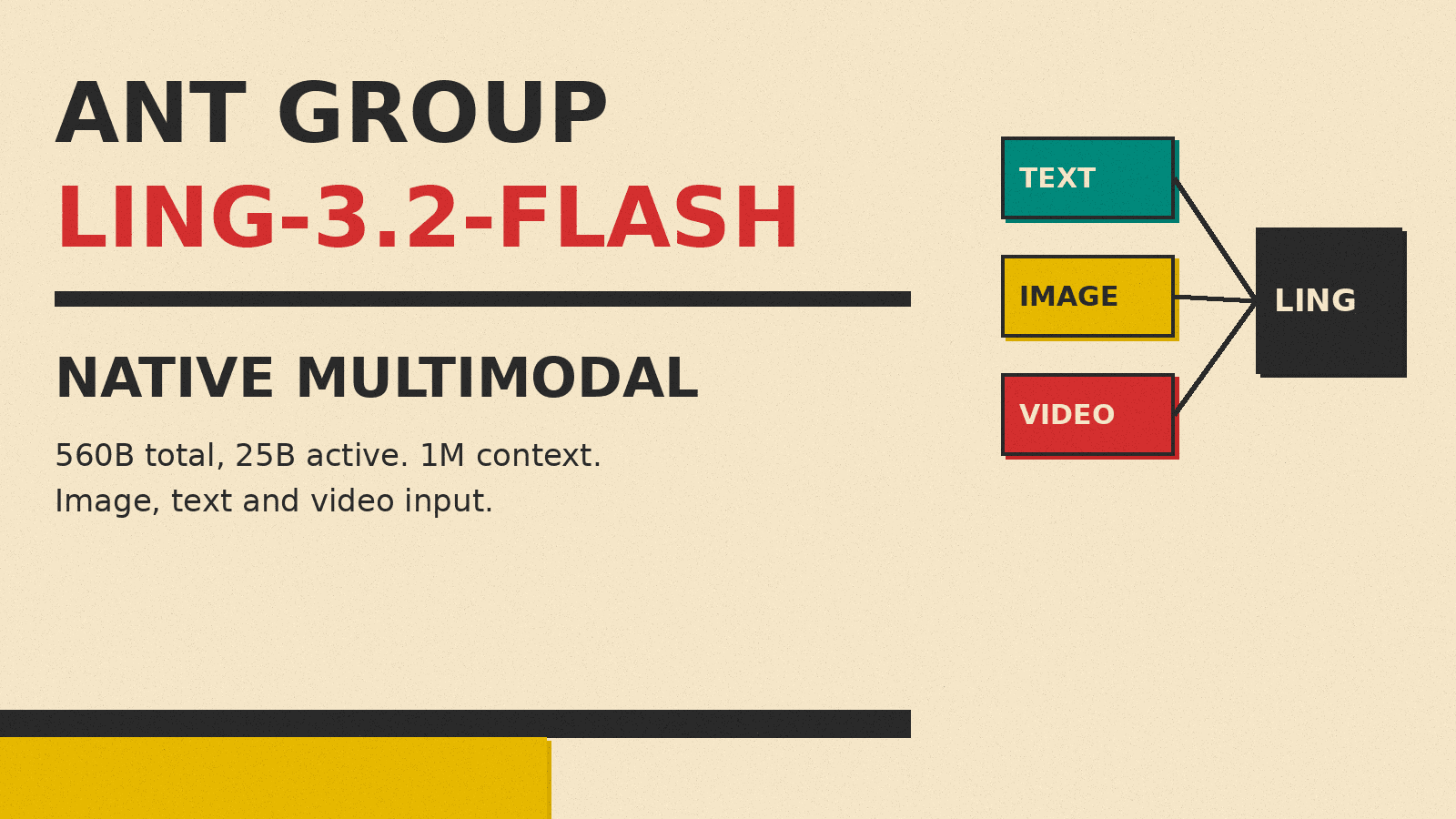
Ant Group's Ling team has added a native multimodal model to its API. Ling-3.2-flash takes image, text and video input, has 560B total parameters with 25B active, and has a context window capped at 1M tokens, according to Ant Ling's developer documentation. The Ant Ling changelog dates the launch to November 5, 2026, and says the model is free for the first two weeks after launch.
As of November 8, the model is an API and chat release. The inclusionAI organization on Hugging Face, where Ant posts its open Ling models, had no Ling-3.2-flash repository when we checked on November 8; its newest uploads were dated October 30.
What Ant released
The Ling model page describes Ling-3.2-flash as "the latest-generation native multimodal model in the Ling series." Ant says it "fuses vision and language capabilities at the architectural level" and does not rely on "external vision modules."
Ant lists four focus areas for the model:
- complex visual understanding
- multimodal long-horizon Agent
- 3D understanding & interaction
- medical multimodal
For the medical area, the documentation says the model handles "medical imaging understanding and report interpretation, assisting professional medical analysis." Ant does not describe it as a clinical tool, and the page gives no medical test results.
Access is through Ant Ling's chat interface and an API that the changelog says is "compatible with both OpenAI and Anthropic protocols." Ant has not posted an end date for the free period. Two weeks from November 5 is November 19.
Ant's benchmark claims
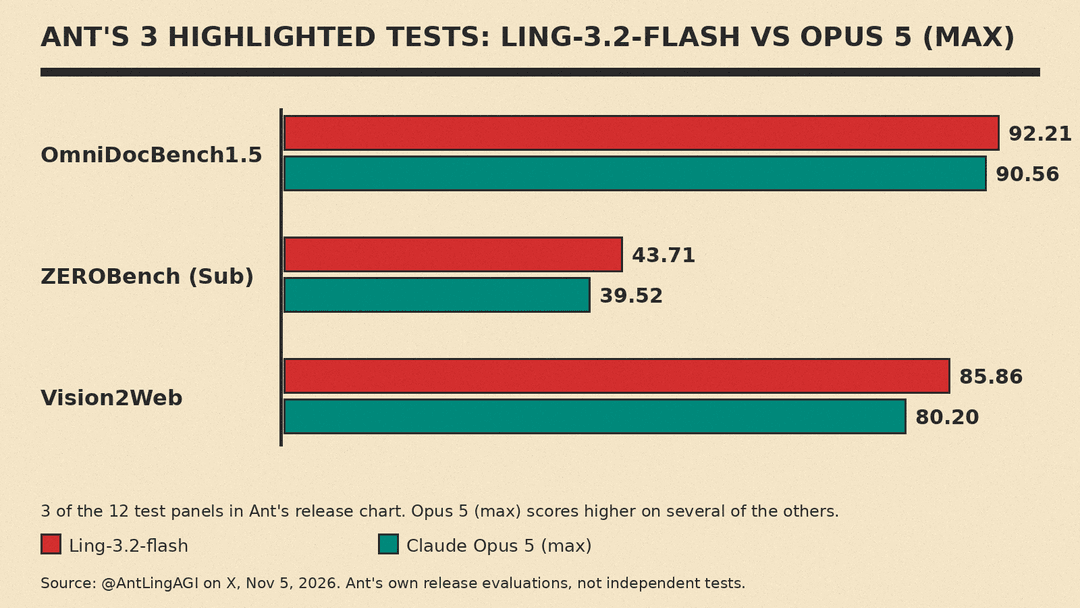
In its launch post on X on November 5, Ant Ling said the model "Outscores Opus 5 (max) in release evaluations" and listed three results:
- OmniDocBench1.5: 92.21 vs 90.56
- ZEROBench(Sub): 43.71 vs 39.52
- Vision2Web: 85.86 vs 80.20
These are Ant's own numbers from its release evaluations, published November 5, 2026. The chart attached to the post has 12 test panels and compares Ling-3.2-flash with five rival models, including Opus 5 (max). The three results above are where Ling-3.2-flash led. On the same chart, Opus 5 (max) scores higher on several other tests, including Humanity's Last Exam-MM (42.69 vs 30.12), AndroidWorld (90.09 vs 85.63), BlenderBench (79.44 vs 67.77) and the full ZEROBench set (26.00 vs 18.00). The chart has no text-only or coding tests. Ant did not post a technical report, and we found no independent run of these tests.
IT Home, a Chinese tech outlet, reported on November 6 that the model entered the top ten of the DesignArena image-to-frontend arena with an Elo score of 1238. IT Home also reported an API price of US$0.30 per million input tokens and US$0.90 per million output tokens. Ant Ling's pricing page lists no Ling-3.2-flash rate as of November 8. It says only that the model is free for the first two weeks and that original prices will resume after the promotional period. Treat the IT Home figures as IT Home's report until Ant publishes a rate card.
How it fits the Ling lineup
Ling-3.2-flash has the same size as Ling-3.1-flash, the text model that Ant updated in October and released as open weights. Both list 560B total and 25B active parameters with a 1M context cap in Ant's model selection guide. The new model adds image and video input.
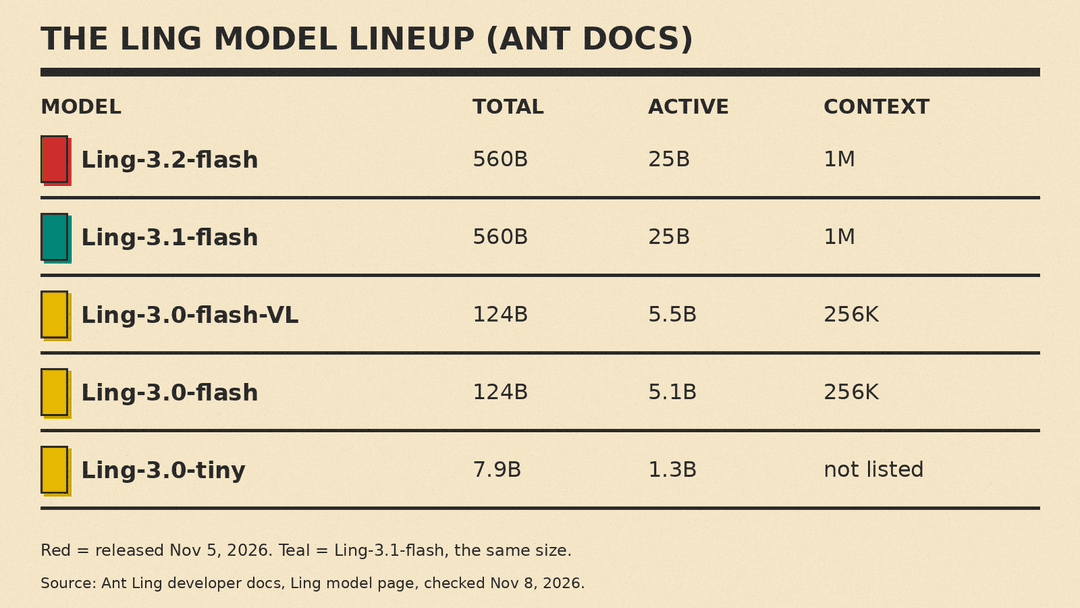
Ant's earlier multimodal model, Ling-3.0-flash-VL, is much smaller: 124B total and 5.5B active, with a 256K context window. Ant's documentation says that model "is now open-sourced on Hugging Face and ModelScope," and its Hugging Face repository lists the MIT license.
The 560B and 25B figures describe a mixture-of-experts (MoE) model. In an MoE model, each token runs through only some of the parameters. Ant's page puts it this way: the model "retains 560B model capacity while keeping per-step activation at around 25B."
Demos Ant showed
Ant's launch thread on X paired the benchmark claims with demos. Ant said the model:
- "coordinates specialist agents using shared context" to turn Q2 financial data into a report, a six-slide board deck and a highlights video
- "operates Blender through UI actions and parameter changes"
- "reads research PDFs, including equations and diagrams, and implements the algorithms in working code"
- identifies ingredients in meal photos and "uses nutrition data to estimate calories and nutrient balance"
These are vendor demos. Ant has not published success rates for them.
Why it matters
Ant now offers a model in the same 560B and 25B class as its text flagship, with image and video input and a 1M token cap. Ant highlighted three vision tests where its model beat Anthropic's Claude Opus 5 (max), and it made the model free for two weeks. The launch landed the same week as other Chinese releases: Baidu released ERNIE 5.5 Flash Base weights on November 5, the same day.
Two things are still open. First, whether Ant will release Ling-3.2-flash weights, as it did for Ling-3.1-flash and Ling-3.0-flash-VL. Ant has not said. Second, what the model will cost after the free period on Ant's own pricing page. For background on Ant and the other Chinese labs, see our guide to China's AI labs.
Sources
- Ant Ling developer docs: Ling model page
- Ant Ling developer docs: changelog, November 5, 2026 entry
- Ant Ling developer docs: pricing page (checked November 8, 2026)
- Ant Ling (@AntLingAGI) launch post on X, November 5, 2026
- Ant Ling demo post on X (multi-agent)
- Ant Ling demo post on X (Blender and frontend)
- Ant Ling demo post on X (PDFs)
- Ant Ling demo post on X (meal photos)
- IT Home: Ling 3.2 Flash launch report, November 6, 2026 (Chinese)
- inclusionAI on Hugging Face
- Ling-3.0-flash-VL on Hugging Face
