
Google is opening the doors of the Gemini app and Search to outside developers. On October 28, Google launched a preview of its Connected Apps Platform, which it describes as "a single place to build and manage apps for Search and the Gemini app." Google calls it "a unified way for more app developers" to bring their features into Gemini and Search, and its developer site says the preview offers self-service onboarding through a new console.
Google also announced a new batch of partner integrations, including Adobe, Calm and Peloton.
What Connected Apps are
Connected Apps let a user link a third-party service to Google's AI products and then ask for things in plain language. Google's examples run "from ordering groceries to making playlists." TechCrunch gives two more: connect Canva to design a flyer, or YouTube Music to build a playlist.
The developer site explains the model. A user links an app once. After that, they "can access their data and take actions in your service seamlessly from applicable Google products." Google calls this "enable once and run Google-wide."
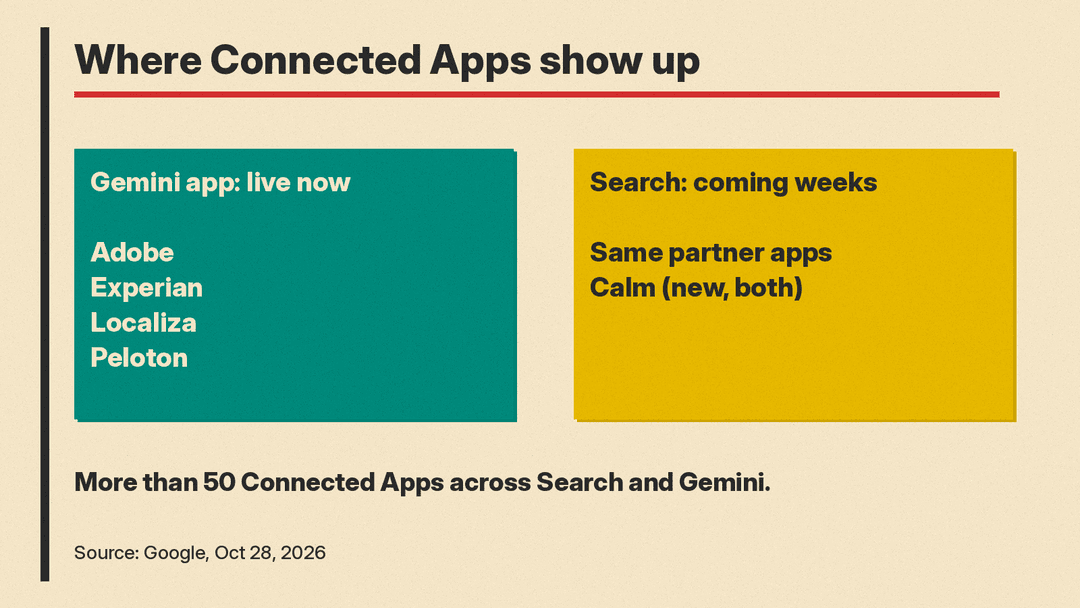
According to Google's post, there are now more than 50 Connected Apps across Search and Gemini, in areas from productivity and event ticketing to health and fitness.
How developers build one
Google's platform supports two ways to plug in. Both are built on MCP (Model Context Protocol), an open standard for connecting AI assistants to outside tools and data.
- Cloud-hosted MCP server. The developer runs a remote MCP server that exposes tools and authorized data. Google's docs point to an OAuth 2.1 guide for letting Gemini act on a user's behalf, and say developers can build richer interactive screens with MCP Apps.
- Android MCP through AppFunctions. This path runs on the phone. Android's AppFunctions API lets an app act like an on-device MCP server, so Gemini can trigger features inside the app. Google says it suits apps that want tool execution to "happen locally on an Android device." AppFunctions needs Android 16 or higher. Google's October 28 Android developer keynote says AppFunctions is now in beta, but the AppFunctions overview page still calls it an experimental preview that is "subject to change."
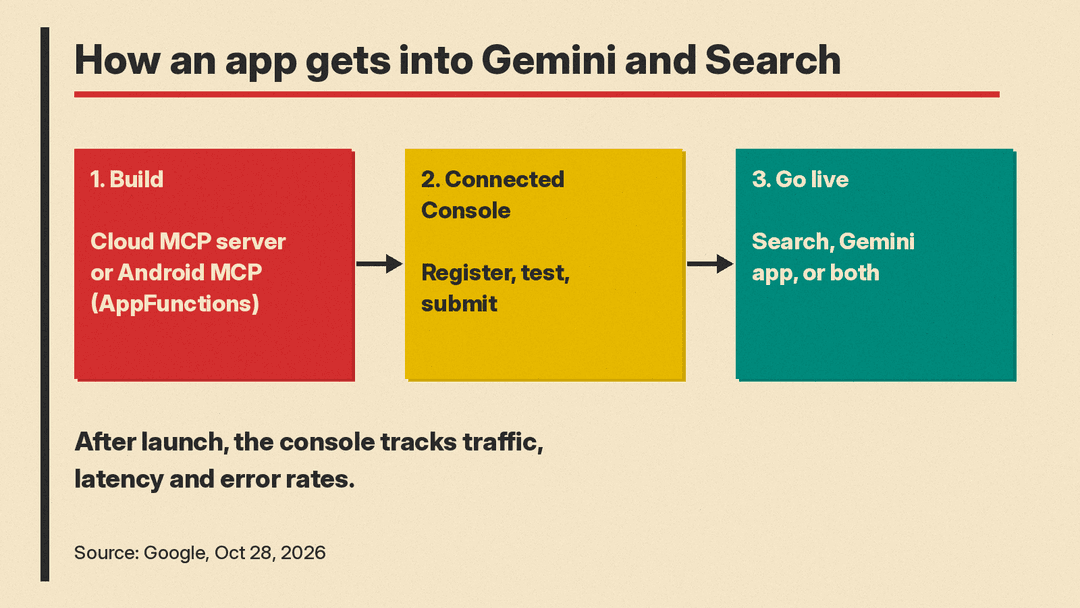
After building the integration, developers use a new tool called Google Connected Console to register, test and submit the app. Before review, they pick where it goes live: Search, the Gemini app, or both. Once it is live, the console shows traffic, latency and error rates. Google says developers also keep control of their brand identity, "including verified logos and authenticated accounts."
The Android path works a bit differently. Per Android's setup guide, an Android MCP connected app has no separate publish button. Google reviews the connected app version, and it goes live when the developer releases the Play app version that contains it to production.
Who can join, and when
Access is limited for now. Google says it is "opening access in phases" and will add "more developers, markets, and Google products over the coming months." Developers sign up for the preview at developers.google.com/connected-apps.
Two outlets reported a US-only start. The Verge said US developers can join "the public beta waitlist starting today." TechCrunch reported that Google did not say when the platform would open more broadly.
What changes for users
Partner apps from Adobe, Experian, Localiza and Peloton are live in Gemini now, according to Google. The company says it will bring these Connected Apps to Search "in the coming weeks." Google also says it will launch a new Calm integration across both Search and Gemini.
TechCrunch noted that Search has fewer integrations today than Gemini, listing Instacart, Canva, YouTube Music and Yahoo Fantasy Football. Gemini also connects to Google's own services, such as Workspace, Photos, YouTube Music and Google Home.
Google's Search help page lists the Connected Apps available in AI Mode and says the feature works in the US, in English. The Gemini help page lists the apps for the Gemini app and says availability varies by location, language and device.
Why it matters
TechCrunch framed the launch as part of a bigger bet: that integrations like these could shift people away from opening individual apps and toward using their favorite services through their preferred AI assistant. It noted that ChatGPT and Meta's Muse have their own takes on the idea, and that to keep users' attention, "there have to actually be a wide range of connected apps to explore."
For businesses, the more practical point is reach. One integration can now show up in two of Google's biggest products. TechCrunch compared it to SEO: just as companies once worked to rank in search results, connected apps "could well be one of the initial steps for businesses that want their services to be more visible to users on the agentic web."
The choice of MCP also matters. Because Google uses an open protocol rather than a custom one, developers who already run an MCP server may be able to reuse that work. We saw a similar move when Apple added MCP support to Creator Studio. Google has also been changing how answers link out to sites, as covered in our look at Google AI Mode link changes.
Some things are still unknown. Google has not said how apps will be ranked or surfaced when several could answer the same request, and has not given a date for wider access. Its Connected Apps Policy lists rules apps must meet, such as no third-party ads and no copies of other Connected Apps without added value, and says Google can reject an app at submission. The Android path also depends on AppFunctions, which Google's keynote calls beta while its developer docs still call it an experimental preview.
For developers already using Gemini through code, our explainer on the Gemini API CLI covers another recent Google developer tool.
The same day, Google made Bring Your Own Agent stable in Android Studio Rabbit 2, so developers can use over 40 outside coding agents, including Claude Agent and Codex, inside the IDE.
Sources
- Google: Build and manage Connected Apps in one place
- Google for Developers: Connected Apps Platform
- Android Developers: Overview of AppFunctions
- Android Developers Blog: Agentic and Flexible: A next era of Android development
- Android Developers: Create and manage Connected Apps in Google Connected Console
- Google for Developers: Connected Apps Policy
- Google Search Help: Use and manage Connected Apps in Search
- Gemini Apps Help: Connected Apps in Gemini Apps
- TechCrunch: As AI agents reshape the web, Google opens Gemini and Search to more apps
- The Verge: Google will let more developers make apps that plug into Search and Gemini
