
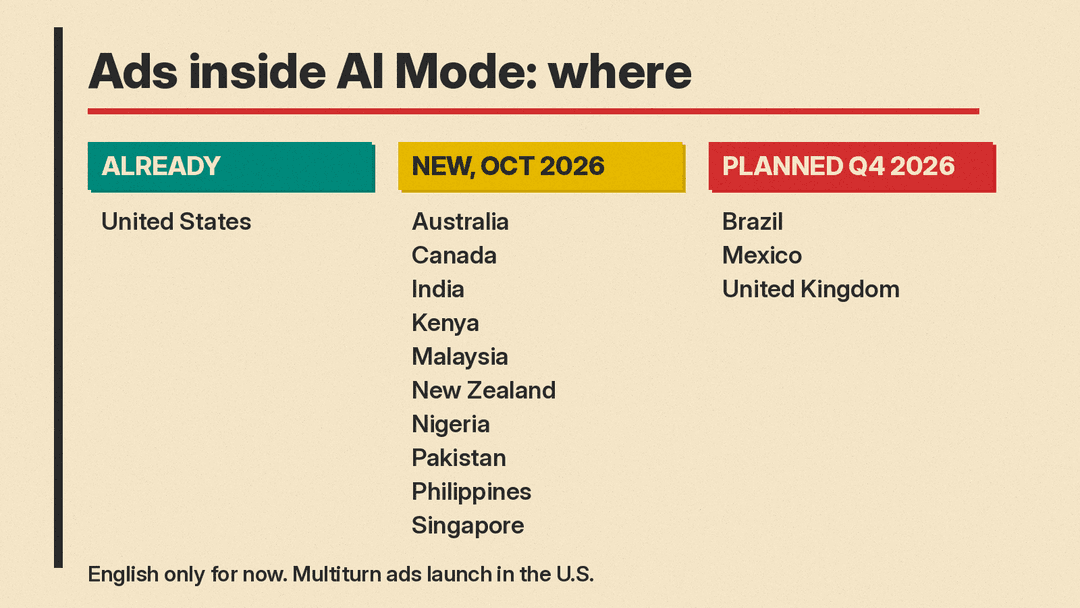
Google is taking ads in AI Mode, its chatbot-style search tab, beyond the United States. In a post on Google's Ads and Commerce blog on October 28, Shashi Thakur, VP and GM of Google Search Ads and Ads on Google Experiences, said the company is now "scaling ads in AI Mode" in 10 countries: Australia, Canada, India, Kenya, Malaysia, New Zealand, Nigeria, Pakistan, the Philippines and Singapore. Brazil, Mexico and the United Kingdom are next on the list, with Google saying it plans to expand to "additional locales" including those three in Q4 2026.
The same post adds a second change for U.S. users: multiturn ads. Google says it is launching multiturn ads "to allow ads in follow-up queries in AI Mode." In practice, a sponsored listing can appear later in a conversation, not only next to the first answer.
What changes for people who search
If you use AI Mode in one of the 10 countries, you may start to see sponsored text ads and Shopping ads inside or next to AI answers. Google says every one of these ads is labeled "Sponsored." Its Google Ads help page on AI-powered experiences says the ads are "visually distinguished from organic content" and that "paid advertising does not influence the organic responses generated by Google AI."
The help page also says an ad can sit above an AI Overview and inside it on the same search, but not inside it and directly below it. Standard Search ads above and below AI Overviews already run in all of the 200+ countries and territories where AI Overviews are available. The newer part is ads placed within the AI answer itself.
Two other details matter for readers:
- AI explainers. Some ad placements come with a short note written by Gemini that explains how an ad relates to your question. Google says advertisers "can't manually write, edit, approve, or opt out of" these notes. In some cases a plain header such as "You might consider these options" appears instead.
- Language. The help page lists English as the only language for ads inside AI Overviews and AI Mode, and says Google plans to add more languages over time.
We covered how Google already changed the way links show up in AI Mode in our explainer on AI Mode link changes. Ads now join those links in the same answers.
Why Google is doing this now
Google's pitch is that AI Mode queries are different. Thakur wrote that queries in AI Mode are "on average, three times longer than traditional searches," citing a Google AI Mode Report from the U.S. in May 2026. He also said click-through rates are "already similar between sponsored and organic product list items within AI Mode," based on Google internal U.S. data from August 20 to September 3, 2026. Both figures are Google's own and have no outside check.
The timing lines up with Alphabet's Q3 results. In his Q3 2026 earnings remarks, Sundar Pichai repeated the "three times longer" figure and added that "one in five AI Mode searches globally use voice, images, or documents." He also said Google is "building one seamless experience across AI Overviews, AI Mode, and traditional Search." Read together, the two posts show Google treating AI Mode as part of Search, with the same ad business attached.
What changes for advertisers
The help page is clear that there is no separate product to buy:
- Existing Search, Shopping and Performance Max campaigns are "automatically eligible" to serve ads in AI Overviews and AI Mode. No new campaign or budget is needed.
- Billing uses the same auction and the same cost-per-click or conversion-based bidding as standard Search ads. Google says there is no extra charge to take part.
- Advertisers cannot target only AI Overviews or AI Mode, and cannot opt out of them separately from Search. Negative keywords and brand exclusions still apply.
- Results are mixed into standard reports. Clicks, impressions and conversions from AI placements are "included in aggregate" in campaign and search terms reports, not broken out on their own.
How an ad gets matched depends on the keyword type. Google describes two paths: direct matching, when the query already says what the person wants to buy, and contextual matching, when commercial intent shows up in the AI answer to a broader question. Google's example is a question about a green pool, where the AI answer mentions vacuuming, so ads for pool vacuums can appear. Exact and phrase match keywords only qualify for the direct path. Broad match, AI Max for Search, Shopping and Performance Max can use both.
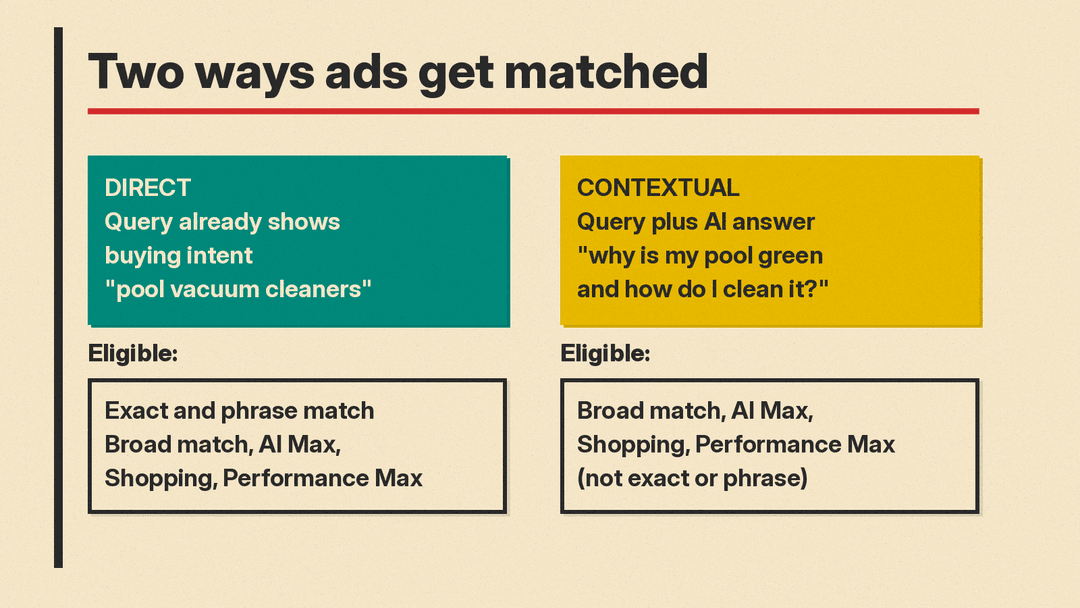
That split is the practical takeaway for marketers. Per the help page, exact and phrase match keywords "aren't eligible for contextual matching on broader exploratory questions," which is the kind of long query Google says AI Mode attracts. Google's own best-practice list recommends AI Max, broad match and Smart Bidding, which leave more of the matching and bidding to Google AI.
What to watch
The rollout is staged. Google says it will "continue testing new formats," and the help page says the visual layout "may evolve over time." The country list on the help page notes that Indonesia gets ads in AI Overviews only, and Pakistan gets text ads only, so the 10-country headline hides some limits.
Ads in AI Mode also connect to other recent Google changes. Earlier this week we explained how Google's privacy policy now lets connected Gmail and Photos data shape ads, and on October 28 Google opened Gemini and Search to more developer apps. Together they show Google turning AI answers into a place where businesses, both paid and unpaid, can reach people.
