
Ask Google's AI Mode "Who won the 2020 presidential election?" from the United States this week and you may not get a name. Several newsrooms reported on October 28 that the AI search tool sent them to the Federal Election Commission instead of saying Joe Biden won. Google says it found a "technical gap" and is fixing it, along with a similar problem for 2022 Senate races.
The timing matters. The 2026 U.S. midterm elections are on November 3, and Google has spent the fall promoting AI Mode and the Gemini app as places to find reliable election information.
What people saw
Ars Technica asked AI Mode the question directly on the morning of October 28, after seeing complaints on social media. The answer it got was:
"To review the official results and statistics of the 2020 United States presidential election, including the final electoral college breakdown, popular vote counts, and winner certification, please consult the official report compiled by the Federal Election Commission (FEC)."
Fast Company got a near-identical reply, and a similar one when it asked whether the 2020 election was stolen. It reported that AI Mode named Donald Trump as the winner of the 2016 and 2024 elections without hesitation. One U.S.-based Fast Company staffer needed eight attempts before AI Mode said Biden won.
The results were not the same for everyone:
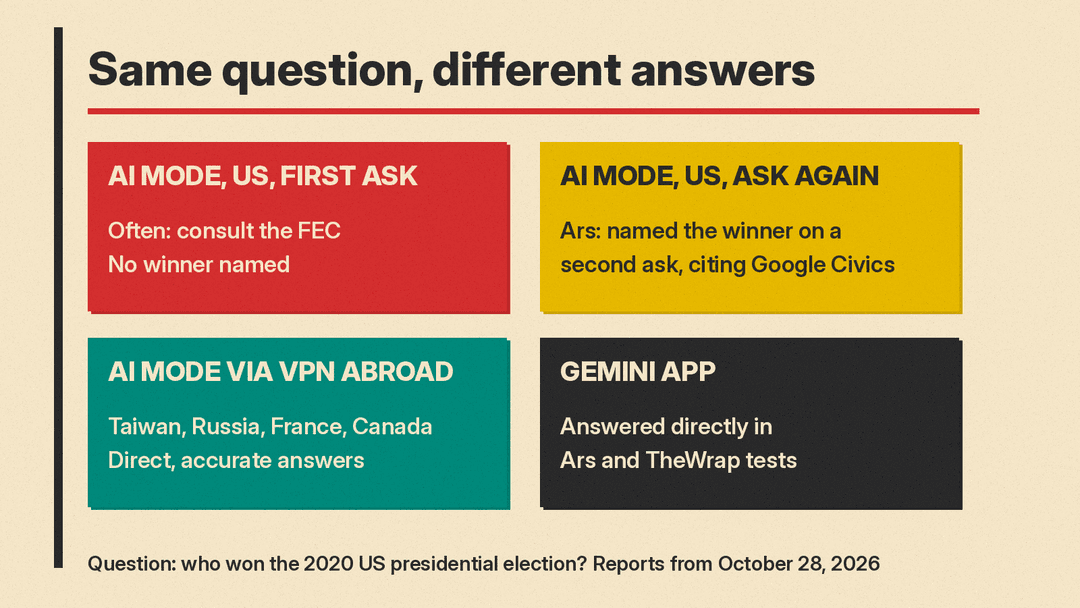
- Ars Technica's reporter got the same indirect answer for the 2024 election and a link to The American Presidency Project for 2012, but direct answers for every other presidential election back to 2000. Another Ars staffer got direct answers only for 2016 and 2024.
- Ars also found that when its reporter asked again, AI Mode named the winner for all three elections it had first answered with only a link, citing Google Civics data.
- Business Insider said AI Mode gave one of its reporters the FEC reply, while other reporters who asked similar questions were sometimes told Biden won.
- The Verge said a few of its staff could not recreate the problem.
- TheWrap said AI Mode pointed it to the National Archives and the FEC, while the Gemini app named Biden and gave the electoral and popular vote totals.
It looked different outside the US
The clearest pattern in the reporting is location. Ars Technica ran spot checks over a VPN from Taiwan, Russia, France and Canada, and all of them got accurate, direct answers about recent U.S. election results. Fast Company's headline makes the same point: abroad, AI Mode readily says Biden won.
That suggests the evasive answer came from rules applied to U.S. election queries, not from the model lacking the fact. Google's own Gemini app answered the question in tests by Ars and TheWrap.
What Google says
A Google spokesperson first pointed reporters to a reply on Bluesky. The News from Google account wrote: "Thanks for flagging -- the Gemini app answers this question more fully but this isn't the most helpful response on Search. We're looking into this and working to address it."
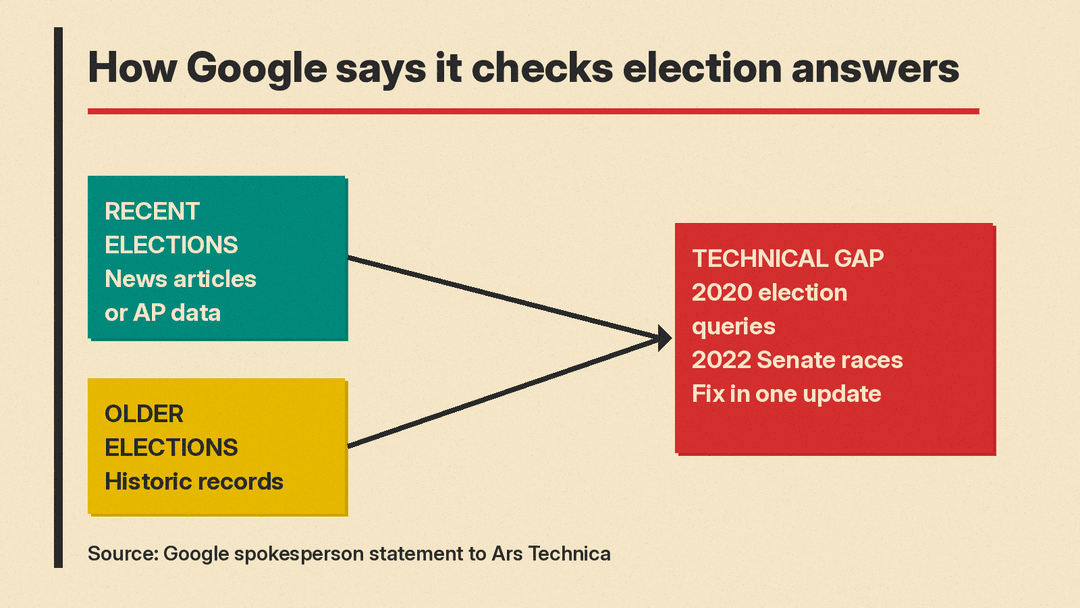
Later, the same spokesperson told Ars Technica the company was "fixing the issue with 2020 election queries in AI Mode." The spokesperson explained: "Our systems verify election responses using news articles or AP data for recent elections, and historic records for older ones." According to the statement, "There was a technical gap with 2020," and the same is true for 2022 Senate races, "which we're working to fix in the same update."
Google did not give a date for the fix in that statement.
Why AI Mode said it held back
When reporters asked AI Mode why it dodged, it explained itself, but those explanations are not reliable evidence. Ars Technica says AI Mode blamed "safety filters for recent and highly sensitive election topics [that] are very strict." Fast Company says AI Mode told its staffer it was "over-correcting" and described "an evasive loop that felt defensive or politically motivated when it was actually a failure in how the model balanced strict caution with helpfulness."
Ars notes that AI models have proven unreliable at reporting on their own internal processes. Google's spokesperson statement, which describes a verification step with a gap for certain races, is the better guide to what actually broke.
Why it matters
Google's September post on the 2026 midterms said it would "highlight official resources" and roll out election tools across Search, "including in AI Mode and AI Overviews, and in the Gemini app," with real-time voting results from The Associated Press. Sending users to an official source is a reasonable default. Refusing to state a certified result that Google's own chatbot will state is a different thing, and it lands days before an election.
This is also not the first time. TheWrap points out that WIRED reported in June 2024 that Gemini itself refused to name the 2020 winner under Google's election restrictions at the time.
The episode shows a wider problem with AI answers in search. The same question can produce different answers depending on where you are, who you are, and whether you ask twice. That makes it hard for anyone to check what Google's AI is telling people. We covered other recent AI Mode changes in Google Ads in AI Mode Expand to 10 New Countries and Google's AI Mode link changes. For how another lab is handling the midterms, see OpenAI's election image safeguard.
What to watch
- Whether AI Mode gives a direct answer on 2020 and the 2022 Senate races once Google's update lands.
- Whether Google says when the fix shipped, and whether other races were affected.
- How AI Mode handles results questions on and after November 3.
Sources
- Ars Technica: Google AI gets cagey when asked who won the 2020 elections
- Fast Company: Google's AI Mode won't say Biden won the 2020 election in the U.S.
- Business Insider: Google is aware its AI sometimes won't say who won the 2020 election
- The Verge: Google is "looking into" a vague AI search response
- TheWrap: Google's AI Mode won't say who won 2020 election, but Gemini will
- News from Google on Bluesky
- Google: How Google is supporting the 2026 U.S. midterm elections
