
Google released the Gemini Decisions API on November 11, 2026. The post is titled Gemini Decisions API: Fast, calibrated multimodal decisions, written by Min Choi, Product Manager, Google DeepMind, and Felix Yu, Principal Scientist, Google DeepMind. The Gemini API Release notes listed Gemini Decision 1 (gemini-decision-1) and the Decisions API as released.
The API does not write an answer in words. Google says it scores a fixed set of choices and returns probabilities and a confidence score. A developer sends one shared input and up to 1,000 questions, then uses those numbers in code.
What the Decisions API does
Google built the endpoint for closed-set decisions such as tool selection, policy checks, model routing, and context grading. Google's Gemini Decision page says the model evaluates typed questions over text, images, video, audio, and PDFs in a single prefill pass, and returns calibrated probabilities with zero output tokens.
Google says the model scores options without token-by-token decoding, with median latency of 50 to 100 ms of model compute and 150 to 250 ms end to end, on multimodal inputs and contexts up to 16K tokens, remaining nearly flat from 1 to 100 questions per request. Google also says Gemini Decision 1 with the Decisions API is nearly 5 times cheaper, across a shared benchmark suite, than Gemini 3.5 Flash-Lite with the Interactions API.
The Decisions API docs define three question types, which a single request can mix:
- Yes/no, called
noul: returns a yes probability from 0.01 to 0.99, plus a confidence score. - Choice: picks one option from 2 to 255 choices, and returns the winner plus a probability for every option.
- Score: grades the input on an ordered rubric that starts at 0, and returns a weighted score and a probability for each level. The docs cap a rubric at 255 levels and recommend 2 to 10.
Every answer includes a confidence score from 0 to 1. Google tells developers to use that score to decide whether to run the action automatically or send the case to a fallback or a person.
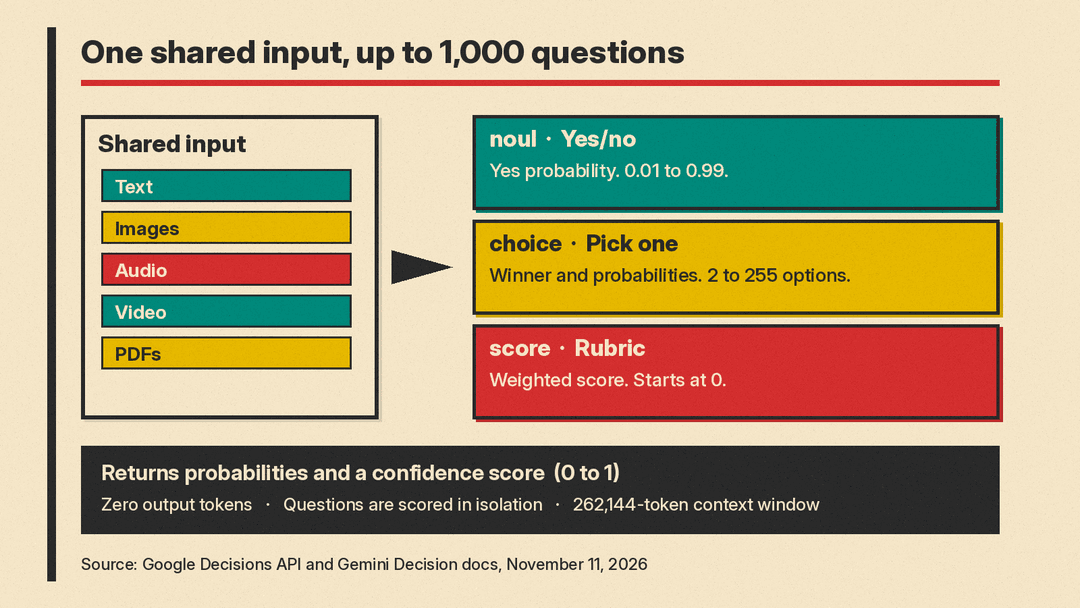
A request can include 1 to 1,000 questions against a context window of 262,144 tokens. The announcement says the shared input can be up to 256K tokens. 256 times 1,024 is 262,144, so the two figures describe the same limit.
Who can use it
The Decisions API is available now through the Gemini API in Google AI Studio. The guide says it is "Available on the Gemini Developer API (v1beta) with Gemini Decision 1 only." The November 11, 2026 release notes describe the model and the API as released. Those notes do not use the words preview or generally available.
Google says support is coming soon to Gemini in Google Cloud. Until that support arrives, this is a Gemini Developer API feature in AI Studio, not a Google Cloud product. For more on building with the Gemini API, see our posts on Gemini API Computer Use and the Gemini API CLI.
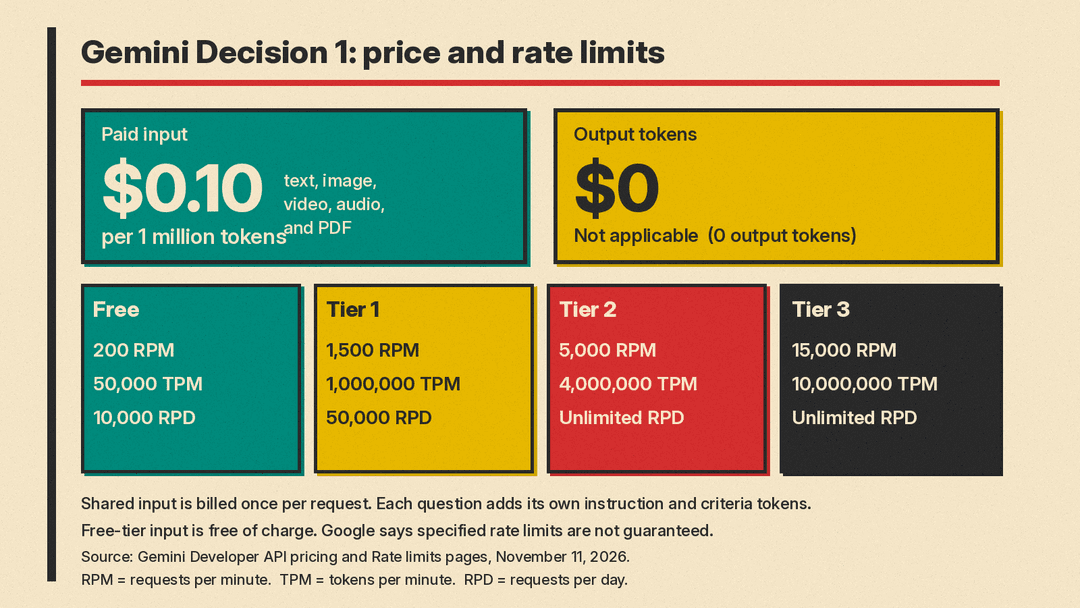
The docs require SDK version 3.2 or later and an API key from Google AI Studio. Rate limits apply per project, and daily request quotas reset at midnight Pacific time. Google's Rate limits page lists these standard interactive limits for Gemini Decision:
- Free: 200 requests per minute, 50,000 tokens per minute, and 10,000 requests per day
- Tier 1: 1,500 requests per minute, 1,000,000 tokens per minute, and 50,000 requests per day
- Tier 2: 5,000 requests per minute, 4,000,000 tokens per minute, and unlimited requests per day
- Tier 3: 15,000 requests per minute, 10,000,000 tokens per minute, and unlimited requests per day
The same page says: "Specified rate limits are not guaranteed and actual capacity may vary." Those names are the Gemini API usage tiers: Free for an active project or free trial, Tier 1 with a linked billing account, Tier 2 after $100 paid plus 3 days, and Tier 3 after $1,000 paid plus 30 days. For regions, Google lists the Gemini API and Google AI Studio countries on its Available regions for Google AI Studio and Gemini API page, including the United States.
What it costs
The Gemini Developer API pricing page prices gemini-decision-1 at $0.10 per 1 million input tokens on the paid tier, for text, image, video, audio, and PDF. The output price is listed as "Not applicable (0 output tokens)." Context caching is listed as "Not available," and the page says the Batch API is not supported. On the free tier, input is "Free of charge." The pricing table also says free-tier content is used to improve Google's products, and paid-tier content is not, per the Gemini API terms.
The announcement says: "Gemini Decision 1 is priced at $0.10 per 1M input tokens and $0 for output tokens, with an API no-cost tier you can use in Google AI Studio for prototyping." Google also says the shared input is billed once per request, no matter how many questions you evaluate, and that each question adds only its own instruction and criteria tokens. It says there are no output-token charges, variable thinking-token bills, or separate audio transcription and OCR costs.
Google says teams inside the company already use the API as a low-latency control plane for query routing in Gemini Notebook, a rapid canvas experiment in Stitch, emoji selection in CC from Google Labs, and a safety layer for MCP tools in Google Search. For Gemini Notebook, Google says the API can serve everyday queries with up to 40% lower latency while reserving deep reasoning models for complex tasks.
For developer reactions, including comparisons with Jev and early tests, see what people are saying about the Gemini Decisions API.
Sources
- Gemini Decisions API: Fast, calibrated multimodal decisions (Google, Min Choi and Felix Yu, November 11, 2026)
- Decisions API
- Gemini Decision
- Gemini Developer API pricing
- Rate limits
- Release notes (November 11, 2026)
- Available regions for Google AI Studio and Gemini API
- Gemini API terms
