
Florida's attorney general has sued the company behind A2E, an AI image and video platform, saying its tools let users "nudify" real people and create child sexual abuse material (CSAM) while its terms claim to forbid both. The state asks a court for a permanent injunction and civil penalties.
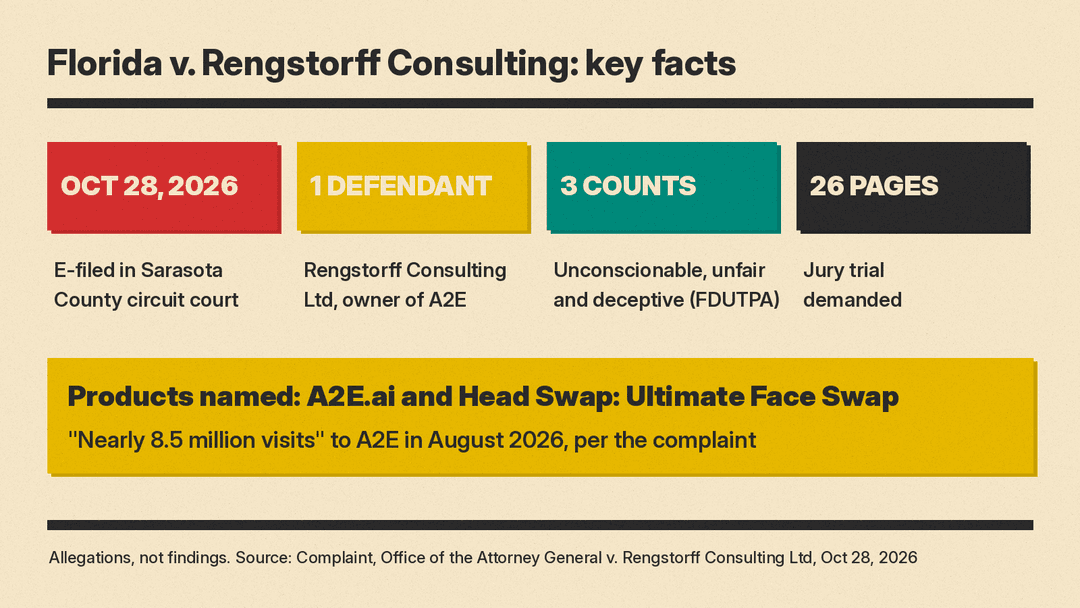
Attorney General James Uthmeier announced the case on October 28, 2026, in a news release from his office. The 26-page complaint was e-filed that day in the Circuit Court of the Twelfth Judicial Circuit in Sarasota County. Everything below is an allegation by the state. No court has ruled on the claims or found the company liable. The Florida Phoenix reported that "A2E did not respond to a Phoenix request for comment."
Who Florida sued
The defendant is Rengstorff Consulting Ltd. The complaint calls it "a Nevada corporation" with its principal place of business in Las Vegas. It says the company owns and operates the website A2E.ai and an Apple App Store app called Head Swap: Ultimate Face Swap. The complaint calls the two together the "Nudification Products."
The complaint says A2E had "nearly 8.5 million visits" in August 2026 alone. It lists a free tier plus paid Pro ($14.90 per month) and Ultra ($59.90 per month) tiers.
What the state says A2E does
The complaint alleges that several A2E features can be used to produce nude or sexually explicit images of real people, "typically without that person's knowledge or consent." The complaint also says the tools let users "digitally de-age" adults so that the output shows children.
The state quotes A2E's own marketing. It says the company describes Cloth Swap as having "[n]o boundaries, no limits." It also quotes Reddit and YouTube posts that call the platform "uncensored," and online comments such as "this one's got no red tape" and "You can literally create anything you can think of."
The complaint cites two Florida criminal cases. A2E is not a party to either case, and the summaries below are the complaint's claims:
- Tampa, June 8, 2026: police arrested a man who, the complaint says, "admitted to police that he used A2E.ai Face Swap" to create nudified images. The complaint says the case involved eight victims, including his two minor stepchildren.
- Leon County, April 28, 2026: the sheriff's office arrested a man for possession of AI-generated depictions of minors. The complaint says some of the images "contained an A2E watermark."
For the Tampa case, the complaint says "Defendant never reported the abusive and criminal images." For the Leon County case, which it calls a Tallahassee case, it says "nothing suggests that A2E reported any of these images even though several other platforms flagged the photos and reported them." The release says that in these cases "the platform did not flag or report the materials."
The terms-of-service argument
The case turns on the gap between A2E's terms and what the state says A2E does. The complaint quotes the terms. They say users are "strictly prohibited" from making "Non-consensual intimate imagery, including deepfakes of a sexual nature" and "Sexual content depicting or appearing to depict minors." The complaint also says the terms claim A2E will immediately terminate accounts used to produce AI-generated CSAM and report them to law enforcement.
The state says those promises are false. The complaint says A2E "lacks content filters, moderation systems, and enforcement mechanisms that actually block or remove nudity and other 'prohibited' material." It also says that the app's privacy terms describe automated scanning of uploaded content but say nothing about scanning generated content. In the complaint's words, A2E "is sneakily silent on any monitoring of generated material for CSAM."
The legal claims and what Florida wants
The state sues under the Florida Deceptive and Unfair Trade Practices Act (FDUTPA). It brings three counts: unconscionable practices, unfair practices and deceptive practices. The first two counts rest on sections 827.072 and 847.0137 of the Florida Statutes. The complaint says these make it "a criminal offense to create and transmit child sexual abuse material generated with artificial intelligence."
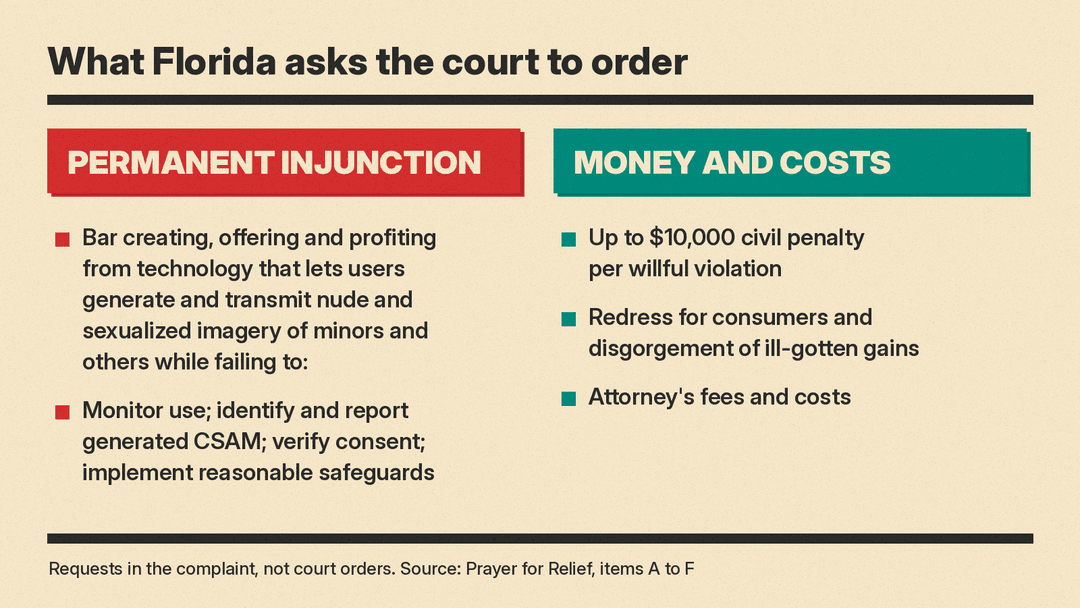
The prayer for relief asks the court to:
- Enter a judgment against the company for violating FDUTPA.
- Enter a permanent injunction barring it from "creating, offering, and profiting from technology that allows users to generate and transmit nude and sexualized imagery of minors and others while failing to appropriately monitor use, identify and report generated CSAM, verify consent, and implement reasonable safeguards."
- Award equitable relief, including redress for consumers and disgorgement of ill-gotten gains.
- Award civil penalties of up to $10,000 per violation for willful violations.
- Award attorney's fees and costs, and other relief the court finds proper.
The state also demands a jury trial.
At a news conference in Orlando, Uthmeier said, as quoted by the Florida Phoenix: "So we want to make them pay. We want to shut them down." The Phoenix also reported that Uthmeier said his office is investigating possible criminal offenses.
Why it matters
Florida's case follows other state consumer-protection suits against AI companies. Texas sued OpenAI and Sam Altman on October 23. Eight state attorneys general filed coordinated suits against OpenAI on October 14, according to the IAPP. This time the target is an image and video generator.
Florida's theory goes beyond what users did. The state argues that a platform's written safety rules, if the platform does not enforce them, can themselves be a deceptive trade practice. No court has yet ruled on that argument in this case.
Other governments are also moving on sexual deepfakes. Queensland, Australia, has a bill that would make creating sexual deepfakes without consent a crime. The bill is not yet law.
Sources
- Florida Attorney General news release, October 28, 2026
- Complaint: Office of the Attorney General v. Rengstorff Consulting Ltd (PDF)
- Florida Phoenix: Uthmeier: AI company allows people to generate sexually explicit pictures of kids
- IAPP: A view from DC: The state enforcement playbook is already spreading beyond social media
