
Queensland wants to make it a crime to create a sexually explicit deepfake of a real person without consent, not only to share one. Attorney-General Deb Frecklington introduced the bill in the Queensland Parliament on October 27, with a maximum penalty of three years in jail for adults.
The bill is not yet law. It still has to pass Parliament. Queensland law already bans distributing intimate images, ABC reports; the bill adds an offence for creating them.
This explainer covers what the bill would do, the gap it targets, how it fits with Australia's federal deepfake law, and what it means for people who build or use AI image tools.
What the bill would do
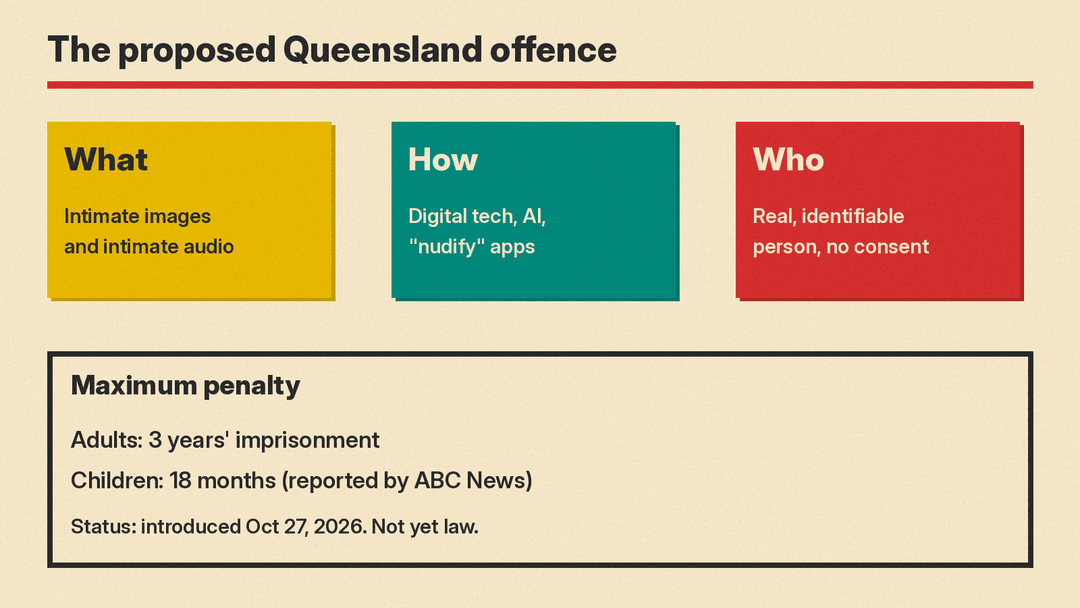
According to the Attorney-General's media statement, the legislation creates a new offence for the non-consensual creation of intimate images or intimate audio material "through digital technology." The statement says the new offence will:
- Capture intimate images that are digitally altered or created entirely with digital technology, including image-editing software, AI-generated images and "nudify" applications.
- Include images of simulated or digitally generated people that closely resemble, or purport to be, an identifiable real person.
- Apply to both intimate images and intimate audio material.
- Carry a maximum penalty of three years' imprisonment.
ABC News reports that the maximum for children would be 18 months. The bill itself sets a single maximum of three years and does not state a separate figure for children.
The bill also changes two definitions, ABC reports. It adds a new definition of intimate audio material, and it updates the definition of an intimate image to include "non-genuine" images. ABC quotes this explanation of the second change: "This is intended to ensure the perpetrator cannot claim the image does not meet the definition, just because the victim is depicted in an impossible setting, or, for example, emojis are used to obscure a part of the image, or a digital filter is used."
What the bill text says
The bill is the Criminal Code (Non-consensual Creation of Intimate Images and Audio Material) Amendment Bill 2026, tabled with explanatory notes. Its main provisions:
- The offence. New section 224 says a person commits a misdemeanour if they create an intimate image, or intimate audio material, of another person without that person's consent. The maximum penalty is 3 years' imprisonment.
- What "create" means. Altering an image or audio to make intimate material, or generating it using digital technology. The bill's example is using artificial intelligence to generate an intimate image.
- Consent. Defined as "free and voluntary agreement by a person with the cognitive capacity to make the agreement." A child under 16 cannot consent.
- Fakes of real people. An image or audio that is not genuine still counts if it could reasonably be mistaken for genuine and the person can be identified, either because it closely resembles them or because it is presented as them. Under the bill it is irrelevant that an image includes stylised or obviously artificial elements, or is partly obscured but still depicts the person in a sexual way.
- Defence. It is a defence if the accused proves the conduct was for a genuine artistic, educational, legal, medical, scientific or public benefit purpose and was reasonable for that purpose.
- Exemptions and related changes. The bill extends existing exemptions from criminal responsibility to the new offence. The explanatory notes give the example of a police officer creating material where reasonably necessary for a lawful operation targeting child sex offenders. It also extends the threats offence to threats to create intimate material, lets courts order material deleted or destroyed, and extends the existing distribution offence to intimate audio material.
- Start date. If passed, the Act would commence 28 days after assent.
The gap it targets
Queensland already has laws against distributing intimate images. What it does not have, according to the government, is an offence for creating them. Frecklington called this a loophole. "For too long, offenders have exploited a gap in the law to create harmful and exploitative content without facing the full consequences," she said, as quoted by ABC.
According to ABC, she pointed to a recent case in which a man was sentenced for creating and distributing sexualised deepfake images of current and former high school students and staff. Under the current law, she said, he "could not be punished for the act of creating these images. Only the distribution."
That distinction matters because, as the government's statement puts it, "highly accessible AI tools can now generate sexually explicit content" that falsely depicts real people without their knowledge or consent. The government says the new offence closes the loophole that "has allowed offenders to evade accountability."
Why schools are central to the debate
The government framed the bill around schools. The media statement says AI-generated content has been used in Queensland schools to cyberbully students and teachers. "Our hardworking teachers and students are on the frontline of this emerging threat, which is why we are taking action to criminalise this harmful conduct," Frecklington said.
ABC reports that Frecklington told Parliament the changes had been applauded by Emma Mason, whose daughter Tilly died after she was bullied on social media, including with fake nude imagery.
How long this has been coming
The plan is not new. Frecklington first announced it in April 2026, with the same three-year maximum. At that time, Brisbane Times reported that the government would consult experts in education, law, sexual violence and online safety, and aimed to start the legislative process midyear.
The October media statement says the final bill was shaped by consultation with stakeholders across the sexual violence, domestic and family violence, victim support, online safety, legal, education and government sectors.
In April, the opposition signaled openness. Labor MP Grace Grace told reporters the opposition welcomed the legislation and would consider its merits "in a very calm and methodical way," according to Brisbane Times.
How it fits with the federal law
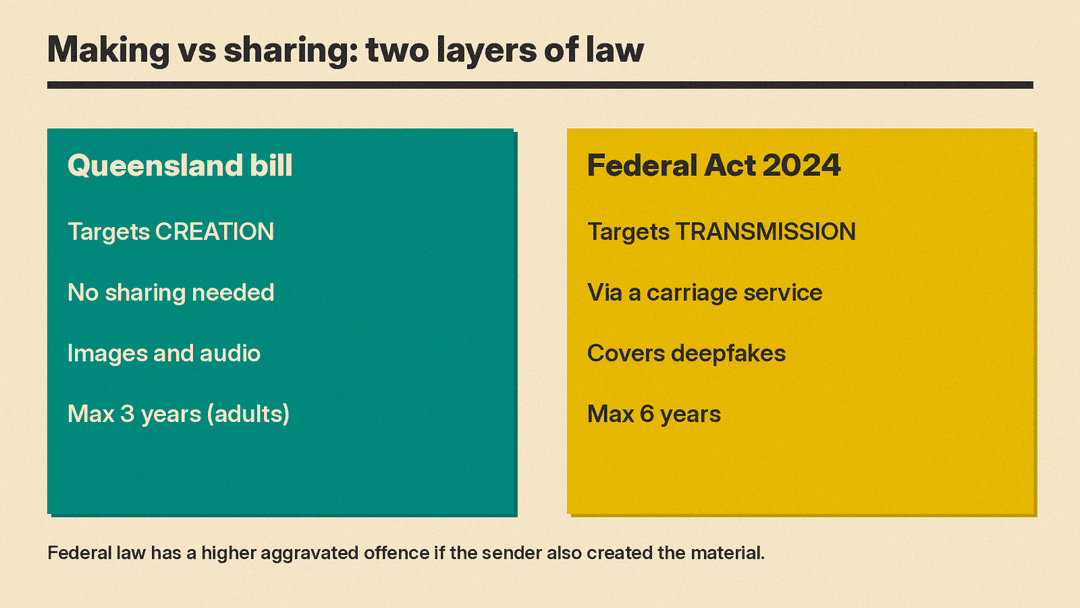
Australia already has a national deepfake offence, but it covers sharing, not making. The Criminal Code Amendment (Deepfake Sexual Material) Act 2024 makes it an offence to use a carriage service to transmit sexual material of an adult when the sender knows the person does not consent, or is reckless about consent, with a maximum of six years' imprisonment. The Act says it does not matter whether the material is unaltered or "has been created, or altered in any way, using technology," and its note names deepfakes as an example.
The federal law also has an aggravated offence where the person who transmits the material was responsible for creating or altering it, as the Parliamentary Library's bills digest explains, with a maximum of seven years. Each federal offence starts with a transmission over a carriage service, so creating material without sending it is not covered. The digest says the Commonwealth lacks a direct constitutional power over technology, which "appears to restrict its capacity to create offences regarding individuals who create, produce or generate deepfakes." It also notes work through the Standing Council of Attorneys-General on harmonised offences for the "non-consensual creation of sexual material." The Queensland bill would add a creation offence at the state level.
What it means for AI tool makers and users
If the bill passes, making a sexually explicit fake of a real, identifiable person in Queensland without their consent would be a crime on its own, unless a defence or exemption in the bill applies.
For companies that build image and audio tools, the bill creates an offence for the person who creates the material and does not impose new duties on developers. It does name "nudify" applications directly, and the offence covers intimate audio material as well as images. For how one AI image tool limits realistic images of real people in a different setting, see our report on ChatGPT's election image safeguard.
The bill's definitions of consent and its defence and exemptions are summarized above; the explanatory notes give the government's reasons. We will update this post when Parliament votes. Other places take a different approach: the EU AI Act requires deepfakes to be labeled, as our EU AI Act explainer covers.
This article is general information about a proposed law, not legal advice. For advice on a specific situation, speak to a lawyer.
Sources
- ABC News: Queensland government introduces new laws criminalising creation of sexually explicit deepfake images
- Queensland Government media statement (Attorney-General Deb Frecklington, Oct 27, 2026): New offence targets AI deepfake sex abuse predators
- Queensland Parliament: Criminal Code (Non-consensual Creation of Intimate Images and Audio Material) Amendment Bill 2026 (PDF)
- Queensland Parliament: Explanatory notes to the Bill (PDF)
- Brisbane Times: Creating AI deepfakes of real people to be made illegal in Queensland (April 2026)
- Criminal Code Amendment (Deepfake Sexual Material) Act 2024, Federal Register of Legislation
- Parliament of Australia bills digest: Criminal Code Amendment (Deepfake Sexual Material) Bill 2024
