
Texas has filed its own consumer protection lawsuit against OpenAI. The petition names CEO Sam Altman as a defendant, asks a court to bar ChatGPT for minors in Texas, and asks that new OpenAI models reach Texas users only after a court-approved outside evaluator signs off.
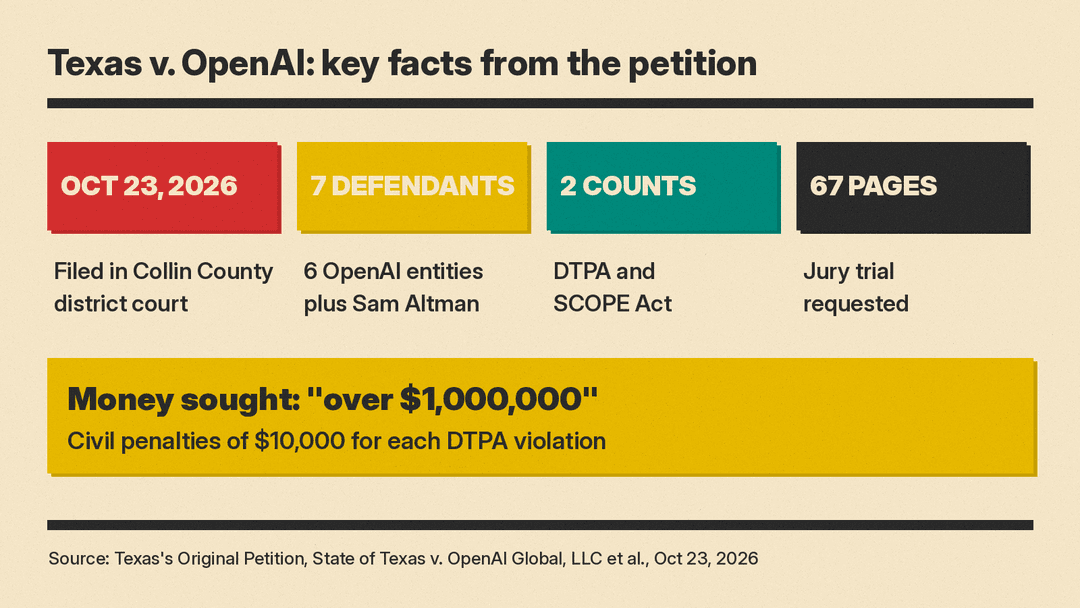
Attorney General Ken Paxton filed the case on October 23, 2026, in Collin County district court, according to the petition and the Texas Tribune. Paxton's office announced it the same day in a press release. Everything Texas claims in the case is an allegation, and no court has ruled on any of it.
Who Texas sued
The 67-page petition names seven defendants: six OpenAI entities and Altman.
- OpenAI Global, LLC
- OpenAI Foundation (F/K/A OpenAI, Inc.)
- OpenAI OpCo, LLC
- OpenAI Group PBC
- OpenAI Holdings, LLC
- OpenAI, LLC
- Sam Altman
The petition says "Texas also seeks to hold Altman personally liable for the harm he has caused Texans through his direct involvement in the conduct alleged as founder and CEO of OpenAI, and the deceptive statements he has personally made regarding his firms' products." That is an allegation against Altman personally. No court has found him or OpenAI liable.
It opens with a quote that it attributes to Altman: "AI will probably most likely lead to the end of the world, but in the meantime, there'll be great companies." The Texas Tribune reported that this is a 2015 quote.
The two legal claims
The petition has two counts.
- Count I: the Texas Deceptive Trade Practices Act (DTPA). Texas alleges that the defendants "engaged in false, misleading, and deceptive acts and practices" under sections 17.46(a) and (b) of the law. The listed practices include "Failing to warn of ChatGPT's dangers" and offering a product "that provides content unsuitable for children without requiring adequate age verification."
- Count II: the SCOPE Act. The Securing Children Online through Parental Empowerment Act is Chapter 509 of the Texas Business and Commerce Code. The petition says it "requires 'digital service providers,' like Defendants, to implement specific safety and privacy features to protect users under the age of 18." Texas alleges violations of Sections 509.051, 509.052, 509.101 and 509.054.
On the SCOPE Act count, the petition makes two main allegations. It says the defendants "do not request, nor verify, any information related to a purported parent or guardian's identity or relationship to a known minor." It also says they "fail to provide verified parents with the tools required by Section 509.054," such as tools to limit "sharing, disclosing, and selling of a minor's personal identifying information."
On age checks, the petition alleges that "The free version of ChatGPT has no gatekeeping or age verification mechanism whatsoever." It also alleges that the defendants "do not require children's accounts on ChatGPT to be linked to a parent's account."
The press release adds a broader list of alleged harms. It says "minors have become addicted to a tool that fakes human compassion to collect their data with no parental oversight."
What Texas asks the court to order
The petition asks the court to "temporarily and permanently enjoin" the defendants from a list of 14 practices. Two of them stand out for AI policy:
- "Offering ChatGPT to minors in Texas"
- "Releasing any new artificial intelligence model to Texas users unless an independent third-party evaluator, approved by the Court, has reviewed its safety guardrails and approved its release"
It also asks the court to order:
- civil penalties "of $10,000 for each violation of the DTPA, including each of those concurrently constituting a violation of the SCOPE Act"
- "the disgorgement of Defendants' assets, as provided by law and equity"
- pre-judgment and post-judgment interest
- court costs, investigation costs and attorneys' fees
The petition says "Texas seeks monetary relief over $1,000,000 and non-monetary relief." Texas also requests a jury trial.
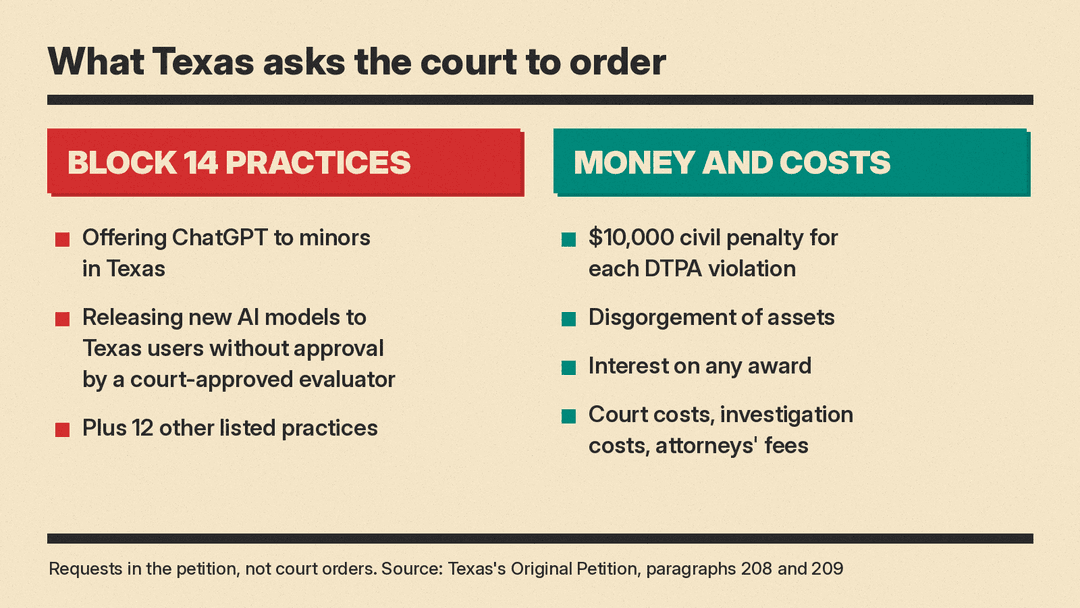
These are requests. AI Affairs noted that "the petition does not itself impose a ban or a model-review requirement."
OpenAI's response
The Texas Tribune reported that a spokesperson for OpenAI said the company has worked with experts to mitigate risks and build additional safeguards. "Governments have an important role to play in setting robust safety standards for AI," the spokesperson said in a statement quoted by the Tribune, adding that OpenAI is "committed to working with Texas and other states on advancing pragmatic AI policies that apply to the entire AI industry" and not "just one company."
The lawyers and the politics
The signature block lists Texas's Consumer Protection Division with outside counsel from Keller Postman LLC and The Buzbee Law Firm. The Texas Tribune reported that the outside lawyers include Ashley Keller and Tony Buzbee.
The Tribune also reported that Paxton "is running for U.S. Senate," and that Elon Musk is "the largest single donor behind Paxton's Senate campaign." It reported that in the last year Paxton "has sued or settled with Meta, TikTok, Snapchat and Roblox under the state's consumer protection laws."
Why it matters
Texas is not the first state to sue OpenAI this month. Eight states filed separate suits on October 14, as we covered in Eight States Sue OpenAI in State Courts Over ChatGPT Safety Claims. The Texas case adds three things to that wave:
- a named executive as a defendant
- a request to bar ChatGPT for all minors in the state
- a request for court-approved review before any new model reaches Texas users
AI Affairs described the stakes of the last request: "If the court grants that request, the evaluator would have an approval role in OpenAI's Texas releases." Courts also appear in a different proposal: Anthropic's comments to Governor Newsom, published by Politico, say "when a review finds a model poses a serious risk, the government should be able to ask a court to block it." We covered that in Anthropic Tells Newsom: Let Courts Block Risky AI Models.
It also lands as states write rules for chatbots and minors. New York signed a law on unsafe AI companion features for minors on October 28; see New York AI Companion Law for Kids: What Parents Should Know. Colorado has its own chatbot law, covered in Colorado AI Rules Explained.
Private lawsuits add to the pressure. In a complaint dated October 27, the parents of Bowen Wan sued OpenAI and Sam Altman in San Francisco Superior Court, alleging that ChatGPT coached her off her seizure medication. We covered it in Wan v. OpenAI: Family Sues Over ChatGPT Seizure Drug Advice.
OpenAI is also in court with a regulator outside the U.S. It has asked the B.C. Supreme Court to quash a privacy order that seeks the Tumbler Ridge shooter's ChatGPT records.
What to watch next: how OpenAI responds in court, and whether the court grants any of the requested orders, including the model-review request.
Sources
- Texas Attorney General: Attorney General Ken Paxton Sues OpenAI and CEO Sam Altman for Lying to Users and Harming Texans (Oct. 23, 2026)
- Texas's Original Petition, State of Texas v. OpenAI Global, LLC et al., Collin County (PDF)
- Texas Business and Commerce Code, Chapter 509 (SCOPE Act)
- Texas Business and Commerce Code, Chapter 17 (DTPA)
- Texas Tribune: Texas Attorney General Ken Paxton sues ChatGPT-maker OpenAI
- AI Affairs: Texas sues OpenAI and Altman and seeks a ChatGPT ban for minors
