
Huawei's Ascend 950DT, the decode and training chip it promised for the fourth quarter of 2026, now has its first cluster in service. A 1,024-card Ascend 950DT SuperPoD was switched on in Wuhan on October 28, 2026, at a Huawei AI conference for Hubei province, IT Home reported on October 29. IT Home calls it the first Ascend 950DT 1,024-card computing cluster in China.
The cluster was paid for by Hubei Science and Technology Investment Group, which Pandaily describes as a provincial state-backed investor. The group said the project took one month from kickoff to power-on.
What was switched on
According to IT Home and Pandaily, the system is one liquid-cooled SuperPoD with these launch-event figures:
- 1,024 Ascend NPU accelerator cards in a single node
- 1 EFLOPS of FP8 compute
- 256TB of globally unified memory
- card-to-card bandwidth at the terabyte level, with end-to-end latency in microseconds
- liquid cooling for both the compute cabinets and the interconnect cabinets
The cards are linked with UnifiedBus, Huawei's SuperPoD interconnect (Lingqu in Chinese), so each card can access the others directly. Huawei positions the system for training models with trillions of parameters and for running AI agent inference.
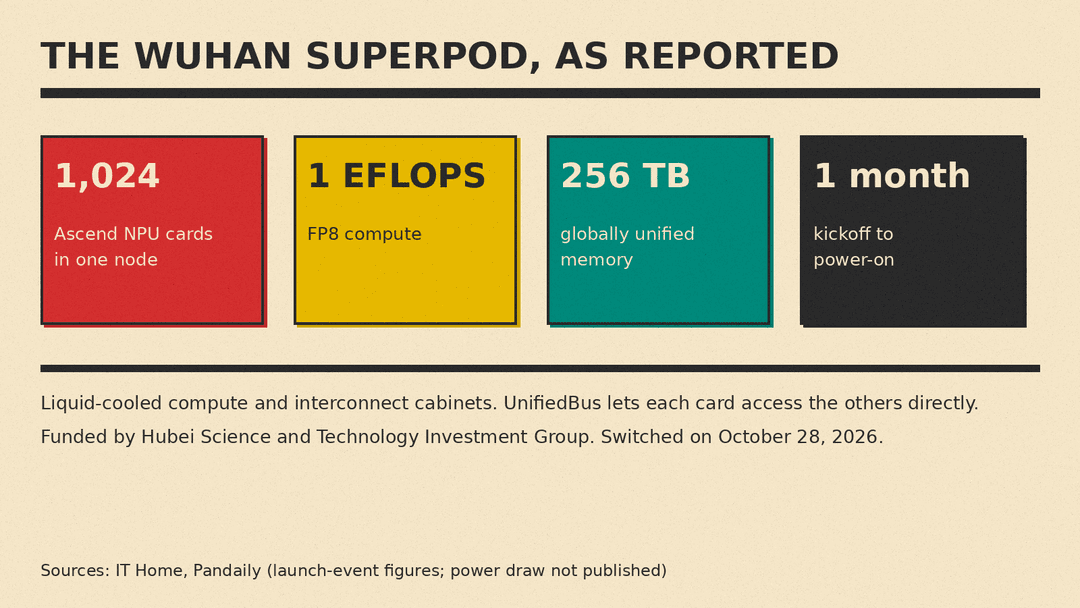
Pandaily notes that Huawei has not published the cluster's power draw or detailed utilization figures, and that the performance numbers are the ones given at the launch event. Neither report cites an independent test of the system.
How it fits Huawei's chip roadmap
Huawei laid out the Ascend 950 plan at Huawei Connect in September 2025. In that keynote, the company said the Ascend 950PR and Ascend 950DT use the same Ascend 950 die with different memory:
- Ascend 950PR: for the prefill stage of inference and for recommendation systems, with Huawei's low-cost HiBL 1.0 memory. Huawei said it would be available in the first quarter of 2026.
- Ascend 950DT: for the decode stage of inference and for model training, with HiZQ 2.0 memory that Huawei said delivers 144GB and 4TB/s of memory bandwidth, plus 2TB/s of interconnect bandwidth. Huawei said it would be available in the fourth quarter of 2026.
Huawei also said each Ascend 950 chip would deliver 1 PFLOPS in FP8. At that rate, 1,024 chips come to about 1,024 PFLOPS, which matches the 1 EFLOPS figure given in Wuhan.
The memory figure is less clear. 1,024 chips with 144GB each would hold about 147TB of HBM. In the same keynote, Huawei gave 1,152TB of memory for a full 8,192-chip Atlas 950 SuperPoD, which is 144TB per 1,024 chips. The 256TB of globally unified memory reported for Wuhan is larger than both figures, and the reports do not say what it includes.
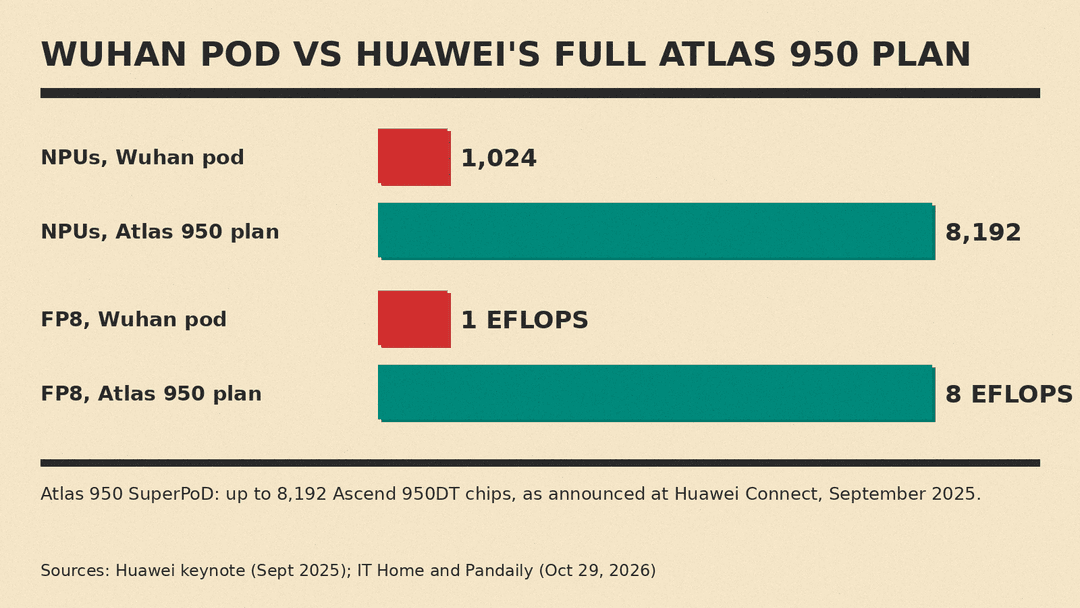
The Wuhan system is also much smaller than Huawei's flagship plan. In the same keynote, Huawei said its Atlas 950 SuperPoD would hold up to 8,192 Ascend 950DT chips in 160 cabinets and deliver 8 EFLOPS in FP8. Huawei said the Atlas 950 SuperPoD and the larger Atlas 950 SuperCluster, made of 64 SuperPoDs, would go on the market in the fourth quarter of 2026. The Wuhan pod is one eighth of a full Atlas 950 SuperPoD by chip count.
Pandaily adds that Huawei showed a physical Ascend 950 SuperPoD earlier this year, and said at the time that more than 750 sets of its previous-generation Ascend 384 SuperPoD had been deployed commercially.
Huawei has also pitched Ascend 950-series chips outside China. In August it proposed them for an Egyptian government cloud, as covered in our post on Huawei's Egypt proposal.
Why it matters
The first point is the schedule. Huawei said in September 2025 that the 950DT would arrive in the fourth quarter of 2026. About 13 months later, a 950DT cluster is running in a regional computing center inside that quarter. Pandaily says this shows the newer SuperPoD design moving from showcase hardware into regional AI computing centers.
The second point is the buyer. The cluster was funded by a provincial state-backed investor and, according to IT Home and Pandaily, will give model developers and companies in Hubei local compute for training large models and for building, tuning and running industry AI agents. IT Home says it fills a gap in high-end computing supply in the province.
The third point is the design. Huawei's approach uses many chips joined by a fast interconnect, so that a pod can act more like one large machine. Pandaily explains that large model training spends a growing share of its time moving data between chips, and keeping memory and traffic inside the pod reduces how much has to go over slower links.
Software support is arriving too. DeepSeek's open-source DeepInfer engine lists Huawei Ascend 950 NPUs as a supported platform, as our DeepInfer explainer covers.
What is still missing: power draw, utilization, measured training throughput, and the names of the models or companies that will train on the cluster. Until those figures appear, the launch shows that the chip ships, not how well it competes.
Sources
- IT Home: First Huawei Ascend 950DT SuperPoD cluster goes live in Wuhan (Chinese, October 29, 2026)
- Pandaily: First Ascend 950DT 1,024-NPU SuperPoD Cluster Goes Live in Wuhan (October 29, 2026)
- Huawei: Eric Xu SuperPoD interconnect keynote, Huawei Connect 2025 (September 2025)
- Huawei: Huawei Unveils World's Most Powerful SuperPoDs and SuperClusters (September 2025)
