
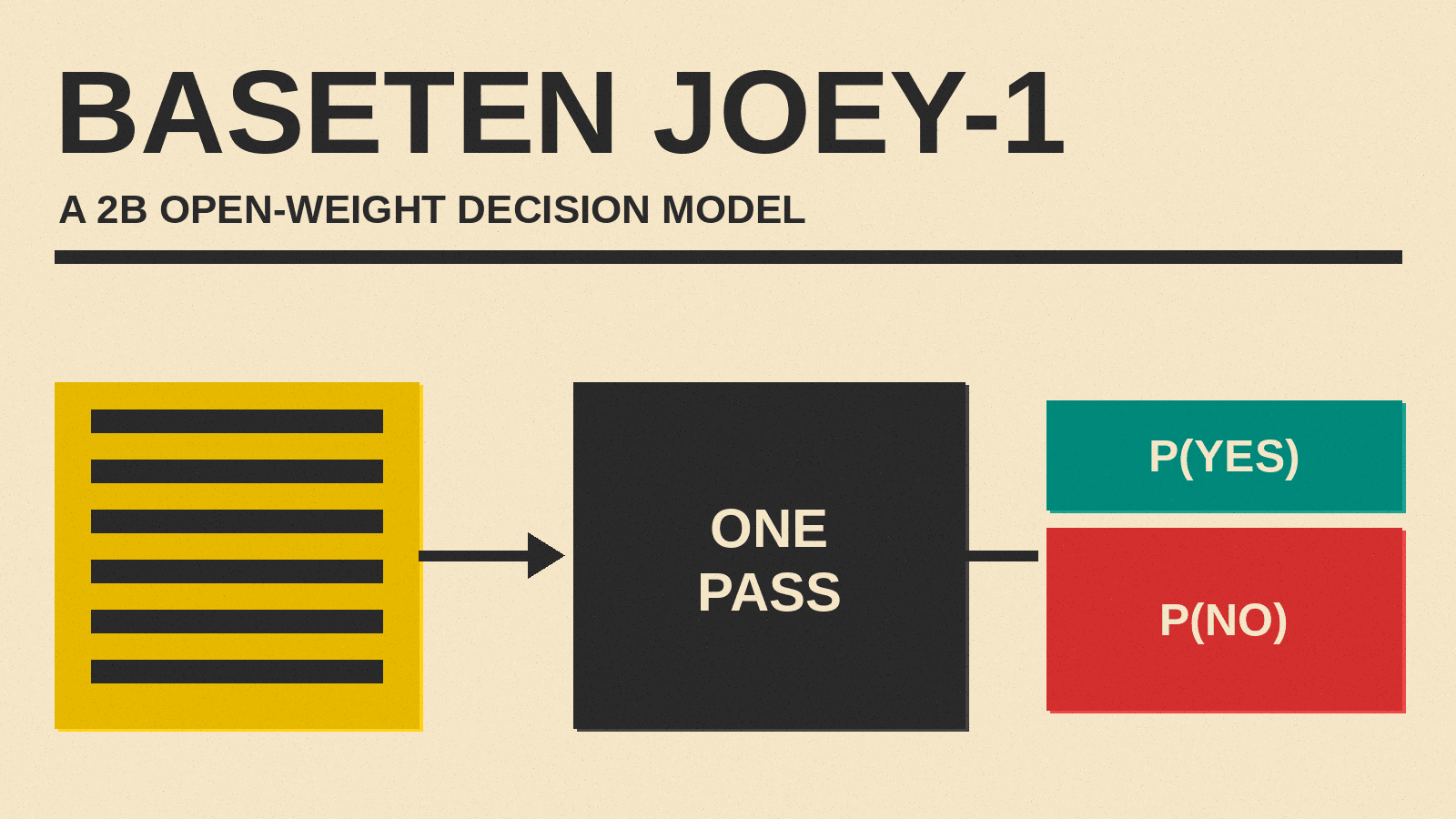
Baseten released joey-1 on October 29, a 2B open-weight model that does not write answers. It picks them. Give it a piece of text, or text plus images, and a list of typed questions, and it returns a probability for every possible answer in a single pass. Baseten's research lab, Base Labs, post-trained it from Qwen3.5-2B and published the weights on Hugging Face under the MIT license.
It is the smallest member of a family Base Labs started eight days earlier with mammoth-1 (27B) and elephant-1 (9B), according to the Baseten launch post.
What a decision model does
Many LLM jobs are not writing jobs. A support system needs to know which team gets a ticket. A moderation step needs to know whether to flag a message. A gateway needs to know whether a prompt is an attack. Today, most teams ask a chat model and then parse the text it writes back.
Baseten's pitch is that this wastes time and money. In its words, "Many LLM use cases don't need generated text; they need decisions." A decision model returns a label and a confidence score in one forward pass instead of generating a reply token by token.
The joey-1 model card lists three question types:
- Yes or no (called
noulin the API): returns the probability of yes. - Choice: pick one of several named options, each with a short description. Returns the choice and a probability for each option.
- Score: pick a level on an ordered scale, lowest first. Returns the level and a probability for each level.
You can ask several questions about the same input at once. The card says the model answers all of them from "one shared-prefix prefill", so the input is read once, not once per question. Its example sends one customer message ("I was charged twice this month, please refund one of them.") and asks whether it is a refund request, which team should handle it, and how urgent it is.
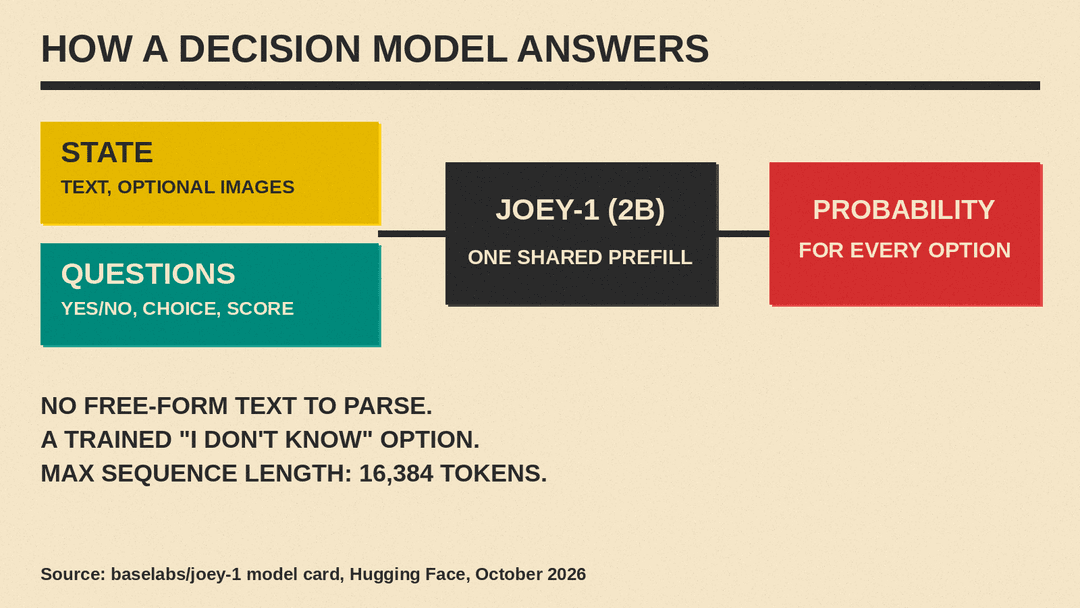
Two details matter for anyone who has tried to build this with a chat model. The card says training included a trained "I don't know" option, so the model can abstain. And requests longer than the trained length limits "are refused, not truncated." The card gives a maximum sequence length of 16,384 tokens, which matches the 16k context window on Baseten Model APIs. Baseten's launch post says dedicated deployments unlock the full 262k context window; the card does not say how that fits with its trained limit.
How fast and how cheap
On Baseten Model APIs, joey-1 costs $0.01 per million input tokens. The library page lists cached input and output at $0.00. Baseten says zero data retention is on by default.
Baseten gives these figures for production use, all its own:
- P50 end-to-end latency of 20 ms for an average 2,000-token request.
- About 2.5x faster than elephant-1, which it puts at 49 ms.
- "5x faster than comparable decision model models."
- A price of one tenth of mammoth-1.
Its worked example: classifying 10 million support tickets a month at about 500 tokens each is 5 billion tokens, which Baseten puts at about $50 a month on joey-1 versus $500 on mammoth-1. The company suggests using joey-1 as a first-line model and sending the cases it is unsure about to elephant-1 or mammoth-1. All three share the same API, so Baseten says switching is a one-line change.
How good is it
The scores come from Baseten, and the sources word the claim three different ways:
- The model card says joey-1 is the best model under 4B on the Jev Decision Index 0.4 public split, with 63.30, ranked #37 of 230 models.
- The launch post says that "in our internal testing (details coming soon), joey-1 is the strongest decision model with 3B or fewer parameters."
- The Baseten library page says it is "the top 2B model on the Jev Decision Index 0.4."
The card also reports 62.9 on what it calls "a replica of the Artificial Analysis Decision Index", run by Baseten, not by Artificial Analysis. On that replica, mammoth-1 scores 65.9 and elephant-1 scores 65.2.
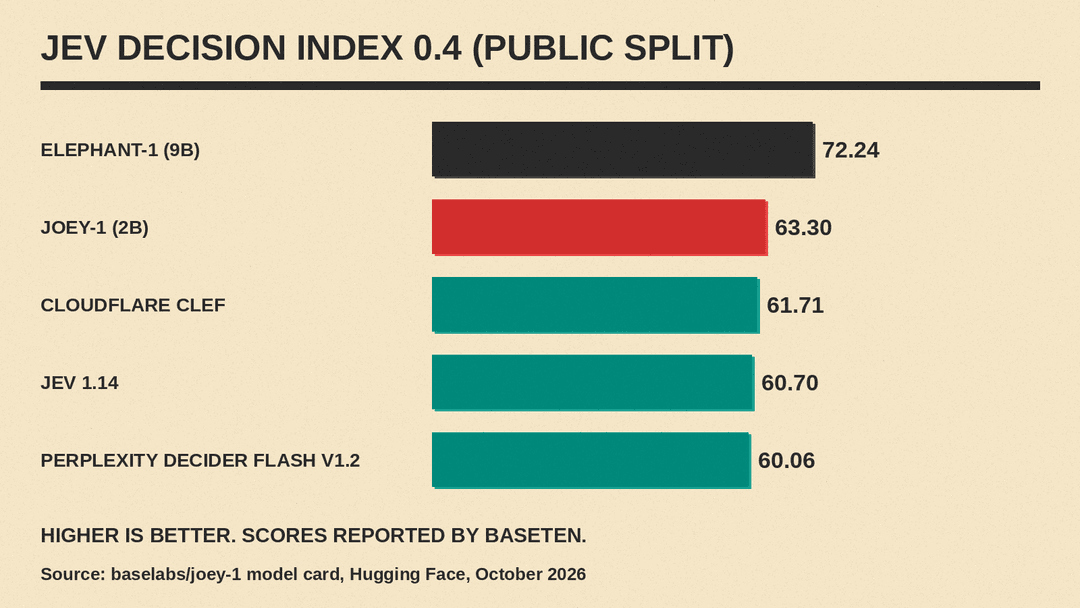
On the public split, the card says joey-1 trails its 9B sibling in every area and beats Jev 1.14 in four of five: language, tools and automation, retrieval and classification, and arts and human taste. Jev itself is a decision model from TypeSafe AI that launched in September, according to The Next Web. The lead over the next models in the card's table is small: 63.30 against 61.71 for Cloudflare Clef and 60.70 for Jev 1.14. No independent evaluation was available at publication.
How it was trained
The model card lists the recipe:
- Data: 6.21 million decision examples. 58.3% core decision skills, 16.1% safety and abstention, 16.1% judging and expert domains, 9.5% public decision data.
- Objective: cross-entropy plus a Brier calibration term, which pushes the reported probabilities to match how often the model is right.
- Method: full fine-tune of the language model on text and image decisions, with the vision encoder frozen, and a block-bidirectional attention mask on full-attention layers.
- Compute: one epoch of 43,390 steps on 2 nodes of 8 H100 GPUs, 16 GPUs in total.
Running it yourself
The weights are about 2.7 billion parameters in one safetensors file, per the Hugging Face listing. The card's self-hosting path is not a plain transformers load. The card says a bundled setup.sh installs a pinned serving runtime (OneJev plus a patch file), needs one CUDA GPU, and expects the pytorch/pytorch:2.8.0-cuda12.8-cudnn9-devel image. The card does not list GGUF files or Mac support, so this is not yet a laptop model in the way small chat models are. If you are new to the model hub, our guide to Hugging Face covers the basics.
Why it matters
Small open models are moving from "smaller chatbot" to narrow tools with fixed outputs. A developer did something similar on Apple platforms with AnyDecisionModel, Liquid AI is targeting devices with its LFM3 family, and Articul8 launched its Bivia decision model a day before joey-1. joey-1 applies the same idea to the most common, least glamorous LLM work: routing, flagging and scoring.
The business logic is clear. Baseten gives the weights away and sells the hosted endpoint at a price low enough that a team may not bother to self-host. For buyers, the questions to test are the ones the launch leaves open: how well the probabilities hold up on your own data, and whether the internal test details Baseten says are "coming soon" support its size-class claims.
