
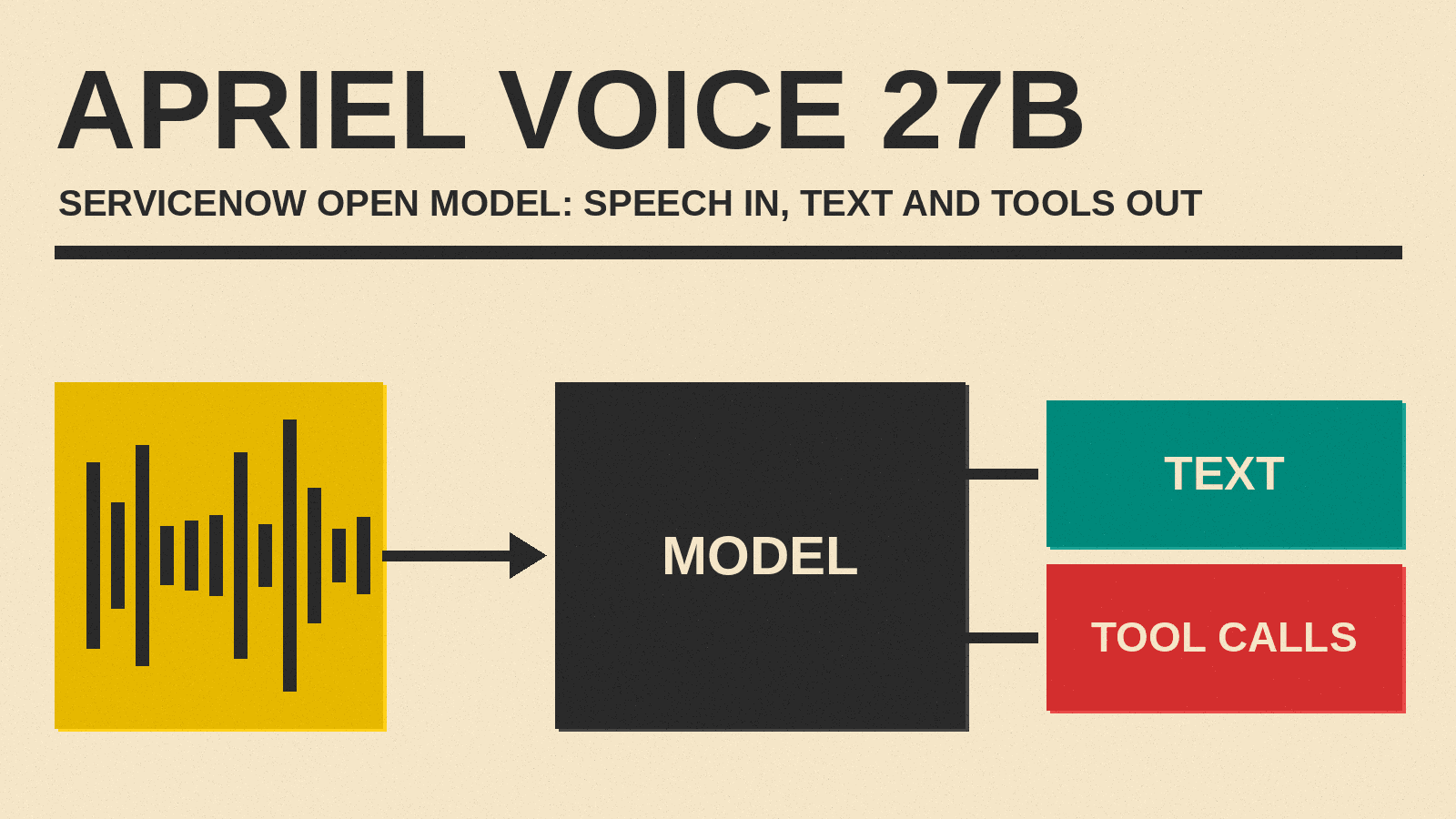
ServiceNow has put Apriel Voice 27B Preview on Hugging Face under the MIT license. It is an open model that listens to speech, reasons over the conversation, and answers with text and tool calls. ServiceNow describes it as "an open model for speech, reasoning, and tool use."
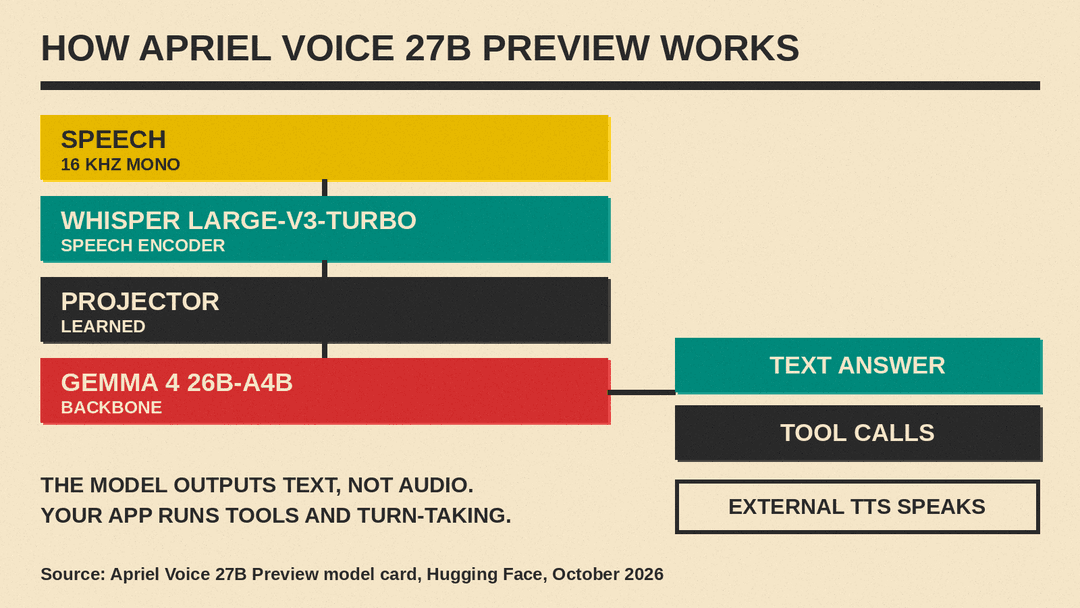
The model does not speak back. The checkpoint "generates text and tool calls rather than native full-duplex speech," according to the model card, so a voice app still needs a separate speech synthesizer for the reply and its own logic for turn-taking. That split is the main thing to understand before you try it.
What it is
Apriel Voice joins two existing parts. A Whisper large-v3-turbo speech encoder feeds audio into a Gemma 4 26B-A4B backbone through a learned projector. ServiceNow says training first aligns this speech interface and then adapts it together with the backbone, using speech tasks plus text replay. The Hugging Face listing shows about 27.2 billion parameters in BF16.
The model keeps the backbone's text and image input. Per the card, it supports:
- Transcription and speech translation
- Spoken question answering and spoken instruction following
- Reasoning, with an optional thinking mode
- Function calling, where your application runs the tool and returns the result to the conversation
The card lists about 50 language tags, but it also warns that "multilingual performance is uneven" and that English results do not imply the same quality in other languages.
How it scores
ServiceNow reports its English voice-agent results against both closed speech-to-speech systems and open pipelines. All two-stage and three-stage systems in the comparison used Cartesia Sonic 3.5 for the spoken output, and Apriel Voice ran in thinking mode. Per the model card:
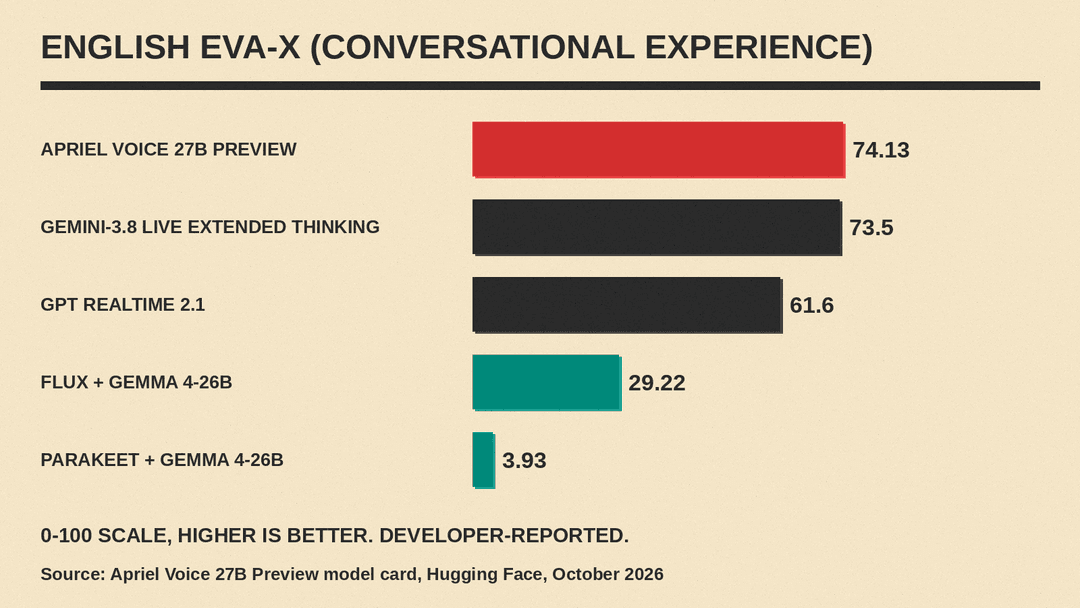
- Apriel Voice 27B Preview: 51.27 EVA-A, 74.13 EVA-X, 65.51 τ-Voice task success, 1.91 seconds mean latency
- GPT Realtime 2.1: 59.03 EVA-A, 61.6 EVA-X, 69.82 τ-Voice, 1.55 seconds
- Gemini-3.8 Live Extended Thinking: 54.82 EVA-A, 73.5 EVA-X, 84.19 τ-Voice, 1.50 seconds
- Parakeet + Gemma 4-26B (an open three-stage pipeline): 39.97 EVA-A, 3.93 EVA-X, 67.78 τ-Voice, 3.01 seconds
EVA-A measures service accuracy and EVA-X measures conversational experience. In ServiceNow's table, Apriel Voice has the highest EVA-X of any system listed, closed or open. It trails both closed systems on EVA-A and task success, and it is slower than both. Against the other two-stage and three-stage systems it is well ahead on the EVA scores and faster, though both three-stage pipelines (one open source, one listed as mixed) score slightly higher on τ-Voice task success, at 67.78 and 65.92.
For plain transcription, the card gives a word error rate of 2.23% on LibriSpeech test-clean and 5.15% on test-other. Lower is better.
ServiceNow also checked that the speech training did not damage text skills. With text input in thinking mode, Apriel Voice scores 84.42 on MMLU-Pro against 85.27 for the Gemma 4 26B-A4B base, 80.40 on GPQA Diamond against 77.80, and 70.95 on τ² against 68.93. The AIME 2024 and AIME 2025 results are the same for both.
These are the developer's own numbers. The card itself notes that benchmark scores "do not guarantee the same accuracy, throughput, or latency on a different workload or deployment."
What it takes to run
This is not a laptop model. The example vLLM commands on the card serve it on four GPUs with tensor parallelism and a 262,144-token maximum context. ServiceNow provides two Docker images built on vLLM 0.32.0. It says the optimized image gives about 2 times the output-token throughput of the standard one on four H100 80 GB GPUs, and that this optimized setup was used for its evaluations and its live demo.
The server exposes an OpenAI-compatible API, so apps can call it with the OpenAI client library. The card's example sends audio by URL inside a chat completions request. The model also loads in Hugging Face Transformers with trust_remote_code.
Audio should be 16 kHz mono. The processor splits long recordings into 30-second chunks. ServiceNow says it saw good results on continuous recordings up to about 30 minutes, and that quality can drop on longer audio. It recommends thinking mode for long inputs.
Why it matters
A common open way to build a voice assistant is a three-stage pipeline: a speech recognizer, a text model, and a speech synthesizer. The closed leaders in ServiceNow's table, GPT Realtime 2.1 and Gemini-3.8 Live, are native speech-to-speech systems. Startups build these too, such as Phonic, covered in our Phonic-1 explainer. Apriel Voice sits between the two. It removes the separate recognizer, and in ServiceNow's tests it answered faster than the three-stage pipelines in its table, while you keep control of the voice output, the tools, and where the model runs.
The MIT license matters for that. It lets companies download, modify and run the model on their own servers. Customer support workflows and spoken tool use are among the uses ServiceNow names on the card.
It also adds to a busy week for open speech models. NVIDIA recently released Nemotron 3.5 Transcribe, and Hugging Face shipped open speech models for Apple apps. IBM added multilingual speech input to Granite Switch 4.1.1.
Limits to keep in mind
- It is labeled a preview.
- Outputs and tool calls can be wrong. The card says to validate tool arguments, results, and task completion, and to keep human oversight where errors have significant consequences.
- Noisy and distant-microphone speech "remain challenging."
- Long recordings can produce repetition or lose coherence.
- End-to-end voice quality depends on the speech synthesizer and turn handling you pair it with.
You can try it in ServiceNow's Apriel Live demo. The technical report has the training recipe and per-domain results. The demo speaks its replies with Cartesia Sonic 3.6, and ServiceNow asks users to use it for research and evaluation and not to share sensitive information.
