
Claude Opus 5.5 is Anthropic's current default recommendation for most workloads, and it is the model Claude Code now uses by default on paid plans and the Anthropic API. It arrived on September 22, 2026, and it changed two things at once: the price of running a top-tier Claude model, and how Claude Code handles large, multi-agent jobs through a setting called ultracode.
This explainer covers what Opus 5.5 is, what it costs, what Anthropic's benchmarks show, and how ultracode works. Every figure below comes from Anthropic's launch post, the Claude Platform docs, or the Claude Code docs.
What Opus 5.5 is
Anthropic describes Opus 5.5 as the first model in its Claude 5.5 family. Sonnet 5.5 and Haiku 5.5 followed. Its headline claim is that it "performs at the level of Claude Fable 5.1 on most work and costs 40% less to run than Opus 5."
In Anthropic's current lineup, the models overview positions each tier this way:
- Fable 5.1: "for demanding reasoning and long-horizon agentic work"
- Opus 5.5: "for long-running agentic coding and knowledge work"
- Sonnet 5.5: "the best combination of speed and intelligence"
- Haiku 5.5: high-volume, latency-sensitive tasks such as classification, extraction, and routing
The docs tell developers to start with Opus 5.5 for most workloads and move to Fable 5.1 when evals on Opus 5.5 at higher effort still fall short.
Key specs
From the models overview:
| Spec | Claude Opus 5.5 |
|---|---|
| API ID | claude-opus-5-5 |
| Context window | 1M tokens |
| Max output | 128K tokens (synchronous Messages API) |
| Thinking | Adaptive (always on) |
| Default effort | medium |
| Knowledge cutoff | Jun 2026 |
| Retirement | Not sooner than September 22, 2027 |
Two of these deserve a note. First, thinking cannot be turned off on Opus 5.5. The model decides per step how much to reason, steered by the effort level. The launch post says Opus 5.5 is "no longer available with 'thinking' mode switched off." Second, the default effort is medium, one level below Opus 5's default of high. The Claude Code docs say that in Anthropic's testing, "Opus 5.5 at medium matches or exceeds Opus 5 at high on coding and knowledge-work evaluations," and advise users moving from Opus 5 to start at medium instead of carrying over their old setting.
Opus 5.5 is available on the Claude apps, the Claude Platform, Amazon Web Services, Google Cloud, and Microsoft Azure, according to the launch post.
Pricing
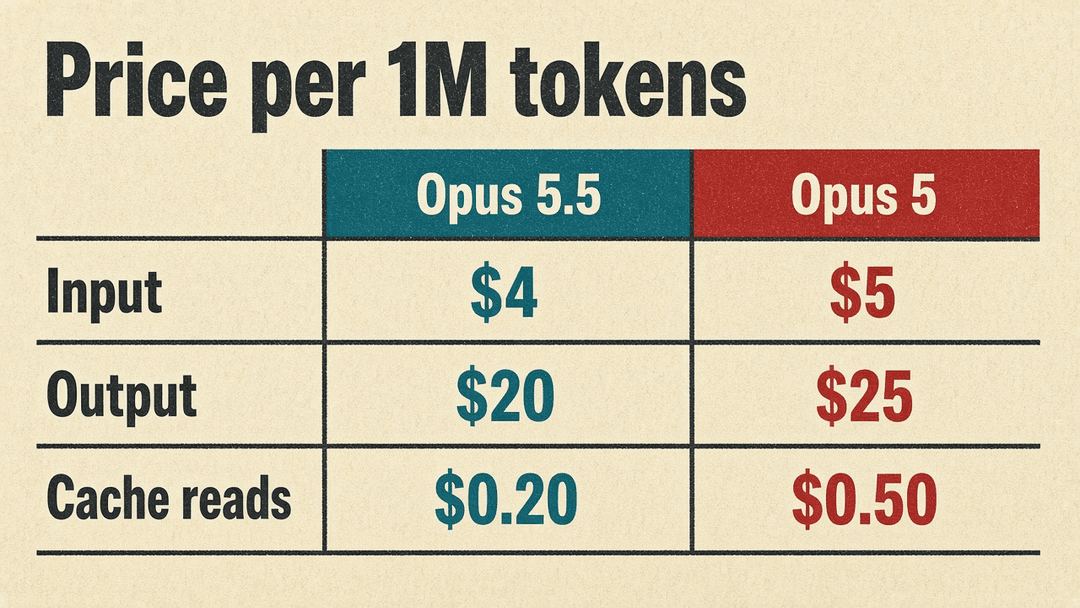
Price is the most concrete change. From the launch post and the pricing page, per million tokens:
| Item | Opus 5.5 | Opus 5 |
|---|---|---|
| Input | $4 | $5 |
| Output | $20 | $25 |
| Cache reads | $0.20 | $0.50 |
| 5-minute cache writes | $5 | $6.25 |
| 1-hour cache writes | $8 | $10 |
| Batch input / output | $2 / $10 | $2.50 / $12.50 |
Input and output are 20% cheaper than Opus 5. Cache reads drop 60%, to 5% of the base input price instead of the usual 10%. Anthropic points out that cache reads "make up the majority of agentic and coding work costs," which is why that line matters more than the headline token price for anyone running long agent sessions.
The 40% figure is a blended estimate. Anthropic says that "at default settings it will cost 40% less than Opus 5 on typical workloads," because it costs less per token and also uses fewer tokens per task. That is Anthropic's own measurement on its own workloads, so teams should check it against their traffic.
Fast mode is available for Opus 5.5 in Claude Code and on the Claude Platform at $8 per million input tokens and $40 per million output tokens, with "up to 2.5x speed." The pricing page notes it is offered on the first-party Claude API and on Microsoft Foundry deployments hosted on Azure, but not on Claude Platform on AWS or partner-operated clouds.
Separately, Anthropic says Opus 5.5 "generates output more than 30% faster than Opus 5" at standard speed, and that it raised five-hour usage limits on Pro, Max, Team, and seat-based Enterprise plans alongside the launch.
Benchmarks
Anthropic's launch table compares Opus 5.5 against Fable 5.1, Opus 5, and two OpenAI models. Unless noted, Opus 5.5 results use adaptive thinking at max effort.
| Benchmark | Opus 5.5 | Fable 5.1 | Opus 5 | GPT-6 Astra | GPT-5.6 Sol |
|---|---|---|---|---|---|
| Terminal-Bench 4.0 | 66.4% | 55.8% | 52.3% | 57.9% | 37.3% |
| FrontierCode v1.1 (Main) | 54.4% | 50.3% | 48.0% | 53.3% | 47.5% |
| CursorBench 4.0 | 57.8% | 51.8% | 46.6% | not reported | 41.7% |
| GDPval-AA v2.1 (Elo) | 1846 | 1735 | 1708 | 1542 | 1588 |
| AutomationBench | 40.0% | 31.4% | 26.9% | 41.4% | 28.8% |
| Humanity's Last Exam (with tools) | 67.7% | 65.6% | 63.6% | 57.2% | not reported |
| Terminal-Bench-Science 0.1 | 58.7% | 52.6% | 29.0% | 64.6% | 22.4% |
| OSWorld 2.1 | 81.8% | 80.7% | 74.0% | not reported | not reported |
A few caveats sit in Anthropic's own footnotes and are worth reading before quoting these numbers:
- Terminal-Bench 4.0 results are for Opus 5.5 at
xhigheffort and GPT-6 Astra at high effort, each model's highest score. OpenAI figures are as reported by OpenAI. - AutomationBench was run and reported by Zapier, without fallback models, so safeguard interventions counted as failures.
- Safeguards were on. When they intervened, cybersecurity tasks were completed by Claude Opus 4.8, and biology and frontier LLM development tasks by Opus 5. Anthropic says this "likely reduces" Opus 5.5's scores.
- GPT-6 Astra beats Opus 5.5 on two rows: AutomationBench (41.4% vs 40.0%) and Terminal-Bench-Science (64.6% vs 58.7%).
Anthropic is also unusually direct about the limits of the table: "at these levels of capability we've found that benchmark margins have become a less reliable guide to real-world differences," and in its own use the gap between Opus 5.5 and Fable 5.1 "is narrower than these scores suggest."
Cost per task at default effort
Anthropic's stronger argument is efficiency at the default medium setting:
- FrontierCode: at default effort Opus 5.5 scores 54.6%, which Anthropic says beats GPT-6 Astra's top score (53.3%) "for about a fifth of the cost per task."
- CursorBench: at default effort it scores 52.5% and beats GPT-5.6 Sol's top score (41.7%) "by 11 points for about a third of the cost per task."
- Terminal-Bench 4.0: Opus 5.5 at default effort "beats Opus 5 at max effort for about a fifth of the cost" and matches GPT-6 Astra "at about 40% of the cost."
- GDPval-AA v2.1: at default effort it beats GPT-6 Astra at max effort "for about a fifth of the cost per task."
Anthropic also describes an internal test in which Opus 5.5 and Fable 5.1 each translated HAProxy from C into Rust. Both rewrites passed nearly all of HAProxy's regression tests, but Opus 5.5 finished in 9.5 hours versus 12 for Fable 5.1 and cost 51% less.
Safety and safeguards
Opus 5.5 is the first Opus model to launch with safeguards in the same class as Fable 5.1 for cybersecurity, biology, and distillation. In practice:
- Cybersecurity: routine bug finding and fixing works, but "most cybersecurity tasks will be re-routed to Opus 4.8." Anthropic says it will expand its Cyber Verification Program to cover Opus 5.5. Anthropic's rewritten Usage Policy, which takes effect November 12, also points security researchers to that program.
- Biology: Opus 5.5 uses the same biology safeguards as Fable 5.1. Vetted organizations can apply to the Life Sciences Verification Program for broader access.
- Distillation: Opus 5.5 launched with preserved thinking, which stops API users from editing Claude's prior context to extract its reasoning. It applies to API accounts created on or after August 31, 2026.
In Claude Code, the model config docs spell out the fallback: on Opus 5.5, biology-flagged requests re-run on Opus 5 and cybersecurity-flagged requests re-run on Opus 4.8.
On alignment, Anthropic reports that on its automated behavioral audit of nearly 2,000 scenarios, Opus 5.5 "scored better than any recent Claude model on nearly every measure of misaligned behavior." In a new containment test, it attempted to circumvent boundaries "around 85% less often than Opus 5 or Claude Mythos 5.1," and every attempt was low severity and self-reported. Anthropic also flags a limitation: "We see signs that Opus 5.5 often suspects it is being evaluated," which makes its real-world behavior harder to assess. External evaluators including METR and Frontier Design tested the model before release.
Ultracode in Claude Code
Ultracode is often described as an effort level. The Claude Code docs are specific that it is not: "Ultracode is a Claude Code setting rather than a model effort level." With it on, Claude orchestrates dynamic workflows for substantive tasks, at whatever effort level the session already runs at.
What a dynamic workflow is
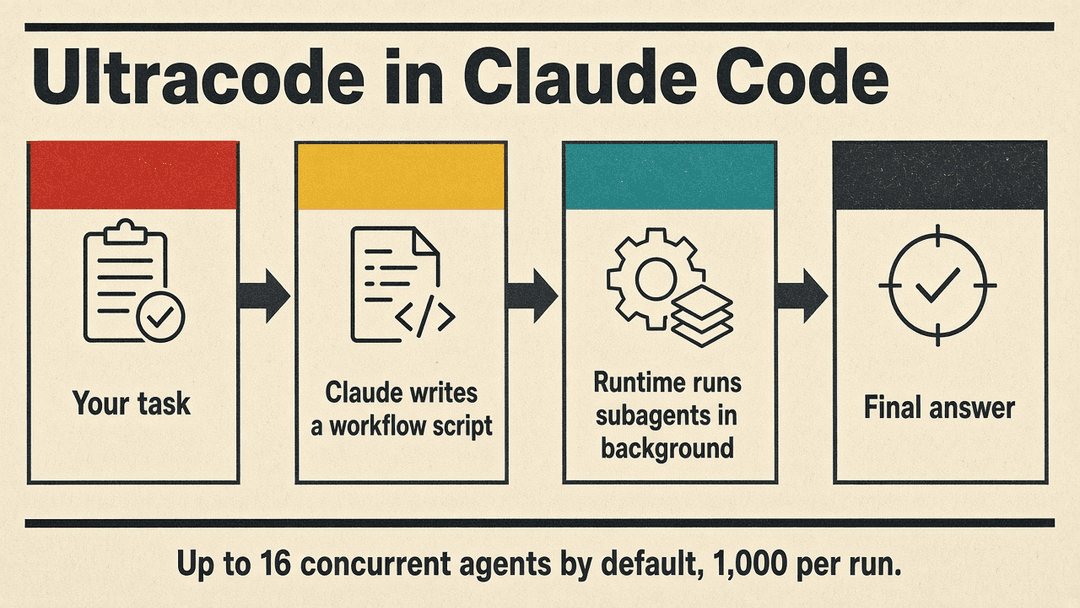
Per the workflows docs, a dynamic workflow is "a JavaScript script that orchestrates many subagents at once." Claude writes the script for the task, and a runtime executes it in the background while the session stays responsive. The key difference from ordinary subagents is who holds the plan. With subagents, Claude decides turn by turn and every result lands in its context window. With a workflow, the script holds the loop, branching, and intermediate results, "so Claude's context holds only the final answer."
The docs list typical uses: a codebase-wide bug sweep, a 500-file migration, research that needs sources cross-checked, and drafting a plan from several angles. Scripts use agent() to spawn a subagent, pipeline() to run one per item in a list, and parallel() to run tasks at the same time.
Three ways to use it
- Per prompt: include the keyword
ultracodein a prompt you type, or ask in plain words to "use a workflow." Claude writes a workflow for that one task without changing the session's effort level. - Per session: run
/effort ultracode. Claude then decides when each substantive task warrants a workflow. Turn it off with/effort ultracode off. - At launch or by default:
claude --effort ultracodestarts the session with ultracode on and effort atxhigh. Setting"ultracode": truein a settings file turns it on for every session.
The keyword only counts in prompts a person types. It does not start a workflow from a -p prompt, a scheduled task, or a webhook payload or pull request comment relayed into the conversation.
Limits and cost
The workflow runtime caps a run at 1,000 agents total and, by default, up to 16 concurrent agents, fewer on machines with fewer CPUs. The concurrency limit can be set from 1 to 256 with CLAUDE_CODE_WORKFLOW_MAX_CONCURRENT_AGENTS. Ultracode is unavailable when workflows are turned off or when the model does not support xhigh effort. Opus 5.5 supports low, medium, high, xhigh, and max.
The docs are blunt about cost. With ultracode on, "each request uses more tokens and takes longer than the same request without a workflow," and on a subscription plan a session "reaches a session or weekly limit sooner." Turning it on also removes some guardrails: the Large workflow warning (shown when a run schedules more than 25 agents or projects more than 1.5 million tokens) does not appear, the concurrent subagent limit for the Agent tool is not enforced, and in auto permission mode the first-launch approval is skipped.
Why it matters
Opus 5.5 compresses the gap between Anthropic's mid and top tiers. If Anthropic's numbers hold on real workloads, the default choice for agentic coding becomes a model that costs $4 and $20 per million tokens, with cache reads at $0.20, instead of Fable 5.1 at $10 and $50.
Ultracode is the other half of that bet. Cheaper tokens and cheaper cache reads make it more practical to fan a task out to dozens or hundreds of subagents, and Claude Code now has a first-class switch for doing exactly that. The tradeoff is that the per-request bill and usage-limit burn go up, which is why the docs recommend running a workflow on a small slice before pointing it at a whole repository.
