
This is an opinion piece. The facts below come from the linked sources; the argument is ours.
When a new AI model launches, the first thing most people see is where it lands on a public leaderboard. A spot near the top reads like a verdict: this is the best model, use this one. Our view is that a leaderboard rank is a useful hint and a poor decision. It tells you how a model did on that leaderboard, under that leaderboard's rules, and not much more about how it will do on your work.
The clearest case for this comes from The Leaderboard Illusion, a study by researchers from Cohere Labs, Cohere, Princeton, Stanford, Waterloo, MIT, Ai2 and the University of Washington. It looked at Chatbot Arena, the crowdsourced site where people compare answers from two anonymous models and vote for the better one. The authors describe it as "the go-to leaderboard for ranking the most capable AI systems." Their findings explain why even a well-run, popular ranking can drift away from what it is meant to measure.
Problem 1: the best of many tries looks like the typical try
The paper reports that some providers could test many private versions of a model on the Arena and then publish only the best score. At the extreme, the authors identify 27 private variants tested by Meta in the lead-up to its Llama 4 release.
Why does that matter? Every score has some luck in it. If you enter one version, you get one draw. If you enter 20 and keep the top one, you will usually get a lucky draw. In the paper's simulation, testing 20 variants raised the best score found by approximately 50 points compared with no private testing.
The authors also ran a real test. They entered two identical copies of one of their own models. The copies scored 1052 and 1069, and 4 other models landed between them on the leaderboard. Same model, different rank, with no difference in model quality. For a reader, the lesson is simple: a gap of a few places near the top can be smaller than the noise.
Problem 2: whoever gets more practice data can learn the test
The second issue is data. According to the paper, the Arena showed proprietary models more often, so their makers received more of the prompts and votes. The authors estimate that Google and OpenAI received 19.2% and 20.4% of all Arena data, while 83 open-weight models together received an estimated 29.7%.
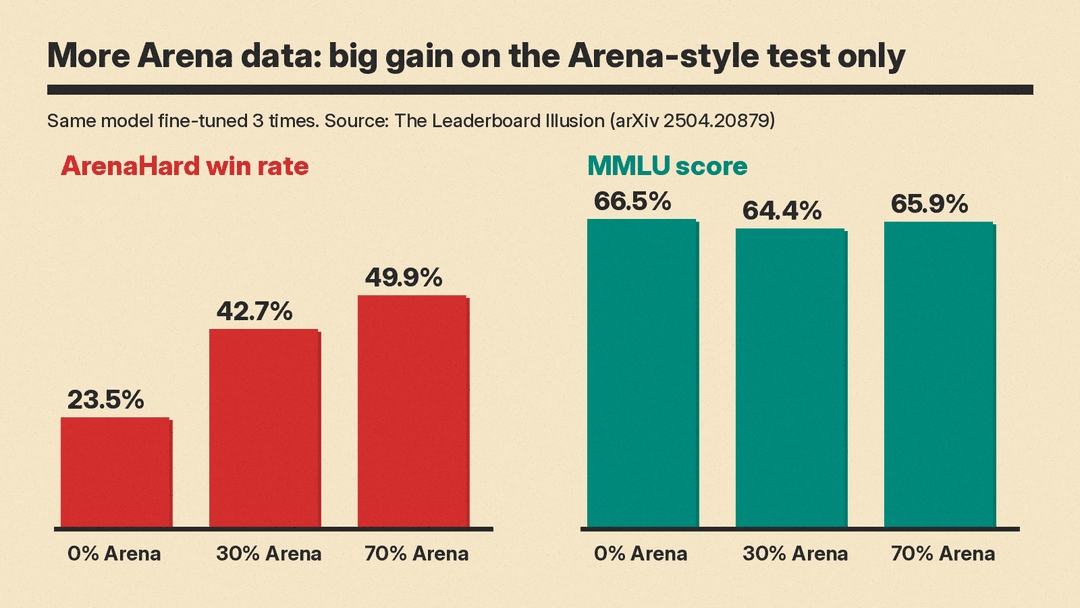
Then they tested what that data is worth. They fine-tuned the same small model three times with 0%, 30% and 70% Arena data in the training mix and measured win rates on ArenaHard, a test set built from Arena prompts. The win rate went from 23.5% to 42.7% to 49.9%, which more than doubled it. On MMLU, a general knowledge test outside the Arena's style, the same models went from 66.5% to 64.4% to 65.9%, a slight decline. In the authors' words, the gains from Arena data are "highly specific and do not translate to broader generalization."
That is the core of our argument. A model can get better at a leaderboard without getting better at the things you need. This is not unique to one site. It is what happens to any score that matters enough for companies to aim at it, and the paper itself cites Goodhart's law: when a measure becomes a target, it stops being a good measure.
The other side
The organizers dispute the study. LM Arena co-founder Ion Stoica told TechCrunch that it was full of "inaccuracies" and "questionable analysis." LM Arena also said that "if a model provider chooses to submit more tests than another model provider, this does not mean the second model provider is treated unfairly," and, per TechCrunch, that ArenaHard performance does not directly correlate to Chatbot Arena performance. TechCrunch also notes a real limit of the study: it relied on models naming their own maker to work out who was behind private variants, a method that "isn't foolproof." The authors say the same in their limitations section.
Those are fair points, and they do not change our conclusion. Even if every number in the paper were cut in half, the mechanisms would remain. Best-of-many selection inflates scores. Practice on a test's own style of questions lifts scores on that test. Neither needs bad intent. Both mean a rank answers a narrower question than most readers think.
Who wins and who loses
Big providers win when leaderboards are treated as final answers. The paper finds that a handful of providers could test many private variants and received more of the feedback data. Smaller labs and open-weight models lose, because they get fewer chances to tune for the same test. The paper's own numbers on data share point that way.
Readers lose too, in a quieter way. If you pick a chatbot or an API because it sits a few places higher, you may be paying for a better test score rather than better help with your writing, code or customer emails. We made a related case in Model Loyalty Is Over: the teams that do best are the ones that can switch models easily, which only works if you judge models on your own tasks.
What to do instead
Treat leaderboards like restaurant ratings. They are good for building a short list and bad for picking the final dish. Then test the short list yourself:
- Collect 10 to 20 real prompts from your own work, including a few that went badly with your current tool.
- Run the same prompts through two or three candidates, without looking at which model wrote which answer if you can.
- Score what you care about: correct facts, following instructions, tone, length, and how often you would need to fix the result.
- Repeat the test when you switch or when a tool changes its model, since a new version is a new model to test.
It also helps to compare a lab's own numbers with independent ones. We looked at that gap in Do AI Labs Inflate Benchmark Scores?, and for agent work our guide to agent evaluation benchmarks explains what each common test actually measures.
The bottom line: a leaderboard rank is the start of your research, not the end of it. The only ranking that should decide which model you use is the one you run on your own work.
