
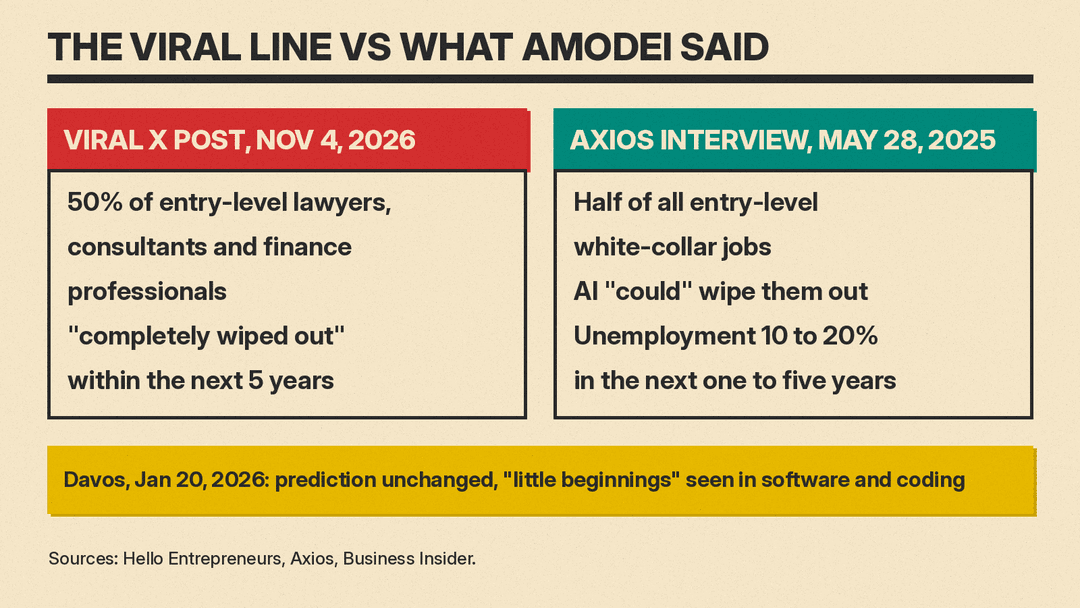
A line attributed to Anthropic CEO Dario Amodei is circulating on X again. It says 50% of entry-level lawyers, consultants and finance professionals will be "completely wiped out" within five years. The wording is not his. It is a compressed summary of a forecast he made in 2025, and it drops the parts that matter most.
The difference matters if you are choosing a major, applying for your first job, or switching careers. A forecast with a range and a condition leads to different decisions than a flat claim about half of a profession. This piece compares what Amodei actually said with what hiring and payroll data show as of November 2026, then lists practical steps you can take now.
What is the claim going around X?
On November 4, 2026, the X account @IndianTechGuide posted the "completely wiped out" line and attributed it to Amodei. Hello Entrepreneurs wrote about the line going viral. That article calls the line "a compressed summary" and notes that the original warning dates to 2025.
Three things changed between the original warning and the viral version. The original is about entry-level white-collar jobs overall, with law, finance and consulting named as examples. It uses conditional language, with the word "could", and the words "completely wiped out" do not appear in it. It gives a range of one to five years rather than a fixed five-year deadline.
What did Amodei actually say?
The first version appeared in an Axios interview on May 28, 2025. Amodei told Axios that AI could wipe out half of all entry-level white-collar jobs and spike unemployment to 10 to 20% in the next one to five years. He named technology, finance, law and consulting as exposed sectors. Axios reported that he wants AI companies and government to stop sugar-coating "the possible mass elimination of jobs" in those fields, especially entry-level gigs.
Amodei also defended saying this out loud. He said: "We, as the producers of this technology, have a duty and an obligation to be honest about what is coming." In the same interview he floated a "token tax" idea, suggesting perhaps 3% of AI company revenue.
He returned to the forecast in his essay The Adolescence of Technology. There he restated that he predicted AI "could displace half of all entry-level white collar jobs" in 1 to 5 years. He explained the reasoning by pointing to shared skills across roles. He wrote that "the general intellectual abilities required for entry-level jobs in, say, finance, consulting, and law are fairly similar, even if the specific knowledge is quite different." That similarity is why one model can affect several professions at once.
He also pushed back on a narrow framing. He wrote that AI "isn't a substitute for specific human jobs but rather a general labor substitute for humans".
At Davos on January 20, 2026, in a joint interview with Google DeepMind CEO Demis Hassabis, he said the prediction still stood. According to Business Insider, his prediction had not changed. He added: "Now I think maybe we're starting to see just the little beginnings of it, in software and coding." He also described what he expects inside his own company: "I can see it within Anthropic, where I can look forward to a time where on the more junior end and then on the more intermediate end we actually need less and not more people."
Hassabis said: "I think we're going to see this year the beginnings of maybe it impacting the junior level."
So the claim is a forecast with a range, about entry-level white-collar work in general. It is not a statement that half of lawyers will be wiped out.
What does the data show so far?
The strongest economy-wide evidence comes from Stanford. The paper "Canaries in the Coal Mine?", revised August 12, 2026, is by Erik Brynjolfsson, Bharat Chandar and Ruyu Chen. It uses ADP payroll data through June 2026.
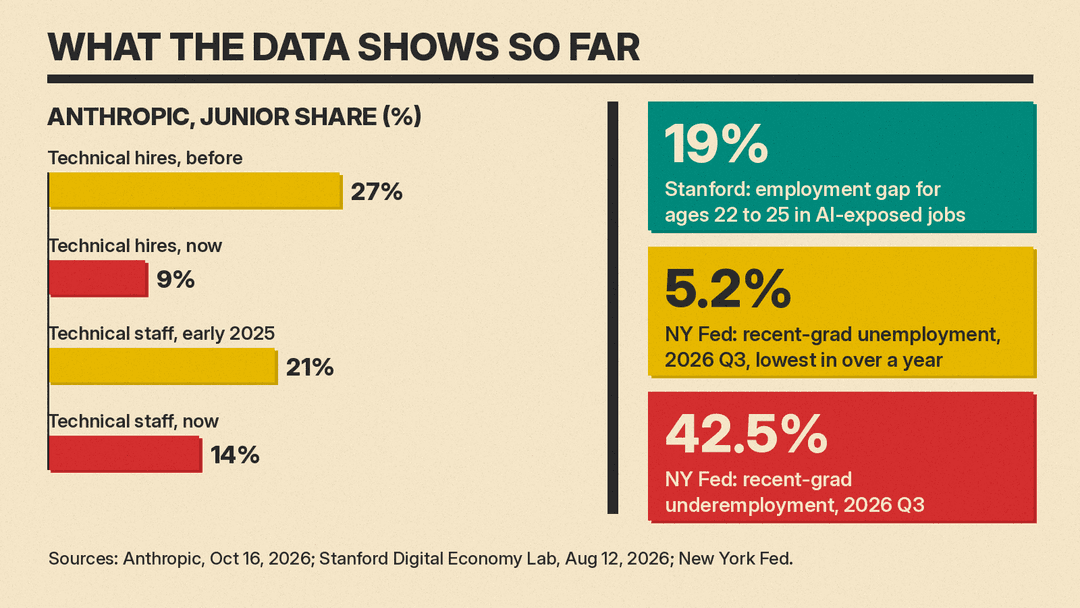
Its headline findings are mixed, and the mix is the point. The authors find no evidence of widespread, economy-wide job displacement. At the same time, employment of workers aged 22 to 25 in AI-exposed occupations sits 19% below where it would be if that group had kept pace with less-exposed peers. Experienced workers show no comparable gap. The gap has widened since the authors first documented it in August 2025.
The mechanism matters for job seekers. The gap works mainly through reduced hiring of young workers rather than through more separations. In plain terms, the gap comes mostly from fewer young people being hired, not from more of them leaving jobs. The declines concentrate where AI substitutes for tasks. Where AI complements workers, employment is flat or rising. The authors are careful to call these early, descriptive indicators, not causal estimates. They also note that the patterns weaken when they control for education, that some trends began before generative AI, and that the gap is larger in the ADP sample than in national survey data.
The New York Fed gives a broader picture of the graduate market. The Labor Market for Recent College Graduates, for 2026 Q3, reports that conditions improved but remained challenging. The unemployment rate for recent graduates aged 22 to 27 fell to 5.2%, the lowest level in more than a year. Underemployment ticked up to 42.5%. The New York Fed does not attribute these figures to AI. The New York Fed counts a graduate as underemployed when they work in a job that typically does not require a college degree.
What does Anthropic's own hiring look like?
Anthropic published a report on October 16, 2026, titled How employment is changing at Anthropic. It is a useful test case because the company building the models is also an employer.
The junior share of technical hires fell from 27% to 9%. The junior share of employees in technical departments slipped from 21% to 14% since early 2025. Postings aimed at juniors fell particularly sharply since December 2025. Technical hiring continued to grow in absolute terms as the company expanded, so the junior share fell while technical hiring overall kept growing.
The report also describes what hiring managers now look for. They increasingly emphasize autonomy and judgment relative to technical domain expertise. Mentions of candidates' track record with AI tools tripled for technical roles and quadrupled for non-technical roles between 2024 and 2026. The report says none of the steps Anthropic describes "directly address the slowdown in junior hires".
One caution, in our reading: Anthropic is a single fast-growing company, so its numbers are a signal, not a national statistic.
Does the forecast match the data?
This is our reading, not a claim by any of the researchers cited.
The data shows fewer entry-level openings in AI-exposed work. It does not show a collapse. The Stanford 19% gap is a real and widening shortfall for young workers in exposed occupations, but the same paper finds no evidence of widespread, economy-wide job displacement, and the recent-graduate unemployment rate is at its lowest point in over a year.
The forecast has also not run out of time. Counting from May 2025, the far end of the stated range reaches 2030. On the evidence available in November 2026, the prediction is neither confirmed nor disproven. What is confirmed is direction. Junior hiring is thinner in the places AI touches most, and employers are describing the skills they want in different terms than they did two years ago.
What this means if you are starting out
The practical response is not to avoid AI-exposed fields entirely. It is to change what you prove to employers before they hire you.
Show that you use AI tools well. Anthropic's report found that mentions of candidates' track record with AI tools tripled for technical roles and quadrupled for non-technical roles between 2024 and 2026. Treat tool fluency as a line item on your resume, with the tasks you completed, not as a skill you list without evidence.
Show judgment and autonomy. The same report found that hiring managers increasingly emphasize autonomy and judgment relative to technical domain expertise. Our suggestion: be ready to point to work you finished on your own, such as a short write-up of a problem you scoped, solved and checked.
Aim at work where AI complements rather than substitutes. The Stanford paper found that declines concentrate where AI substitutes for tasks, while employment is flat or rising where AI complements workers. Our suggestion: when you compare roles, ask whether the core of the job is producing text and numbers from a template, or whether it involves negotiating, being accountable for a result, or working with physical or human systems that a model cannot reach.
Build proof of work you can link to. We have written about the specific projects that hold up in interviews in AI portfolio projects that get interviews. If you are coming from another field, AI jobs without a CS degree looks at what hiring data says about degree requirements. For more on the Anthropic numbers, see our earlier look at Anthropic's junior hiring data.
Watch for scams that exploit exactly this anxiety. Our guide to remote AI job scams separates real entry-level AI work from job scams that ask you to pay to get paid.
Track the market with data rather than headlines. Software engineer jobs and AI data looks at Indeed postings and Bureau of Labor Statistics data for software roles.
Bottom line
The viral line is not what Amodei said. He predicted AI could displace half of entry-level white-collar jobs in one to five years, with conditional language and a range. Data through mid 2026 shows a real squeeze on young workers in AI-exposed occupations and a sharp shift in Anthropic's junior hiring mix, alongside no evidence of widespread displacement and a lower recent-graduate unemployment rate. The forecast window is still open. Your best move is to build visible proof of skill, emphasize work where AI assists rather than replaces you, and check the numbers yourself.
Sources
- Hello Entrepreneurs on the viral line, November 5, 2026
- X post by @IndianTechGuide, November 4, 2026
- Axios: Amodei on AI, white-collar jobs and unemployment, May 28, 2025
- Dario Amodei, The Adolescence of Technology
- Business Insider: Anthropic and Google DeepMind CEOs on junior roles at Davos, January 20, 2026
- Anthropic research: How employment is changing at Anthropic, October 16, 2026
- Stanford Digital Economy Lab: Canaries in the Coal Mine?, revised August 12, 2026
- New York Fed: The Labor Market for Recent College Graduates
