
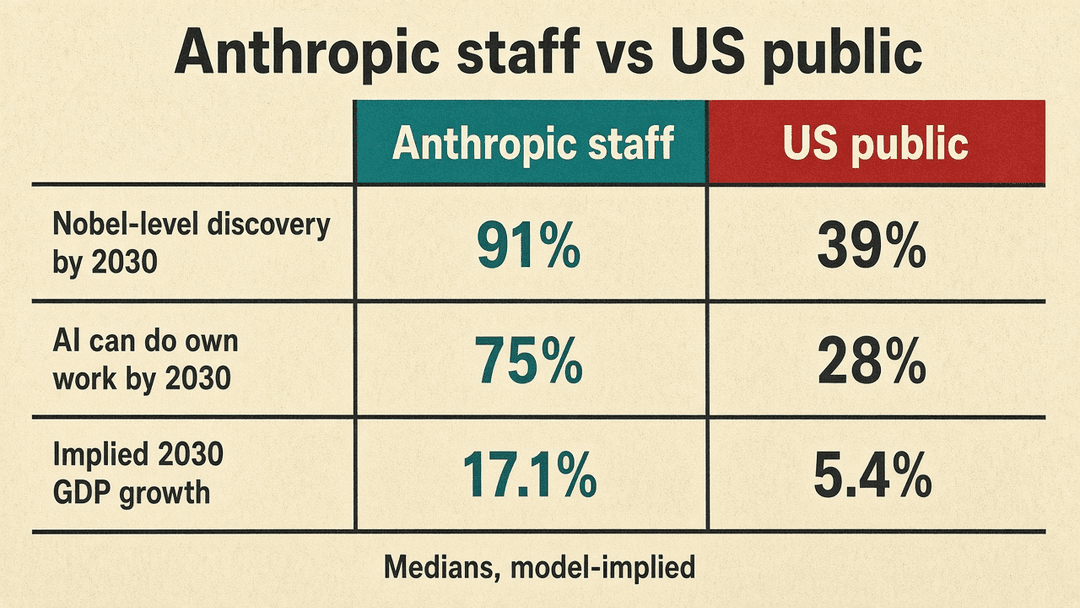
Anthropic surveyed its own staff and a nationally representative sample of the US public about where AI is headed, then ran both sets of answers through its economic model. The result, published on October 16 as The AI Expectations Gap, is a clean measure of how far apart the people building frontier AI and everyone else are. The median staff member's answers imply US GDP growth of 17.1% in 2030. The median US adult's imply 5.4%.
That 17.1% figure has been quoted widely since. It is worth being precise about what it is: a model output derived from survey answers, not a forecast by Anthropic.
Who was surveyed
The report, by Szymon Sacher, Tess Cotter, Charles I. Jones, Anton Korinek, and Peter McCrory of the Anthropic Institute, draws on two surveys from August 2026:
- US public: fielded online by Morning Consult from August 11 to 23, reaching 10,980 people, weighted to be representative of the adult population. Half were asked about 2027 and half about 2030; the report uses the 2030 answers unless stated otherwise.
- Anthropic staff: an internal poll from August 9 to 12 with 1,334 respondents from every part of the company, unweighted, all asked about 2030.
Anthropic notes the public survey used opt-in online panelists, so it excludes adults without internet access and may differ from the population in ways weighting cannot fix.
Where the two groups disagree
The headline finding is that the groups largely agree on what AI can do today, and split sharply on how fast it will improve.
- Nobel-level discovery by 2030: 91% of staff expect AI to be able to do it, compared with 39% of US public.
- "Never": between 19% and 40% of US public, depending on the task, say AI will never be able to do a given task, compared with at most 2% of staff.
- Time savings: among US public who use AI at work, 26% say a well-suited task takes a quarter of the time or less with AI. For staff, that share is 59%.
- Their own jobs: on average, staff expect AI to be able to do 75% of their current work hours by 2030. US workers put the figure at 28%, and only 1 in 20 say AI could do 80% or more of their work by then.
- Adoption: of the work tasks AI will be able to do, US public expect 42% to be done with AI by 2030. Staff expect 65%.
One finding cuts against the idea that staff simply hold a different worldview. In both groups, people who expect AI to do more of their own work forecast higher unemployment, and at the same level of expected automation, both groups forecast about the same unemployment rate. Respondents were told unemployment is about 4.2% today. US workers who expect AI to do 80% or more of their work forecast an average of 12.2% in 2030. Anthropic's read is that the two groups reason about the labor market the same way; they differ in what they expect AI to be able to do.
How the 17.1% figure was produced
The GDP numbers come from mapping each respondent's answers onto the model in Anthropic's earlier paper, Economic Scenarios for Transformative AI. Five inputs feed it: capabilities, diffusion, automation, productivity, and worker transition frictions. All other model parameters are held at their values in the paper's "Substantial" scenario.
Only respondents who answered every key question were included: 3,259 US public and 1,093 staff. From that:
| Group | Model-implied GDP growth in 2030 |
|---|---|
| Median US adult | 5.4% |
| Median website quiz visitor | 12.5% |
| Median Anthropic staff member | 17.1% |
For reference, the paper's three scenarios are Modest (2.4% annual GDP growth), Substantial (5.4%), and Extreme (15.4%). The staff median lands above Extreme. In the report's conclusion, Anthropic puts the staff view this way: by 2030, "GDP is doubling in size roughly every four and a half years."
The report flags several limits itself. There is "significant variation within each group, so the distributions overlap widely." The 12.5% visitor figure comes from 23,075 people who took a shorter quiz in the 48 hours after Anthropic published its scenario explorer on September 9, and who "are likely to be more interested in AI than the general public." And a repeat public survey in September, with 7,613 US public, produced a median of 5.6%, so the public number held steady.
Staff expect hiring to grow anyway
Despite expecting AI to do most of their work, 95% of staff expect Anthropic's headcount to grow over the next 12 months. The median expects 66% growth, and 27% expect it at least to double. Anthropic stresses that these "are the personal expectations of staff members in an internal poll and do not represent Anthropic's plans or its view of its headcount."
Staff were also asked how much of the work of building an early-2026 frontier model AI does today. The median answer was 51%, rising to 80% by the end of 2027 and 95% by the end of 2030. Again, Anthropic labels these personal estimates, "not a measurement by Anthropic or a company forecast."
The junior hiring drop
The junior hiring numbers often reported alongside this survey come from a companion report published the same day, How employment is changing at Anthropic, by Nathan Wilmers, Regina Catipon, Maxim Massenkoff, and Peter McCrory. It uses internal employment, hiring, and AI-use data plus 17 employee interviews. Its findings:
- The share of junior-level employees in technical departments slipped from 21% to 14% since early 2025.
- The proportion of junior technical hires fell faster, from 27% to 9%.
- Postings for juniors have fallen particularly sharply since December 2025.
- By April, engineering and research teams had deemphasized hiring for lower band technical positions, and around a third of ML managers and a fifth of SWE managers reported hiring less due to AI.
These are shares, not absolute cuts. The report says technical hiring has kept growing in absolute terms as the company expands, while hiring in sales, finance, and recruiting has grown faster. It also notes that interactive AI agent hours outnumbered employee hours six to one by August, and that the median employee spends 20% more time in meetings than a year ago.
Why it matters
The survey gives a number to something that is usually argued anecdotally: people at a frontier lab expect much faster change than the public, and the gap is mostly about capabilities and adoption, not about how the economy works. That matters for policy debates where lab forecasts are treated as either inside information or self-interest.
The companion data adds the uncomfortable part. Inside the company whose staff are most bullish, the share of junior technical roles is already shrinking. Anthropic's own report says none of its internal measures "directly address the slowdown in junior hires," and that employer action has to come alongside government policy on retraining and income support.
