

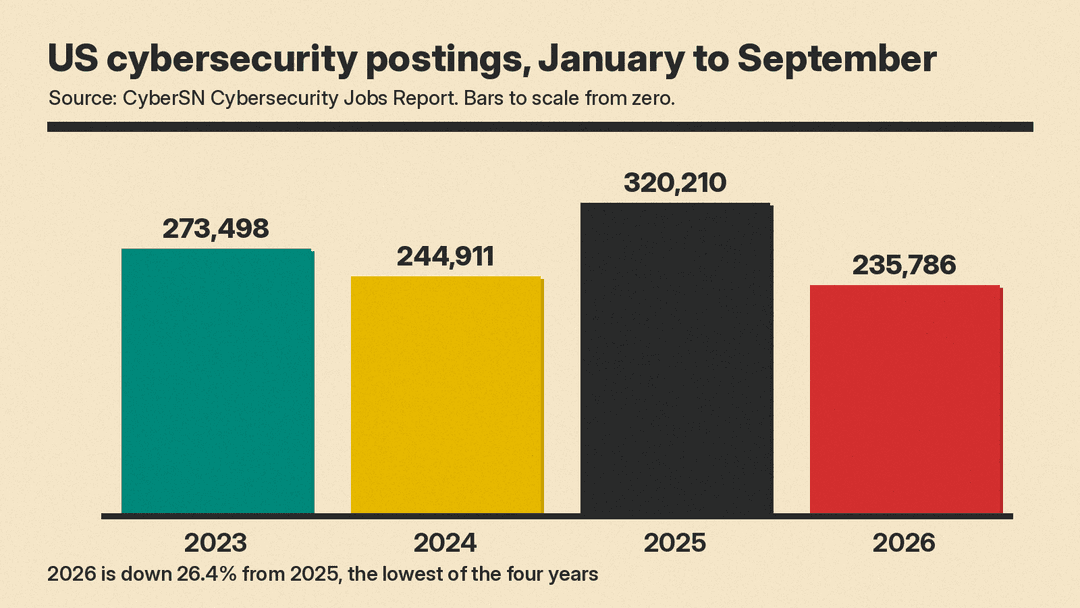
US employers posted fewer cybersecurity jobs in the first nine months of 2026 than in any of the previous three years, according to CyberSN's Cybersecurity Jobs Report. One small role moved the other way: postings for AI Security Engineer rose 268.3%. Below are the figures as CyberSN reports them, what the role involves, and the free and paid resources that map to what employers ask for, all checked as of October 2026.
What CyberSN found
CyberSN, a cybersecurity recruiting and workforce intelligence firm, counts US job postings from the JobSpikr dataset with duplicates removed, then sorts each posting into its own taxonomy of cybersecurity roles by the work described rather than the job title. The report says its data was pulled October 7, 2026. Infosecurity Magazine reports that it was published on October 16.
The headline numbers, from the report page:
- 235,786 US cybersecurity job postings from January to September 2026, down 26.4% from 320,210 in the same months of 2025.
- The same nine months ran 273,498 in 2023 and 244,911 in 2024, which makes 2026 the lowest of the four years CyberSN tracks.
- Eight of the nine months ran below the same month of 2025. September was the exception, at 27,951 against 27,582.
- At the current pace, CyberSN projects 288,911 to 325,540 postings for the full year, which it calls "a seasonal pace estimate, not a prediction of any event." Full year 2025 had 392,356.
Leadership roles fell sharply. Postings with an Information Security Officer title, CISO included, fell 38.9% to 2,832, which CyberSN notes is close to the 2,808 seen in the same months of 2024. Cybersecurity Lead fell 41.0%. Outside leadership, Penetration Tester fell 45.9%.
CyberSN is explicit about the limits: "Every number here counts job postings: what employers asked for, not jobs or people." A drop in postings is not the same as a drop in employment, and the report does not try to explain why demand fell.
The AI security exception
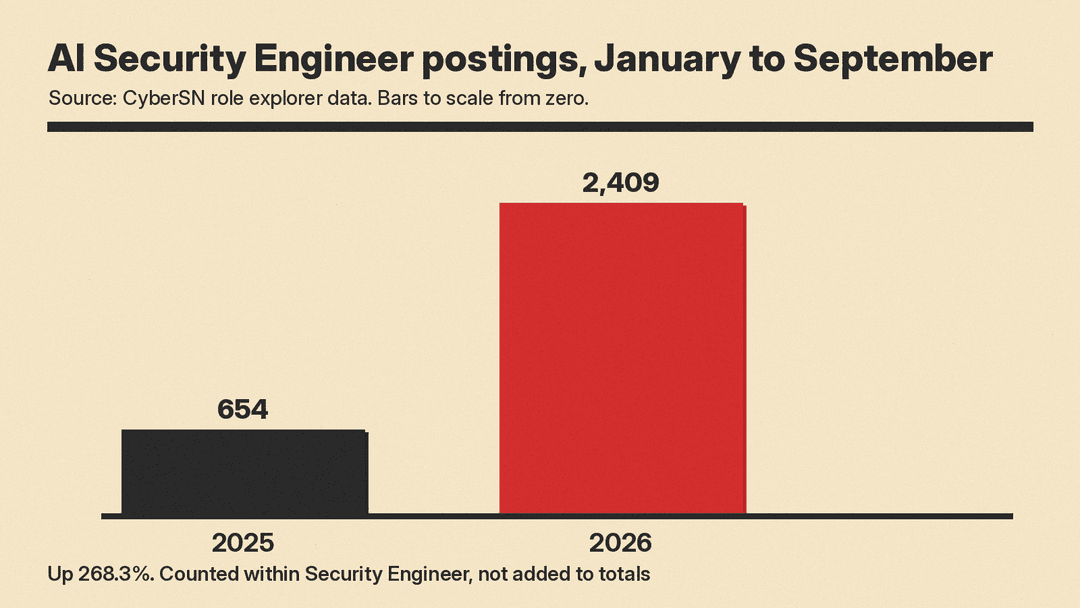
In CyberSN's role table, AI Security Engineer shows 2,409 postings from January to September 2026, up 268.3% on the same months of 2025. The page text does not print the 2025 count, but the data the page loads for its role explorer lists 654 postings for the prior period, which matches the percentage.
Two things put that in context:
- It is a small base. 2,409 postings is about 1% of the 235,786 total.
- CyberSN treats AI Security Engineer as a subset of Security Engineer, so it is "shown within their function for orientation without being added to totals." Security Engineer itself fell 32.3% to 44,083 postings.
The other AI-heavy role on the rise was Cyber Data Scientist, up 203.5% to 1,493 postings. Across all tracked roles, 14.6% of postings mentioned AI or machine learning terms, roughly level with 15.1% a year earlier, but CyberSN says the share was rising through the year and hit 20.0% in September, its highest month since January 2025.
The role explorer data also gives a profile of AI Security Engineer postings for January to September 2026: 76.5% mention AI or machine learning terms, 31.6% are flagged remote, 6.2% are contracts, and 6.7% are inferred as entry level. That last figure matters for anyone planning a move. Most of these postings expect experience.
What an AI Security Engineer does
CyberSN's AI Security Engineer role page describes the job as protecting "AI and machine learning systems, securing models, training data, and the AI supply chain while evaluating those systems for weaknesses such as prompt injection and data poisoning." It classes the role as mid career, within the Defense function.
The tasks it lists:
- Assess AI and machine learning systems for prompt injection, jailbreaking, data poisoning, and model extraction
- Design security controls for AI-enabled products and internal AI tools
- Protect training data, model weights, and inference endpoints
- Secure the AI supply chain, including third-party models, datasets, and frameworks
- Run adversarial testing and red team exercises before and after deployment
- Define guardrails, input and output filtering, and access controls for LLM applications
- Set standards for safe internal AI use with security, engineering, and governance teams
- Investigate AI-related security incidents
Job titles vary. CyberSN groups AI/ML Security Engineer, Machine Learning Security Engineer, GenAI Security Engineer, LLM Security Engineer, AI Application Security Engineer, and AI Red Team Engineer under this role, so a job search should use all of them.
Skills and tools employers ask for
CyberSN's role page lists the common technologies and environments:
- AI security testing: adversarial testing and AI red teaming frameworks, prompt injection and jailbreak test suites, model and dataset scanning tools
- ML platforms and pipelines: PyTorch and TensorFlow, model registries and MLOps pipelines, cloud AI services, vector databases
- Standards and guidance: MITRE ATLAS, the OWASP Top 10 for LLM Applications, and the NIST AI Risk Management Framework
On machine learning depth, CyberSN says you need "working literacy in how machine learning systems are built and deployed" but "you do not need to be a research scientist." It names Security Engineer, Application Security Engineer, and Machine Learning Engineer as common ways into the role, and Security Architect and Cybersecurity Manager as where it can lead.
How to get into AI security
The path below follows the role page: a security base, then the shared frameworks, then hands-on testing, then proof of work. Each resource was opened and checked in October 2026.
Security foundations
Most people enter from security engineering or application security. If you are coming from ML or software instead, PortSwigger's Web Security Academy describes itself as "free, online web security training from the creators of Burp Suite." It covers the classic web vulnerabilities that LLM features sit on top of, and its Web LLM attacks topic explains how attackers use a model's access to data and APIs, comparing it to server-side request forgery. That topic links to its own set of labs.
The shared frameworks
These three come up on the role page and give the field a common vocabulary. All are free to read.
- OWASP Top 10 for LLM Applications: the 2025 list runs from LLM01 Prompt Injection through Sensitive Information Disclosure, Supply Chain, Data and Model Poisoning, Improper Output Handling, Excessive Agency, System Prompt Leakage, Vector and Embedding Weaknesses, and Misinformation to LLM10 Unbounded Consumption. The OWASP project page notes it has grown into the wider OWASP GenAI Security Project, with work on agentic security and AI red teaming.
- MITRE ATLAS: a knowledge base of adversary tactics, techniques, and case studies against AI systems. The underlying data is public in the atlas-data repository on GitHub.
- NIST AI Risk Management Framework: released January 26, 2023 and "intended for voluntary use." NIST says AI RMF 1.0 "is being revised as part of the White House AI Action Plan." The companion Generative AI Profile, NIST AI 600-1, was published July 26, 2024.
Google's Secure AI Framework (SAIF) is a useful fourth. It walks through 15 AI security risks and the controls that address them, and adds an agent risk self assessment.
Hands-on testing
The role page puts adversarial testing at the center of the job. These let you practice it for free:
- Red Teaming LLM Applications on DeepLearning.AI: a beginner short course listed at 1h39m with 7 video lessons, taught by Matteo Dora and Luca Martial of Giskard. The page shows "Enroll for Free"; a certificate of accomplishment requires the paid PRO plan. Basic Python is recommended.
- PyRIT: Microsoft's Python Risk Identification Tool, "an open source framework built to empower security professionals and engineers to proactively identify risks in generative AI systems." MIT license.
- garak: NVIDIA's open source LLM vulnerability scanner. Apache 2.0 license.
- promptfoo: an open source tool to test prompts, agents, and RAG systems, with red teaming and vulnerability scanning. MIT license.
Running these against hosted models will cost whatever the model API charges. You can point them at a local open-weight model to avoid that.
Certifications
CyberSN lists three certifications often held by AI Security Engineers and says "none are universally required," adding that hands-on experience "carries at least as much weight."
- AIGP from the IAPP: AI governance. The exam is sold through the IAPP, which offers a free body of knowledge, exam blueprint, and study guide.
- AAISM from ISACA: AI security management. ISACA requires an active CISM or CISSP and aims it at people with security or advisory experience and some AI expertise.
- CISSP from ISC2: the broad security certification CyberSN suggests pairing with the two above.
Proof of work
CyberSN's advice on the role is that "demonstrated hands-on work, such as AI red teaming or securing production ML systems, carries at least as much weight as any certification." A practical version: pick an open source LLM app, run garak or PyRIT against it, map each finding to its OWASP Top 10 for LLM Applications entry and ATLAS technique, and publish the write-up.
How to read the market
The broader report has advice that applies here too. CyberSN suggests searching "by the work, not the title," since employers use many titles for the same job. It also notes that August and January carried the most postings on average from 2023 to 2025, and December the fewest. With only 6.7% of AI Security Engineer postings inferred as entry level, the realistic route for most people is to get a security engineering or application security job first and move into AI security from there.
Coverage at SecurityWeek summed up the report as "a mixed bag." The numbers support that reading. Overall demand is lower than in any of the last four years, while one small, specialized role is growing quickly.
Sources
- CyberSN: Cybersecurity Jobs Report, 2026 through September
- CyberSN: AI Security Engineer role page
- Infosecurity Magazine: US Cybersecurity Job Postings Fall 26%, Hitting Four Year Low
- SecurityWeek: US Cybersecurity Job Postings Fall 26% as AI Security Engineer Demand Soars
- OWASP Top 10 for LLM Applications 2025
- OWASP Top 10 for Large Language Model Applications project
- MITRE ATLAS
- MITRE ATLAS data on GitHub
- NIST AI Risk Management Framework
- NIST AI 600-1 Generative AI Profile
- Google Secure AI Framework (SAIF)
- PortSwigger Web Security Academy
- PortSwigger: Web LLM attacks
- DeepLearning.AI: Red Teaming LLM Applications
- Microsoft PyRIT
- NVIDIA garak
- promptfoo
- IAPP AIGP
- ISACA AAISM
- ISC2 CISSP
