
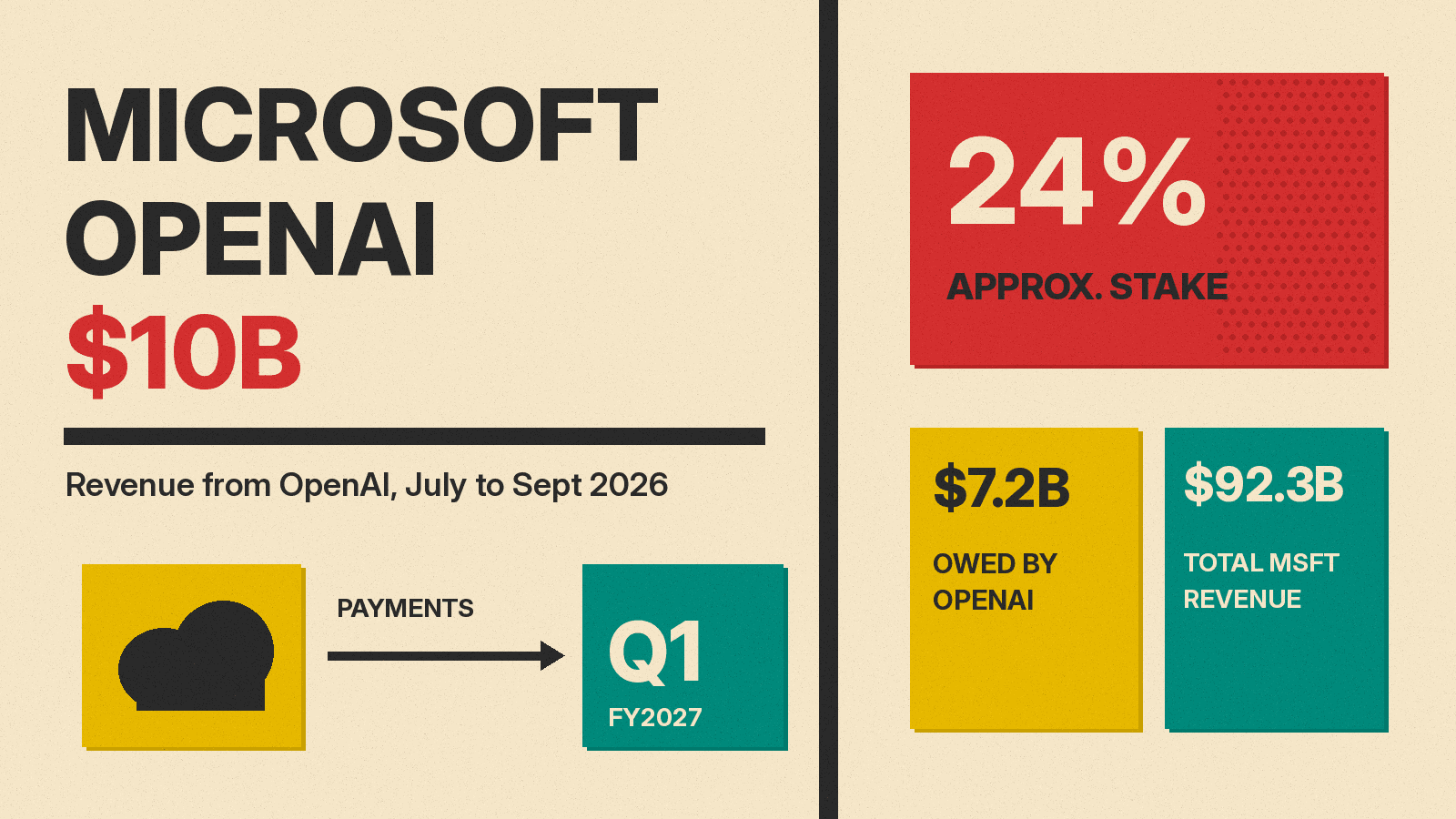
Microsoft booked $10.0 billion in revenue from its business with OpenAI in the three months to September 30, 2026, according to the quarterly report it filed on October 28. The number shows how much money now flows from the ChatGPT maker back to Microsoft, which owns about a quarter of it.
The figure sits in a short related-party note in Microsoft's Form 10-Q. Because Microsoft accounts for its OpenAI stake under the equity method, OpenAI is a "related party" under US accounting rules (ASC 850), and Microsoft must disclose revenue and receivables from it.
What the filing says
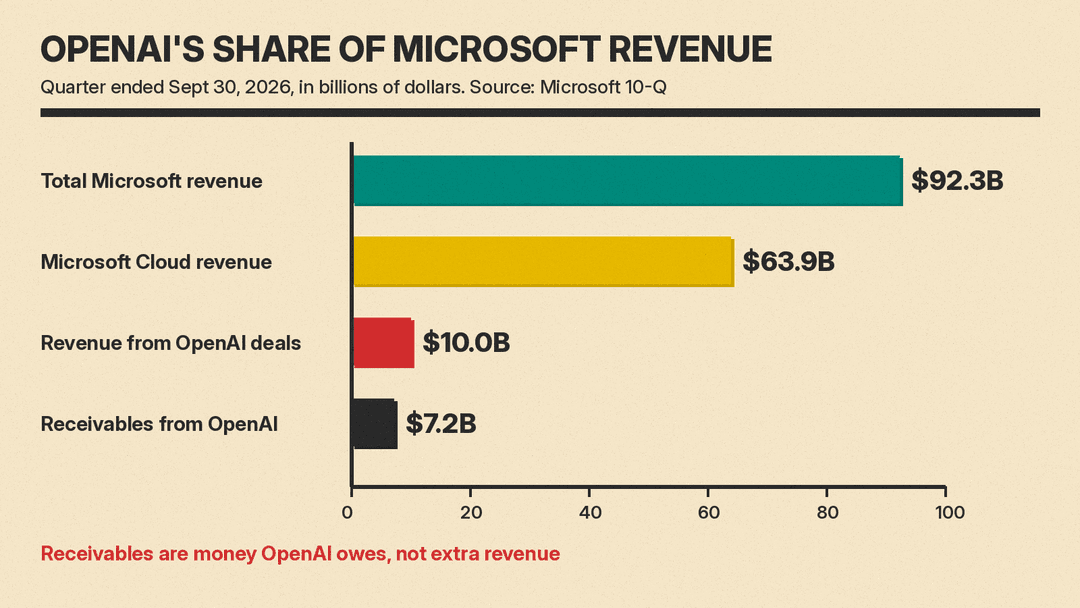
The note reads: "For the three months ended September 30, 2026, we recorded revenue from commercial arrangements with OpenAI, inclusive of revenue-sharing payments, of $10.0 billion." It adds that accounts receivable from OpenAI were $7.2 billion on September 30, up from $6.0 billion on June 30.
The same note says Microsoft holds "an approximate 24% interest on an as-converted basis" in OpenAI, accounted for under the equity method. It also says Microsoft has made total funding commitments of $13.0 billion related to the investment, of which $12.0 billion had been funded as of September 30.
Other OpenAI lines in the filing:
- Other income included $272 million of net gains from investments in OpenAI this quarter. A year earlier, the same line was $4.1 billion of net losses.
- After tax, the OpenAI gains added $207 million to net income and $0.03 to diluted earnings per share, Microsoft said in its earnings release. A year ago, OpenAI losses cut net income by $3.1 billion.
- Microsoft's "adjusted" non-GAAP results exclude net gains and losses from OpenAI investments. Microsoft says these measures "aid investors by providing additional insight into our financial performance."
- The business overview says Microsoft "is a major investor in OpenAI and will continue to receive revenue-sharing payments" and holds rights to OpenAI's intellectual property, "including models and infrastructure."
How big is $10 billion for Microsoft
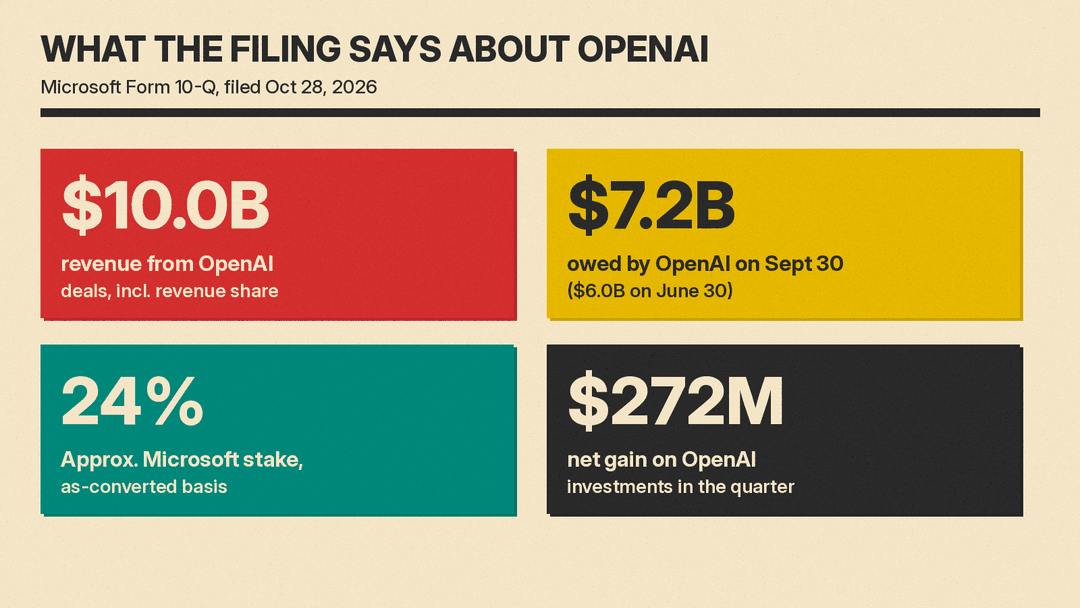
Microsoft's total revenue for the quarter was $92.3 billion, up 19% from a year earlier. So OpenAI-related revenue was nearly 11% of the total, a share TechCrunch also reported.
For context, the 10-Q puts Microsoft Cloud revenue, which includes Azure, Microsoft 365 commercial cloud and Industry solutions cloud, at $63.9 billion for the quarter, up 30%. Azure revenue grew 48%. Commercial remaining performance obligation, the contracted revenue not yet recognized, rose 73% to $677 billion.
TechCrunch also reported that Microsoft's revenue from OpenAI was $24.1 billion for the full 2026 fiscal year, which ended June 30. That is an average of about $6 billion a quarter, well below this quarter's $10.0 billion. TechCrunch notes that at the latest pace, OpenAI-related revenue would reach about $40 billion a year.
What the filing does not say
Microsoft does not split the $10.0 billion between revenue-sharing payments and what OpenAI pays for Azure cloud computing. TechCrunch said it is not clear how much came from each, and that it had asked for more information.
The receivables figure is also easy to misread. The $7.2 billion is money OpenAI owes Microsoft for past transactions. As TechCrunch put it, it represents "amounts OpenAI owes for previous transactions, not additional revenue." A rise from $6.0 billion to $7.2 billion means the unpaid balance grew during the quarter. The related-party note gives no payment schedule.
The filing does not confirm the size of the revenue share. TechCrunch reports that OpenAI "reportedly shares 20% of its revenue with Microsoft," and adds that neither company has publicly confirmed this percentage.
Why the deal looks like this now
The two companies have loosened their partnership over the past year. According to TechCrunch, Microsoft gave up its hold on OpenAI in October 2025 so the startup could work with other cloud providers, and OpenAI in return committed to buy an additional $250 billion in Azure services. Under an April 2026 agreement, TechCrunch reports, OpenAI must keep sharing revenue with Microsoft through 2030, subject to a cap, even as it works with competing clouds.
TechCrunch also reports that Microsoft's stake has slipped from about 25% in June to 24% in September, down from roughly 27% after OpenAI's October 2025 recapitalization. Microsoft did not say what caused the dilution.
For a wider look at where OpenAI's money comes from, see our explainer on how OpenAI makes money, and for OpenAI's side of the ledger, our report on OpenAI's second-quarter revenue.
What it means
The number shows two things at once. OpenAI-related deals now bring in about one in every nine dollars of Microsoft revenue, and Microsoft is owed a growing balance by OpenAI. In its risk factors, Microsoft names its OpenAI partnership as an example of its strategic alliances and warns: "If an arrangement fails to adequately anticipate changing circumstances and interests of a party, it may result in early termination or renegotiation of the arrangement."
The open questions are the split between cloud spending and revenue share, and whether the jump from the fiscal 2026 average is a one-off or a new run rate. Microsoft's next quarterly report, for the three months to December 31, will show whether the $10 billion level holds.
