
For a second straight quarter, Alphabet's capital spending exceeded the cash its operations brought in. In the third quarter, Google Cloud revenue more than doubled to $30.7 billion, but capital expenditures of $51.4 billion left free cash flow at negative $9.1 billion, after negative $5.9 billion in the second quarter, according to the company's earnings release. Shares fell more than 10% after the report, CNBC reported.
The headline numbers
For the quarter ended September 30, 2026, Alphabet reported:
- Revenue of $127.6 billion, up 25% from $102.3 billion a year earlier.
- Google Cloud revenue of $30.7 billion, up 103% from $15.2 billion.
- Google Search & other revenue of $63.4 billion, up 12%. YouTube ads rose 9% to $11.2 billion.
- Operating income of $40.6 billion, up 30%, for an operating margin of 31.8%.
- Net income of $26.5 billion. After $298 million of preferred stock dividends, net income available to common stockholders was $26.2 billion, or $2.12 per diluted share, down from $35.0 billion, or $2.87, a year earlier.
Profit fell because other income swung to an $8.2 billion loss, including an $8.7 billion loss on equity securities. Chief financial officer Anat Ashkenazi said on the earnings call this was "due primarily to unrealized loss from our investment in SpaceX." The release says the equity loss cut earnings per share by $0.55.
Against analyst estimates compiled by LSEG, revenue of $127.58 billion missed the $128.22 billion forecast and adjusted earnings of $2.67 per share missed $3.02, CNBC reported. Cloud revenue beat the $28.7 billion analysts expected.
Cloud: TPUs and a $561 billion backlog
Cloud operating income rose from $3.6 billion to $11.1 billion, and its operating margin rose from 23.7% to 36.2%, Ashkenazi said. The release credits growth in Google Cloud Platform "across enterprise AI infrastructure and enterprise AI solutions," and says TPU systems sales "were also a meaningful contributor."
Ashkenazi said Cloud's backlog was $561 billion and that Alphabet expects to recognize "just over 55%" of it as revenue over the next 24 months. Google Cloud CEO Thomas Kurian said nearly 100 customers use TPUs today. He named Anthropic and Apple among TPU customers and said Google has recently entered partnerships to deliver TPU systems with Crux AI and Oracle.
There is a cost to that growth. Ashkenazi said Google started using third-party compute capacity at the end of the quarter because supply is tight, and "we expect margin headwinds in the near term" as that use ramps in the fourth quarter.
Where the cash went
Free cash flow has fallen in each of the last three quarters and was negative in the last two. Over the trailing twelve months it was still positive, at $19.7 billion. Alphabet's reconciliation, in billions of dollars (rounded):
- Q4 2025: operating cash flow 52.4, capex 27.9, free cash flow +24.6
- Q1 2026: operating cash flow 45.8, capex 35.7, free cash flow +10.1
- Q2 2026: operating cash flow 39.1, capex 44.9, free cash flow -5.9
- Q3 2026: operating cash flow 42.3, capex 51.4, free cash flow -9.1
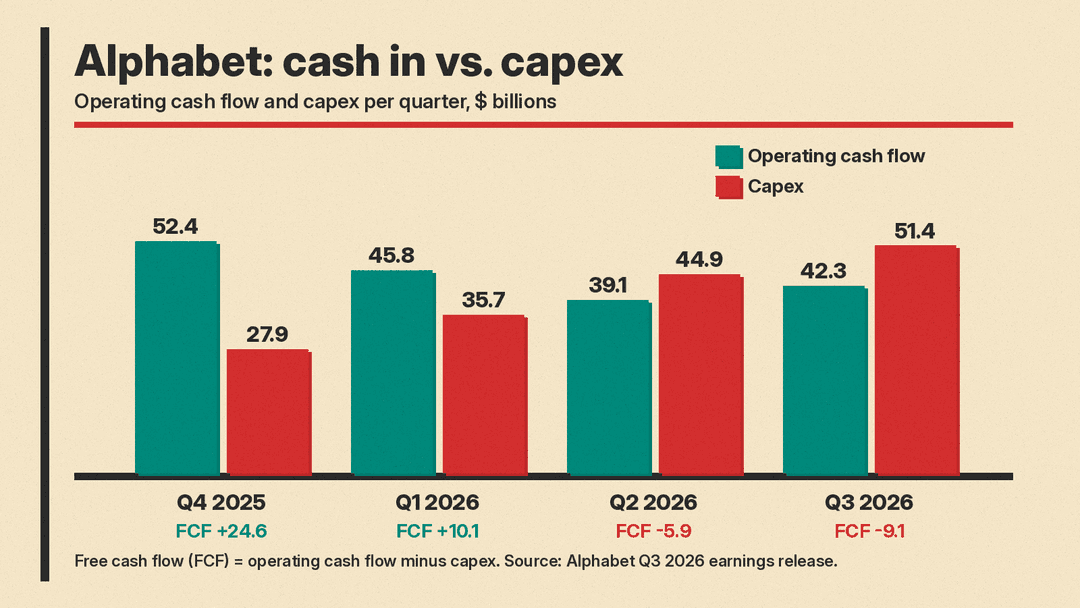
Third-quarter capex of $51.4 billion was more than double the $24.0 billion of a year earlier. CNBC said analysts had expected $55.09 billion in capex and negative free cash flow of only $2.70 billion. Ashkenazi said cash flow was also hit by inventory built up for TPU system sales and a $5.2 billion payment for a 2018 European Commission fine.
Alphabet kept its 2026 capex forecast at $195 billion to $205 billion. It has spent $132.0 billion in the first nine months, so the range implies roughly $63 billion to $73 billion in the fourth quarter (our math). "We continue to expect our CapEx to increase significantly in 2027," Ashkenazi said.
Paying for it with stock and debt
The release shows how Alphabet is funding the build. In the quarter it sold 12 million Class A shares and 24 million Class C shares through an at-the-market program for net proceeds of $12.4 billion, with $27.6 billion still available. It also issued senior unsecured notes for net proceeds of $28.7 billion. It bought back no stock in the quarter, against $11.5 billion of buybacks a year earlier.
Meta also reported negative free cash flow last week (see our Meta Q3 explainer).
Search and AI Mode
Google Search & other revenue grew 12%, and CEO Sundar Pichai said the year-over-year query growth rate is "the highest it's been in the last five years." Chief business officer Philipp Schindler said foreign exchange was the largest reason Search growth slowed from the second quarter. He also named AI Mode: "the strong growth in AI Mode queries had an impact because of the lower monetization we were seeing in AI Mode." He said Google is now expanding ads in AI Mode to international markets and adding multi-turn ads in AI Mode in the U.S.
Schindler did not say how large that gap is. In an opinion piece, we argue that advertisers should get the number.
Pichai also said the Gemini app has reached one billion users and that Google's first-party model APIs process nearly 32 billion tokens per minute. He pointed to Gemini 4 Carbon, announced the same day, and said, "I would expect the next 12 months to see continued acceleration because of RSI."
Why it matters
One report shows both sides of the AI build. Cloud revenue doubled and its margin rose. But capex exceeded operating cash flow for a second straight quarter, Alphabet sold stock and notes and bought back no shares, and it expects capex to rise significantly in 2027. CNBC tied the share drop to the free cash flow decline. Microsoft also reported the same day (see Microsoft's $10B from OpenAI).
