
Amazon now sells a $74.99 wristband that listens to your conversations and turns them into notes. On October 15, Amazon announced two new devices from Bee, the AI wearable startup it bought last year: Bee Frontier, which you wear on your wrist or clip to your clothes, and Bee Eclipse, a card that sticks to the back of your phone.
Both devices do the same job. They hear what is said around you, then give you summaries, to-dos and reminders. That is useful if you forget things. It also puts the people around you in a new spot, because they did not buy the device and may not know it is on. A CNBC report from October 18 asked lawyers whether devices like this can break state wiretap laws, and some of the answers point at the wearer, not at Amazon.
Here is what the two devices do, what they cost, how Amazon says it handles your data, and what the legal debate is about.
What Bee Frontier is
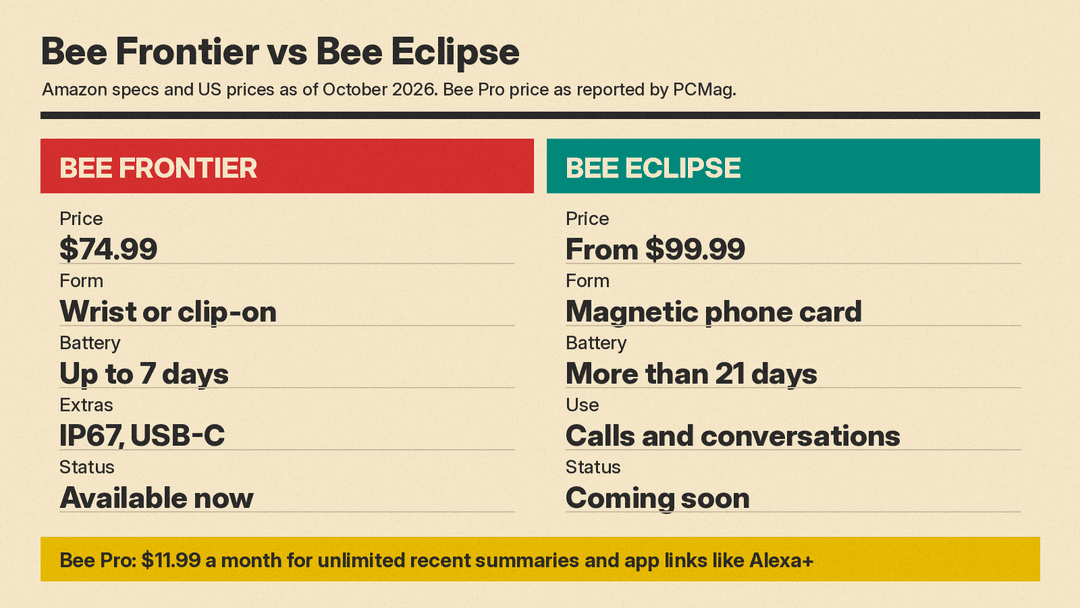
Bee Frontier is the new version of Bee's original wearable. Amazon describes it as a light device with a soft silicone band that you can wear on your wrist or clip onto clothing. It comes in three colors: Lavender, Sage and Onyx.
The specs Amazon lists:
- Price: $74.99, on sale now at Amazon.com
- Battery: up to seven days, charged over USB-C
- Water resistance: IP67
- Microphones: two, with noise filtering that Amazon says works in places like a crowded restaurant or an open office
You control it with one button. Press it to start or stop listening, and a light shows when it is on. You can also set it to turn itself off when it hears no sound for a while, for example 5 or 15 minutes.
Bee's first device, the $49.99 Bee Pioneer, no longer appears to be on sale, according to PCMag.
What Bee Eclipse is
Bee Eclipse is a new shape for Bee. Amazon says it is about the size of a credit card and attaches magnetically to the back of your phone, so there is nothing extra to wear.
- Price: from $99.99
- Colors: Silver, Midnight, Honey and Blush
- Battery: more than 21 days on one charge
- Availability: "available soon," not on sale yet
Amazon's example use is a phone call: you turn Eclipse on while you plan a vacation with family or friends, and it keeps track of arrival times and restaurant picks. Amazon says that, as with all Bee devices, users are prompted to get permission from call participants each time a recording is started.
What Bee does with what it hears
When it is on, Bee listens and uses what it hears, plus the apps you connect, to build summaries and suggestions. You read them in the Bee phone app or a new desktop app. Amazon says there are templates for different situations, such as lectures, care plans and brainstorms, and you can look back at "memories" from the past few days. Bee also looks for themes that come up again and again and suggests goals and actions.
You can connect Bee to apps you already use. Amazon names Gmail, Google Calendar and Microsoft Outlook. After a call or meeting, Bee can list action items, draft follow-up emails or create calendar invites. It can also connect to Apple HealthKit and to your photos.
Two new connections tie Bee to the rest of Amazon:
- Alexa+. You can ask Alexa for a meeting summary, your to-dos, or the name of a book a friend mentioned. Amazon says your Echo device uses voice ID to recognize your voice and give you your Bee insights.
- Amazon.com. Items you mention can show up as product recommendations on the Amazon homepage and in the Bee apps.
The second point is worth noting. A device that hears you say you need dish soap, and then shows you dish soap on Amazon, is a shopping tool as well as a memory tool.
If you have read about Apple HomeView, this is the same trend: the big assistant makers want their AI in more of your day, not only on your phone.
What it costs over time
The $74.99 or $99.99 is not the only cost. PCMag quotes Amazon saying that every buyer gets conversation summaries, recaps and 14-day memory at no extra charge. The paid tier, Bee Pro, costs $11.99 a month, and PCMag says it adds things like unlimited recent conversation summaries and links to other apps, including Alexa+.
So if the Alexa+ connection is the reason you want one, plan for the subscription.
How Amazon says it protects your conversations
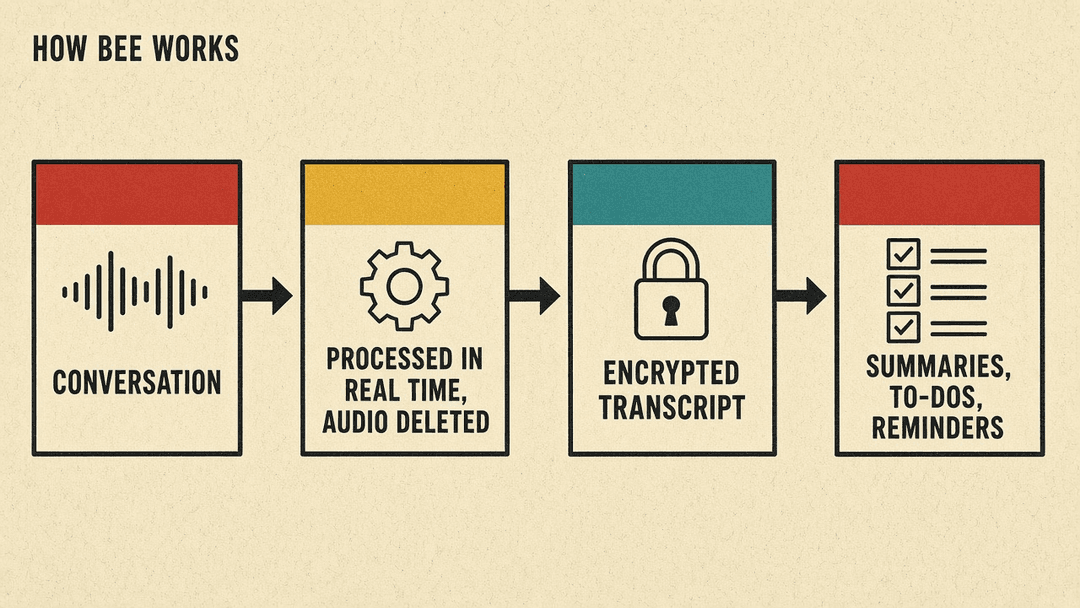
Amazon says both devices run on what it calls Bee Private Compute. In Amazon's words, your conversations are processed "inside a secure and isolated processing environment where no one, including Amazon, can access your data." The specific promises:
- No audio is stored. Audio is turned into notes in real time and then deleted.
- Transcripts are encrypted with keys that only your device creates and controls, and only you can see them unless you share them.
- You can delete transcripts and summaries at any time.
- One press turns the device on or off, and a light shows when it is on.
PCMag points out two limits of the light: it can be easy to miss, and strangers may not know what it means. The product page already has pushback. PCMag quotes one negative Amazon review: "Recording people without permission is illegal."
The legal question: is listening without saving still interception?
Bee is not alone. CNBC notes that Apple, Amazon, Meta and several startups have all released always-listening AI devices this year. Apple's Apple Watch Series 12, unveiled in September, will have Siri Recap, which takes notes through the day and summarizes conversations, and Live Rewind, which can recap 15 seconds of a conversation as a text transcription. Meta's smart glasses can record voice notes, startups Plaud and Pocket make card-sized note takers, and Friend sells an AI necklace.
Old smart speakers waited for a wake word. Some of the new devices can listen continuously, interpret speech and extract its meaning without keeping the audio. Apple and Amazon both say they do not store the audio. The question CNBC put to lawyers is whether that matters.
The issue, as CNBC explains it, is that many state wiretap and eavesdropping laws are written around whether a private conversation was intercepted or its contents were acquired, not only whether an audio file was saved.
- Colin Zick, a privacy attorney at Foley Hoag, pointed to Massachusetts, which defines an intercepting device to include equipment that can receive or record a communication, and treats the "contents" of a communication as including its meaning. In his view, a device that hears speech and writes a summary could fall within that language even with no audio file. He also said: "A non-wearer did not buy the watch, agree to Apple's terms, or choose to have their conversation summarized in the app."
- Daniel Pi, an associate professor at the University of New Hampshire Franklin Pierce School of Law, told CNBC he believes New Hampshire's law is broad enough that the Apple Watch's new audio features would count as interception. He said a user there could potentially face civil or criminal liability for using such a feature in a private conversation without everyone's consent, but he stressed that the practical risk of prosecution is far lower.
Pi also said that because the user deliberately opts in, responsibility could shift toward the wearer rather than the technology company. He was talking about the Apple Watch, but Bee works the same way: the user turns it on.
CNBC calls whether this kind of processing counts as an unlawful interception "a largely untested question." Amazon's own design already asks Eclipse users to get permission from people on a call.
Who it is for, and what to check first
Bee makes the most sense for people who already take a lot of notes about their day: busy parents tracking plans, students in lectures, or anyone whose job is a string of calls. If you mainly want notes from work meetings, a software note taker may be simpler. We compared the main ones in our guide to AI meeting note takers.
Before you buy, check these points against the sources above:
- The real price. $74.99 for Frontier is the start. Unlimited recent summaries and the Alexa+ link come with Bee Pro at $11.99 a month, according to PCMag.
- Eclipse is not on sale yet. Amazon lists it as coming soon, from $99.99.
- The off switch. Use the button, watch the light, and set the auto-off timer that Amazon describes.
- The people around you. Experts told CNBC that in some states the legal exposure may fall on the person wearing the device. PCMag's advice is to set the auto-off timer and tell people when it is running.
- The shopping link. Connecting Bee to Amazon.com means things you say can turn into product recommendations. It is optional, so decide if you want it.
