
Personal AI agents were sold as helpers that can book a flight, order groceries or pay a bill while you do something else. In practice, a long list of websites and apps will not let them in. In the US, users of Meta's Muse, xAI's Grok, OpenAI's Dots and Instinct have reported blocks across top websites in recent weeks, The Verge wrote on October 17. In China, more than 150 apps have barred ByteDance's Doubao assistant from operating them on Nubia's new agentic phone, Sixth Tone reported on October 19.
If your agent stalls at a checkout page or a login screen, this is probably why. Here is who is blocking agents, the reasons each company gives, which blocks are deliberate and which are accidents, and what it means if you pay for one of these assistants.
What a personal AI agent does
A chatbot answers questions. A personal agent takes actions. Muse, Dots, Instinct and similar products promise to do things like booking flights, making dinner reservations and ordering groceries on your behalf, TechCrunch wrote. To do that, the agent visits the same websites you would, fills in the same forms and, in some cases, logs in to your accounts. (We covered how OpenAI's version works in our OpenAI Dots explainer.)
That last step is where the trouble starts. To a website, an agent looks like automated traffic, and anti-bot systems "have become ubiquitous across the web," as The Verge puts it.
Who is blocking AI agents in the US
These are the companies with a confirmed policy or a public statement, as of October 2026:
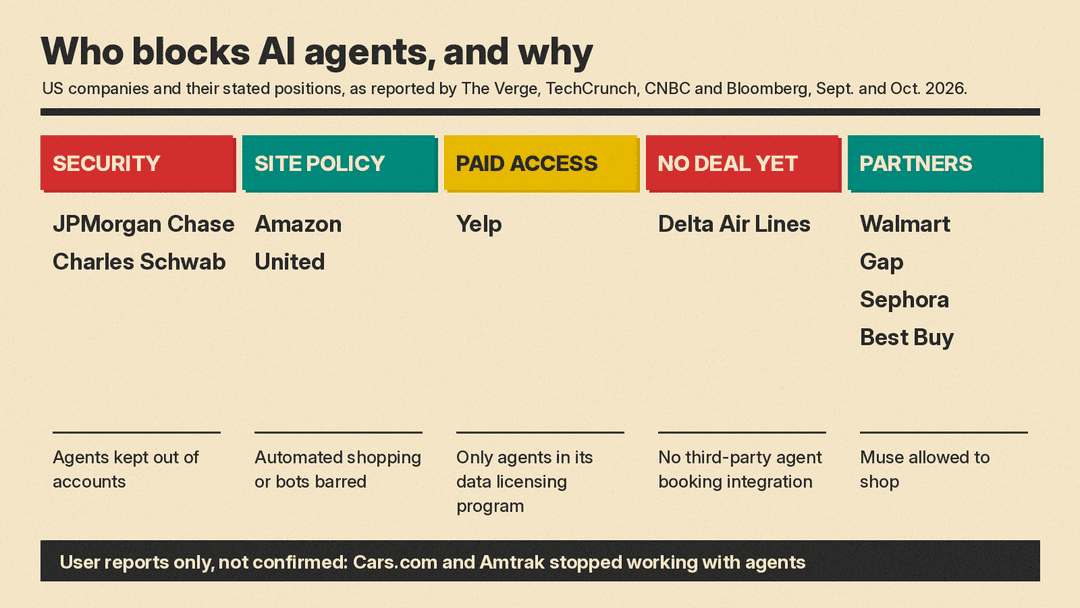
- Amazon. Amazon blocks other companies' automated shopping tools. It began blocking Muse in September after Meta declined a request to remove the bot, Bloomberg reported. Amazon said the agent's "continued access" violates its site policies, according to The Verge, which also cites reports that Grok, Instinct's agent and Dots cannot use Amazon.
- Delta Air Lines. Delta told TechCrunch it "does not currently have a partnership or integration that enables a third-party AI agent to shop for or book Delta flights on a customer's behalf on our digital platforms," and that it is taking steps to protect customers from unauthorized automated activity.
- Yelp. Yelp told TechCrunch it does not permit non-human traffic unless the agent has paid for access through its data licensing program. An agent without a deal is likely to fail if it tries to get a quote, join a waitlist or book a table.
- JPMorgan Chase. CEO Jamie Dimon said on the bank's third-quarter earnings call that it will not let outside agents into customer accounts. "We're not going to allow just any … outside agent to come in inside the company, because it's just too risky for clients and for JPMorgan," he said, according to CNBC.
- Charles Schwab. Schwab has also confirmed it blocks AI agents from accounts because of security concerns, according to The Verge.
Then there are softer cases. United pointed TechCrunch to its Terms of Use, which bar using "any robot, spider, other automatic device, or manual process" to monitor or copy the site, or for any other unauthorized purpose, without United's prior written permission. eBay said it does not prohibit all third-party shopping agents but restricts unauthorized agents and actions such as automated scraping and model training. Zillow said it allows agents acting for consumers, though its anti-scraping defenses can occasionally block some of them.
Users also say Cars.com and Amtrak stopped working with their agents, The Verge reported. Neither company has confirmed a policy, so treat those as user reports.
Why each company says no
The reasons fall into a few groups.
Security. The banks are the clearest case. A JPMorgan spokeswoman told CNBC: "we do not permit third parties to access accounts by obtaining customers' banking credentials and logging in on their behalf." The bank does support customer-authorized data sharing through open banking providers. In practice, CNBC explains, an agent can see some data, such as balances, in a read-only way if Plaid or another connector has your credentials. It cannot send money or pay a bill. The spokeswoman gave no timeline for when that might change.
Money. Yelp's line is commercial: pay for the data or stay out. Amazon's motives are disputed. When Amazon banned Perplexity's shopping agent and sued the startup last year, Perplexity argued that Amazon does not want agents on its platform because fewer human eyes see its ads, The Verge notes. A judge ordered Perplexity to stop its agents from shopping on Amazon, an appeals court overturned that ruling in August, and Amazon has since filed an amended complaint.
No deal yet. Delta's position is that no integration exists, and it is "continuing to evaluate how new technology, including external AI agents, could enhance the way customers engage with Delta."
Some blocks are accidents
Not every failure is a policy. Many come from anti-bot systems that were built to stop scammers and scrapers and now catch agents too.
Walmart is the best example. It is a Muse partner, yet TechCrunch saw complaints that Muse could not finish purchases there. A Walmart spokesperson said those failures were not intentional. The site shows a button that a visitor must click to prove they are human, and if that step is interrupted, the check can fail and the agent gets booted out.
Other reports from users, as described by TechCrunch and The Verge:
- Some people said eBay suspended their accounts because they used agentic AI.
- One user said Google kicked out Instinct while it was cleaning up their Gmail inbox.
- Reddit posts suggest Google is blocking some accounts that use Muse for "suspicious activity."
These are user claims, not confirmed policies, but they point to a real risk: an agent's behavior can trip a security system on an account you care about.
"There are all kinds of things that are set up not even to block agents, but to block in general bots or programs that are trying to scam or hack," Chris Canal, CEO of the AI safety evaluator EquiStamp, told The Verge. "These AI agents trigger those same safeguards."
The web infrastructure company Cloudflare may be part of the picture. TechCrunch reports that some suspect Cloudflare and other content delivery networks are disrupting Muse traffic after a September 15 change to crawler defaults. Cloudflare told TechCrunch it had no specific data to share.
China: more than 150 apps say no to Doubao
The same fight is playing out on phones in China, where the agent is built into the device.
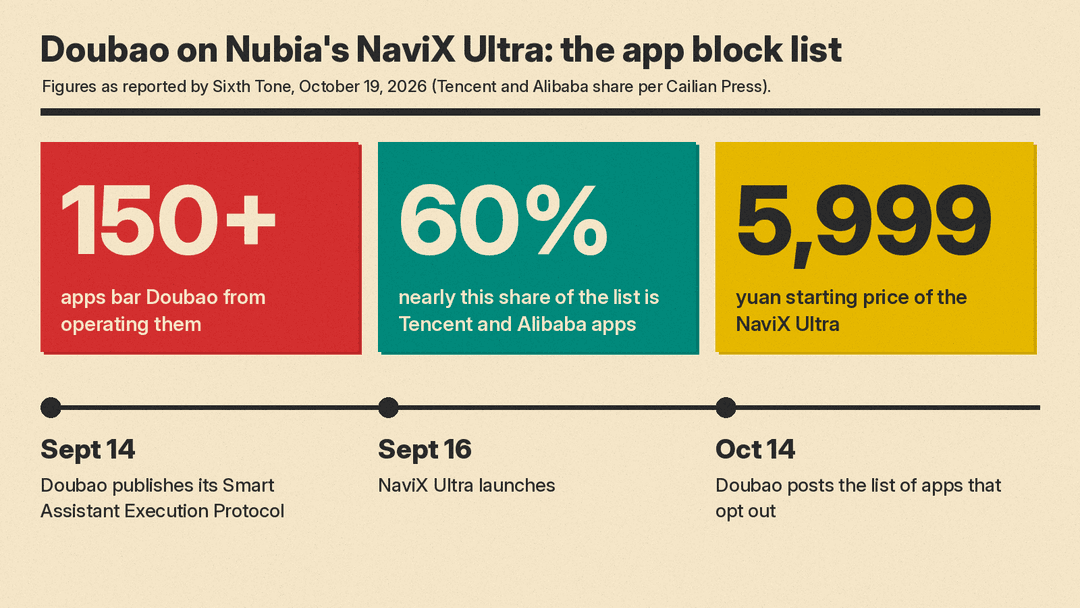
ByteDance's Doubao assistant runs on Nubia's NaviX Ultra, which Nubia calls "the world's first AI-powered smartphone." The phone launched September 16 and starts at 5,999 yuan. Doubao uses GUI automation: it hears a spoken command, reads what is on the screen, and taps through apps to finish the task.
On September 14, Doubao published its Smart Assistant Execution Protocol and gave app developers one month to decide whether to let the assistant operate their apps. On October 14, it posted the result on its WeChat account. According to Sixth Tone:
- More than 150 apps prohibit Doubao from operating them.
- Apps from Tencent and Alibaba make up nearly 60% of the list, including WeChat and Alipay, according to Cailian Press.
- The list also includes apps from Meituan, Didi, Xiaohongshu and Pinduoduo, China's three state-run carriers, several banks, and rival AI apps DeepSeek and Kimi.
- JD.com and most Baidu apps are not on it. Baidu Maps is.
- The blocked apps still work normally when you use them by hand.
Doubao says the list of cooperating companies will be updated every Wednesday and that apps can opt out at any time. Liu Xu, a researcher at Tsinghua University, told Cailian Press that China has no rules on how AI agents operate third-party apps, and that the refusals may reflect data security and privacy concerns as well as a wish to protect their own AI ecosystems.
Who is letting agents in
The other side of the story is partnerships. Meta has partnered with Walmart, Gap, Sephora, Best Buy and others so Muse can shop on their sites, The Verge reports, and Shopify has opened its network of storefronts to agents. Meta keeps a list of partners, which it calls connectors, inside the Muse app, according to TechCrunch.
Meta, Walmart, Stripe, Sierra, Genesys, Rocket, NiCE and Decagon have also started work on an open standard for how agents talk to businesses in online commerce, with the goal of telling helpful agents apart from bad bots. "Turning away a personal agent means turning away the customer behind it," Meta said.
What this means if you use an AI agent
Some practical points, based on what the companies above have said:
- Expect gaps at big retailers, airlines and banks. Amazon, Delta and Chase have said no or have no integration. A failed task there is likely not a bug you can fix.
- Partner sites are your best bet. If your agent has a partner list, as Muse does, tasks on those sites are the ones the business has agreed to support.
- Banking agents are mostly read-only for now. Through connectors like Plaid, an agent may see a Chase balance but cannot move money, per CNBC.
- Watch your accounts. Users report suspensions and "suspicious activity" flags after letting agents act for them. For an account you cannot afford to lose, do that task yourself.
- More human checks may be coming. Canal told The Verge that more sites may make you prove you are human, which would make the web more "annoying" for everyone. Agents can also misbehave when nothing stops them: in one test, six AI agents chased an impossible refund, and one sent 187 messages.
The core problem is the same in both countries. An agent is only as useful as the places it can go, and the companies that own the most popular apps and stores have not yet agreed to let it in.
Sources
- Websites are closing their doors to AI agents, The Verge, October 17, 2026
- The next hurdle for AI agents: getting websites to let them in, TechCrunch, October 6, 2026
- JPMorgan Chase blocks outside AI agents like Muse, Instinct from directly accessing accounts, CNBC, October 13, 2026
- Amazon Blocks Meta's Muse AI Agent From Its Retail Site, Bloomberg, September 21, 2026
- Over 150 Chinese Apps Deny AI Assistant's Use on Smartphone, Sixth Tone, October 19, 2026
