
AI research engineers write the code, run the experiments and scale the systems behind new AI models. At OpenAI, most research engineer postings also carry the "Research Scientist" title. This guide reads real job posts from OpenAI and Anthropic, pulls out what they ask for, and lays out learning resources for each skill, in order.
Job-post details below are as of November 2026. Postings change, so check each link before you apply.
What does an AI research engineer do?
OpenAI's general Research Engineer posting says the role is "responsible for building AI systems that can perform previously impossible tasks or achieve unprecedented levels of performance." It asks for "solid engineering skills (for example designing, implementing, and improving a massive-scale distributed machine learning system), writing bug-free machine learning code, and building the science behind the algorithms employed." The post adds: "We expect engineering to play a key role in most major advances in AI of the future." Applying to it puts you in the running for research engineer roles across all OpenAI teams.
Team-specific posts show what the work looks like day to day:
- Pretraining. Anthropic's Research Engineer, Pretraining role (London) covers research on model architecture, algorithms, data processing and optimizer development, plus designing, running and analyzing experiments and scaling training infrastructure. Sample projects include optimizing the throughput of novel attention mechanisms, comparing the compute efficiency of Transformer variants, and scaling distributed training jobs to thousands of GPUs.
- Interpretability. Anthropic's Research Engineer, Interpretability role (San Francisco) builds the inference and training infrastructure behind interpretability research, including activation extraction and steering vector application.
- Evaluations. Anthropic's Research Engineer, Post-Training Model Evaluations role (San Francisco or Seattle) steers the eval strategy for production Claude models and monitors the eval fleet as models train.
- Agents and post-training. OpenAI's Research Engineer, Codex post says "This role is intentionally broad." Its work spans RL, data pipelines, graders, reward signals and evals.
Research engineer vs research scientist
On November 11, 2026, 12 of the 16 OpenAI postings with "Research Engineer" in the title on its job board also named Research Scientist. On Anthropic's board, 5 of 36 also named a scientist role (Research Scientist, or Research Engineer / Scientist). Anthropic's interpretability team described that overlap in The engineering challenges of scaling interpretability (June 13, 2024): "we consider research and engineering to be inseparable." Team members "switch back and forth between research and engineering," and the team wants "generalist engineers who are able to work flexibly across different domains," with building pipelines, running ML experiments and optimizing GPU usage as examples.
The same article says people joined that team from neuroscience, mathematics, biology, physics, data visualization and software engineering. If you are comparing this path with nearby jobs, see our guide to AI engineer vs ML engineer vs data scientist.
Skills in order, with learning resources
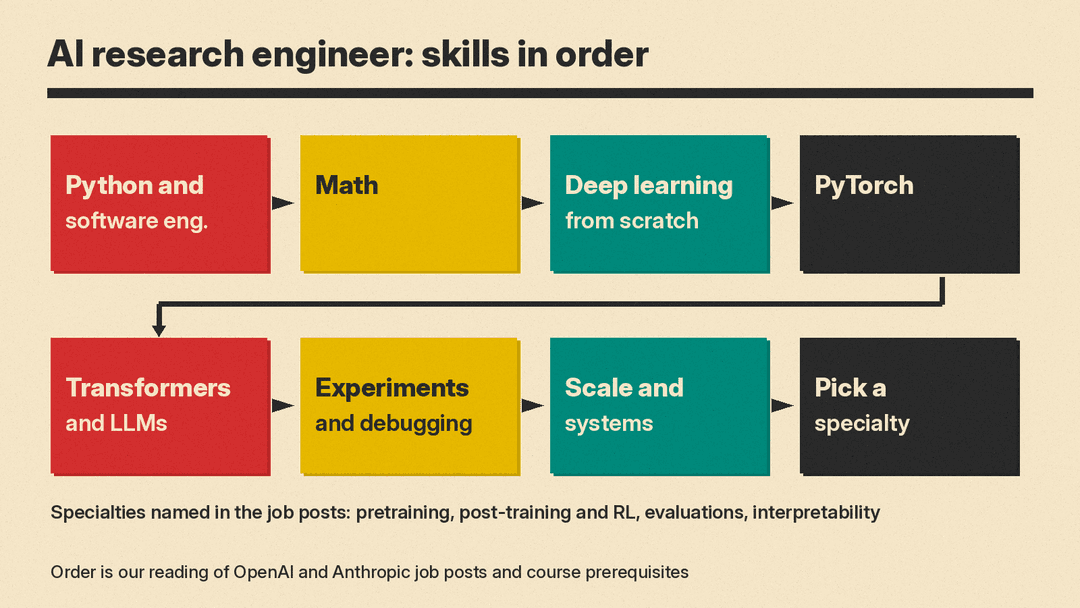
Our reading: the order below follows the requirements the job posts repeat most and the prerequisites the course pages list.
Python and software engineering
This is the skill every post names. OpenAI's general post lists "strong programming skills" and experience with large distributed systems. Anthropic's pretraining post asks for strong software engineering skills and Python. The interpretability post asks for 5-10+ years of experience building software and says you should be productive with Python. The evaluations post asks for strong Python and comfort with production systems.
If you are starting out, our list of free Python courses for AI beginners covers the basics.
Math
Stanford CS336 (below) lists college calculus, linear algebra, and basic probability and statistics as prerequisites. Andrej Karpathy's course asks for "intro-level math (e.g. derivative, gaussian)." The Mathematics for Machine Learning book, whose authors say they "will keep PDFs of this book freely available," covers linear algebra and other foundations, and our math for machine learning guide lists more courses and videos.
Deep learning from scratch
Neural Networks: Zero to Hero by Andrej Karpathy is a course "on building neural networks, from scratch, in code." It starts with backpropagation and builds up to modern networks like GPT. Its stated prerequisites are "solid programming (Python), intro-level math (e.g. derivative, gaussian)." The first video, at 2h25m, builds a small autograd engine called micrograd.
Practical Deep Learning for Coders from fast.ai calls itself "A free course designed for people with some coding experience." Its Part 2 is a ">30 hour video course for more experienced students," with lessons on backpropagation, mixed precision, and attention and transformers.
PyTorch
Anthropic's pretraining post names PyTorch as its preferred framework. The interpretability post mentions PyTorch/CUDA on GPUs or JAX/XLA on TPUs. The official PyTorch tutorials are the place to start.
Transformers and large language models
The Hugging Face LLM Course teaches LLMs and natural language processing with the Transformers, Datasets, Tokenizers and Accelerate libraries. The course page says "It's completely free and without ads." For the core idea in plain English, read our explainer on transformers and attention.
Stanford CS336: Language Modeling from Scratch (Spring 2026) goes much deeper. It walks students through data collection and cleaning, transformer construction, model training and evaluation, and lecture recordings are on YouTube. The page warns that students "will be given minimal scaffolding" and that the code they write "will be at least an order of magnitude greater than for other classes." It also expects strong PyTorch skills and basic systems concepts like the memory hierarchy. The first assignment asks students to implement a tokenizer, model architecture and optimizer to train a standard Transformer language model.
Experiments and debugging
Anthropic's evaluations post asks for people who "Care deeply about measurement quality, thinking twice before trusting a number." Strong candidates there may have a background in statistics and experimental design.
Karpathy's A Recipe for Training Neural Networks (2019) describes a process that "builds from simple to complex," with concrete hypotheses tested by experiments at each step. Its first step is "Become one with the data."
To practice end to end, nanochat calls itself "the simplest experimental harness for training LLMs." It runs on a single GPU node and covers tokenization, pretraining, finetuning, evaluation and inference. Its README says you can train a GPT-2 capability model for about $48, roughly 2 hours on an 8XH100 node. The older nanoGPT repo now says it is "very old and deprecated" and points to nanochat. For cheaper compute, see our guide to free GPU options and student cloud credits.
Scale and systems
OpenAI's general post asks for experience with large distributed systems, and Anthropic's pretraining post includes scaling training jobs to thousands of GPUs. How to Scale Your Model, written by Google DeepMind authors, explains how TPUs and GPUs work and communicate, how LLMs run on real hardware, and how to parallelize training and inference. Hugging Face's Ultra-Scale Playbook describes itself as "The ultimate guide to training LLM on large GPU Clusters."
Pick a specialty
The posts above cover four tracks: pretraining, post-training and reinforcement learning, evaluations, and interpretability. OpenAI's Codex post wants hands-on experience with LLMs, RL, RLHF/RLAIF, post-training, evals, synthetic data, coding agents or production ML systems. Our RLHF explainer is a gentle start on that track.
For safety-focused work, ARENA (Alignment Research Engineer Accelerator) runs in-person programs in London. ARENA 9.0 ran from October 5 to November 6, 2026, and applications are closed. ARENA says its curriculum is open for self-study. Our AI safety careers guide lists more fellowships and courses.
How to show proof of work
Our reading: posts ask for experience you can point to, such as "high-performance implementations of deep learning algorithms" (OpenAI) or evaluations designed and run at scale (Anthropic). Public projects are one way to show it. The ML Reproducibility Challenge is an annual event promoting research into the reproducibility of machine learning papers. MLRC 2026 is a NeurIPS 2026 track, held in December 2026 in Sydney. Submissions for MLRC 2026 closed on September 30, 2026.
Do you need a PhD?
Anthropic's pretraining post lists an advanced degree (MS or PhD) under qualifications, but its logistics section sets the minimum education as "Bachelor's degree or an equivalent combination of education, training, and/or experience." The interpretability post says it wants people curious about interpretability research, "though no research experience is required." OpenAI's general research engineer post lists its requirements without naming a degree.
What do AI research engineers earn?
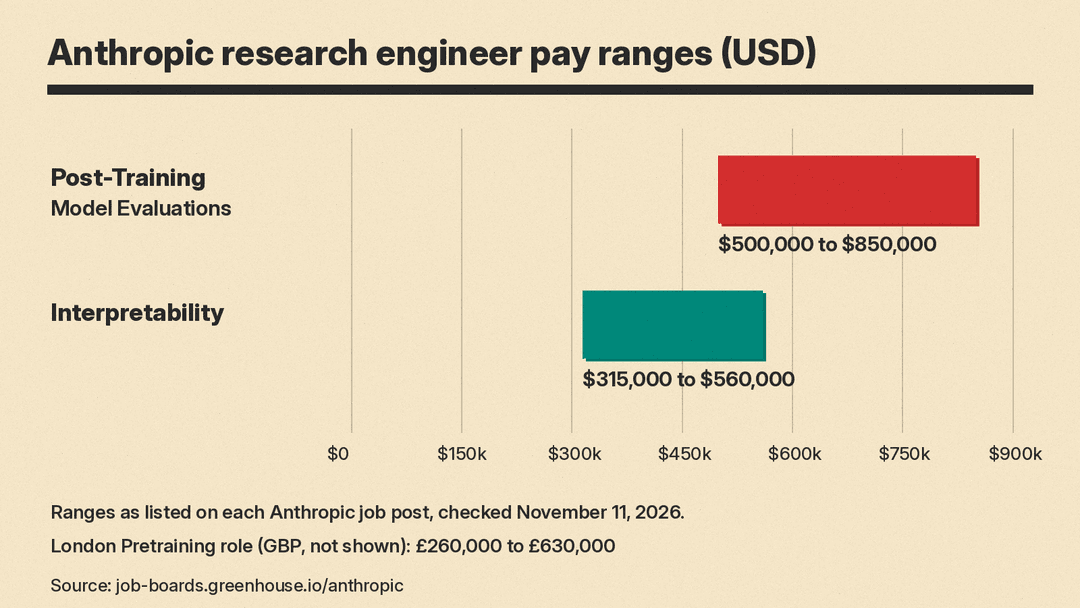
Both labs list salary ranges on these posts. Anthropic's, as of November 2026:
- Research Engineer, Post-Training Model Evaluations (San Francisco or Seattle): $500,000 to $850,000 USD
- Research Engineer, Interpretability (San Francisco): $315,000 to $560,000 USD
- Research Engineer, Pretraining (London): £260,000 to £630,000 GBP
OpenAI's two posts cited here list $250K to $445K (Research Engineer) and $380K to $500K (Research Engineer, Codex), both in San Francisco and both with equity. These are ranges for specific roles, not market averages. For BLS wage data and posted pay at more employers, see our AI engineer salary guide.
If you want a nearby path that builds products more than models, our AI engineer roadmap and AI agent engineer roadmap cover those skills.
The bottom line
Research engineer posts at OpenAI and Anthropic ask for strong programming and systems skills, deep learning and LLM skills, careful experiments, and depth in one track. Our reading: start with Python and math, build networks from scratch, learn PyTorch and transformers, practice careful experiments on small models, study how training scales, then pick pretraining, post-training, evals or interpretability.
Sources
- OpenAI: Research Engineer
- OpenAI: Research Engineer, Codex
- OpenAI job board
- Anthropic: Research Engineer, Pretraining
- Anthropic: Research Engineer, Interpretability
- Anthropic: Research Engineer, Post-Training Model Evaluations
- Anthropic job board
- Anthropic: The engineering challenges of scaling interpretability
- Mathematics for Machine Learning
- Neural Networks: Zero to Hero
- fast.ai: Practical Deep Learning for Coders
- PyTorch tutorials
- Hugging Face LLM Course
- Stanford CS336: Language Modeling from Scratch
- Karpathy: A Recipe for Training Neural Networks
- nanochat
- nanoGPT
- How to Scale Your Model
- Hugging Face: The Ultra-Scale Playbook
- ARENA
- ARENA: Using our materials
- ML Reproducibility Challenge
