
The American Federation of Teachers and the United Federation of Teachers announced on November 10, 2026, what they described as a legally binding agreement with Anthropic on the unions' AI Safety and Privacy Standard for Schools. The AFT said the standard automatically applies to Anthropic's existing agreements with school districts that use Claude for Teachers, and that the November 10 announcement marks the point those principles go formally into effect.
GovTech reported the same announcement on November 11, 2026. K-12 Dive and Education Week also dated the news to November 10, 2026. The AFT posted a public copy of the signed memorandum of agreement. That document, not the press summaries, is what this article uses for the rules themselves.
What the unions and Anthropic said
The memorandum is titled "AI Safety & Privacy Standard for Schools," September 2026, Version 1.0. It names the parties as the National Academy for AI Instruction, called "the Academy" in the text, and Anthropic, PBC.
The AFT said Anthropic is a founding partner of the Academy, alongside the AFT, the UFT, Microsoft, and OpenAI. The AFT described the Academy as New York City-based. GovTech reported that the Academy launched in 2025 and provides educators with training on how to use AI in teaching.
In the AFT release, Elizabeth Kelly, the head of beneficial deployments at Anthropic, said: "As society adapts to AI, we must work to protect and enhance the deeply important work of teachers. That is only possible if teachers, students and school systems trust us. These agreements provide a foundation for that trust. We will live up to them and build on them for our education approach globally."
AFT President Randi Weingarten said the agreement is "now one step closer to an industry standard with Anthropic joining us," and that "we want this standard embedded in law." She also said: "In the almost total absence of federal and state AI regulation, we want to make certain no teacher or parent ever has to choose between AI tools and the safety and privacy of their children. This legally binding contract is how we build a world where algorithms and technology can never replace human judgment, relationships or responsibility."
Michael Mulgrew, president of the United Federation of Teachers, said: "Ideally, the federal government would step in, but since it hasn't, teachers unions are working to hold AI companies accountable. We are heartened that Anthropic sees the value of upholding student privacy and listening to parents and educators."
The AFT described itself as a 1.875 million-member organization and said it represents pre-K through 12th-grade teachers, paraprofessionals, higher education staff, government employees, nurses and healthcare workers, and early childhood educators. It described the UFT as the 200,000-member United Federation of Teachers in New York City.
What Anthropic's commitment covers today
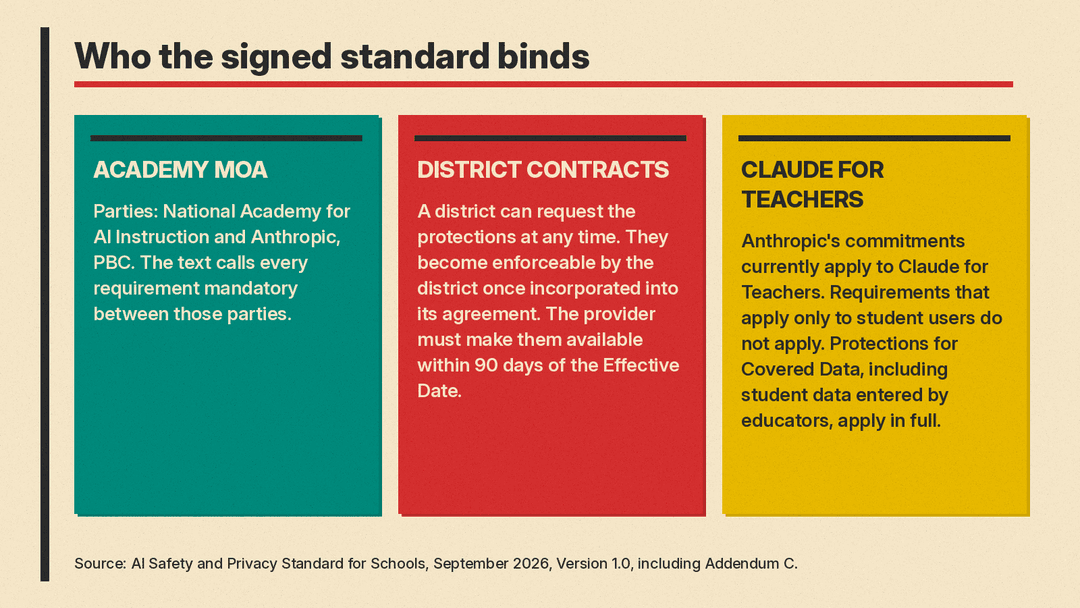
Addendum C of the signed standard, in a section headed "Anthropic," states: "Anthropic's commitments under these Standards currently apply to Claude for Teachers. Claude for Teachers is an educator-facing product that is not offered to students or individuals under 18. As such, requirements that apply only to student users do not apply. All protections for Covered Data, including student data entered by educators, apply in full."
If Anthropic later offers Claude for Teachers or any other "AI Provider Educational product or service" to U.S. K-12 students or for use by U.S. K-12 students, including through school-district customers, the addendum says "Anthropic and the Academy will ensure that the product or service meets the Standard before it is offered, including amendments to Addendum C where necessary."
The AFT said Anthropic launched Claude for Teachers in July and that the tool "gives verified U.S. K-12 educators free access to Claude, a library of teaching skills and a direct connection to evidence-based curricula mapped to academic standards in all 50 states." For how school and district accounts work, see our earlier post on the Claude for Teachers school and district offering. A comparison of classroom tools is in our guide to AI tools for teachers.
Addendum C also records an agreement on Anthropic Insights. It says aggregated outputs from Anthropic Insights "constitute Telemetry Data as set out in the Standard," and that the Academy agrees Anthropic may use this telemetry data "for the limited, additional purpose of conducting and publishing research and analysis regarding AI model use, including the use of AI in education." The standard defines Telemetry Data as de-identified technical and operational data that "cannot reasonably be used to identify, relate to, describe, or be linked to an individual student, or educator," and says Covered Data "does not include Telemetry Data."
What the ten principles require
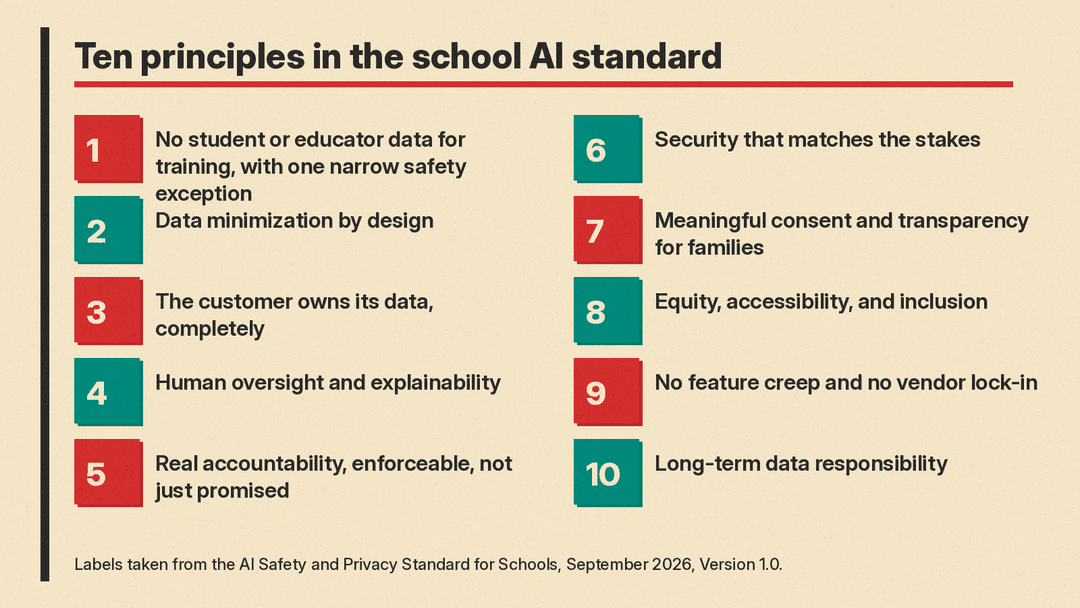
The standard lists ten core principles and says: "Each principle below is a binding commitment. The AI Provider must comply with all ten, across every AI Provider Educational Product it provides to an EDU Customer who has opted in to the principles." It also says the principles are to be implemented in accordance with applicable laws, including FERPA, COPPA, and IDEA, and that "where this Standard provides stronger protections, those stronger protections shall apply to the extent permitted by law."
The AFT said student and educator information "can never be sold or used for targeted advertising," that educators, not AI systems, "remain responsible for instructional decisions and other consequential decisions about students," and that families should get "clear, plain-language information about how AI products work, what data they collect, where they fall short and what safeguards apply." The signed text's ten principles, in short, say:
| Principle | What the signed standard requires |
|---|---|
| 1. No training on student or educator data | No using Covered Data, including prompts, files, or derivatives, to train or improve models, except a narrow safety and security exception. The ban is retroactive and "survives the termination of this agreement indefinitely." |
| 2. Data minimization by design | Collect only data that is "strictly necessary." Without written customer approval, the text prohibits practices including precise or continuous location monitoring (except a documented safety or operational need), behavioral tracking, keystroke logging, long-term profiling, and biometric collection "of any kind." |
| 3. The customer owns its data | Covered Data "belongs exclusively to the EDU Customer and its students." It may not be sold or used for advertising. The customer has "direct control over deletion and retention," export tools, and a 180-day active-system deletion timeline after it initiates deletion, subject to its settings, legal holds, and retention required by law. Data must stay in the European Union or North America. |
| 4. Human oversight and explainability | No covered AI system may make decisions for educators and students "without allowing for meaningful human review or prior approval." The provider must publish limits, mark AI interactions, and give "clear, age-appropriate notices that AI outputs may be incorrect." Companion-style features designed to foster attachment or dependency are not allowed for any EDU Customer user. |
| 5. Real accountability | If requested, the "substantive protection" of the standard must be made available within 90 days of the Effective Date, and is "contractually enforceable by the EDU Customer" once incorporated. Breach notice is due no later than 72 hours after the provider becomes aware of a confirmed or reasonably suspected breach affecting Covered Data. |
| 6. Security | Encryption appropriate to the use case, access controls, multi-factor authentication for provider staff who can access systems holding Covered Data, annual independent penetration testing, an incident response plan, and a vulnerability disclosure program. |
| 7. Consent and transparency for families | Within 90 days of the Effective Date, develop plain-language guides and an FAQ, then publish them for U.S. education customers and offer webinars. A processor "will reasonably assist the EDU Customer" with family requests. |
| 8. Equity, accessibility, and inclusion | Accessibility features plus, within 12 months, an independent equity and accessibility analysis that "no EDU Customer or other third party may rely upon or enforce." |
| 9. No feature creep and no vendor lock-in | New data practices or agentic features need "notice and ability to manage settings." Covered Data must be exportable at any time, at no cost, with at least 30 days to export after termination. |
| 10. Long-term data responsibility | The training and sale-or-share bans are permanent after a contract ends. The duty to delete lasts 2 years or until no Covered Data remains, "whichever occurs later." The duty to report a post-termination breach lasts 2 years or until no Covered Data remains, "whichever occurs first." |
The narrow safety and security exception in Principle 1 allows Covered Data to be used only when reasonably necessary to detect, prevent, investigate, mitigate, or remediate harm to users or threats to the product's security or integrity. Examples in the text include self-harm risk, child sexual abuse material, grooming, threats of violence, bullying, malicious activity, security incidents, vulnerabilities, or unauthorized access. The exception "will be interpreted narrowly" and may not be used for general model training, except to the limited extent that a specific safety or security classifier, safeguard, or functionality is being evaluated or improved for those permitted purposes. Upon request, a senior officer must sign a written annual statement confirming that no Covered Data was used for training outside the exception and that no data, learnings, or model improvements derived from Covered Data "crossed from safety systems into any other model or product."
Principle 5 says breach notice to the affected customer must come "without unreasonable delay and, in any event, no later than 72 hours after becoming aware of a confirmed or reasonably suspected Breach affecting Covered Data." Principle 5 also lists certifications the provider must pursue or maintain: SOC 2 Type II, ISO 27001, ISO 27701, ISO 42001 or equivalent, and FedRAMP Moderate authorization or an equivalent federal authorization "where required." If a required certification is not held at signing, a target date "must be specified in Addendum C." The Anthropic notes in the public Addendum C address product scope, Anthropic Insights, and indemnity. They do not list certification target dates. The standard also requires a public trust page, updated at least quarterly, listing current certifications, recent audit summaries, and any known past security incidents affecting education customers.
What is binding, and what a district still has to do
The memorandum calls itself "a binding Memorandum of Agreement between the National Academy for AI Instruction and any AI Provider that the Academy engages." It says "every requirement in this agreement is mandatory."
That binding relationship, on the face of the document, is between the Academy and the provider. For a school district, the text is more conditional. The ten principles apply to products the provider supplies "to an EDU Customer who has opted in to the principles." A section titled "Beyond the Academy" says each signing provider will create "a clear, simple, and expeditious process" through which any school district can request that the provider "meet or exceed the Standard" in that district's own agreements for covered educational products. The provider must make the "substantive protections of the Standard available to EDU Customers upon request within 90 days of the Effective Date." Those protections "may be incorporated into the EDU Customer's existing data privacy agreement, licensing agreement, or addendum and need not be adopted in the identical form set forth in the Standard," provided the resulting terms meet or exceed the substantive protections. "A district can make the request at any time." Once it does, the provider "will work diligently to incorporate the applicable terms."
Only after those protections are incorporated into the district's agreement does the standard say they are "contractually enforceable by the EDU Customer." Revoking a provider from the Standard "does not relieve the AI Provider of any Standard obligation incorporated into an agreement with an EDU Customer or any obligation that expressly survives termination."
The AFT's November 10 release uses broader language. It said the standard "automatically applies to Anthropic's existing agreements with school districts using Claude for Teachers." K-12 Dive reported that the terms "will apply to Anthropic's existing agreements with school districts" and that the agreement "is effective Tuesday." Education Week reported that "the Anthropic and Microsoft agreements cover existing school district contracts, but districts will need to opt into the agreement for future licensing agreements."
The signed text defines Effective Date as the date signed and says the principles "remain in force for a term of two years," with written renewal every two years. A later general term says the agreement "is effective from the date signed and continues for the term specified in the applicable service agreement," and that the AI Provider "may terminate its participation in this agreement with 60 days' written notice."
Microsoft signed the same standard earlier. K-12 Dive and GovTech reported that the unions announced Microsoft's agreement in September 2026. GovTech, citing a company fact sheet, reported that Microsoft committed to making the protections available to U.S. school districts beginning November 1, 2026. K-12 Dive reported that a district can add the standards to new or current Microsoft contracts "without being required to renew or renegotiate."
Some duties are enforceable only by the Academy or the AFT, not by a district or a parent. Principle 7 says its family-facing transparency materials "are not product warranties, service commitments, or representations made to any EDU Customer or other third party, and no third party shall have any right to rely upon or enforce this Section." Principle 8 says the independent equity study may be enforced only through the Academy and AFT remedy process. Addendum A, which is supposed to record contacts, the product name and version, and authorized use cases, "is to be completed by both parties within 90 days of Effective Date." In the public PDF, those fields are blank.
What the agreement leaves out
Education Week reported that it is "not clear how much the standards will change how AI works in schools." As an example, the outlet said the agreement "only covers Claude for Teachers, so the agreements wouldn't necessarily cover education tools built by other companies using the Claude models."
That limit also appears in the standard's own definitions. "AI Provider Educational Products" means services or features that use generative AI, are "primarily designed and marketed for use by students, educators and administrators," and are used with authenticated access under an agreement between the educational entity and the AI Provider. "For the avoidance of doubt," the text says, general-purpose productivity, collaboration, communication, search, cloud, development, or workplace-assistance products, "including products that may be licensed or used by educational entities but are not primarily designed for educational purposes," are not AI Provider Educational Products.
Education Week also reported that the agreement "calls for school districts to institute policies and train staff to ensure humans review any grading, discipline, or class placement decisions informed by AI," and that "these promises depend on training educators using the programs not the programs themselves." In the signed text, a list of "prohibited uses, no exceptions" sits under this sentence: "As part of the Academy's instruction, the Academy will instruct that educators cannot use AI for the following." The five items are automated grading without human review; automated disciplinary decisions or recommendations based on AI analysis of educator or student behavior; automated placement decisions (course selection, ability grouping, special education referrals); emotional or psychological assessment of educators or students; and surveillance of educators or students for behavioral prediction purposes.
Education Week reported that the union "is still negotiating with OpenAI" and that "AFT has no agreement with other AI developers like Meta or Google." OpenAI is also a founding partner of the Academy, according to the AFT, and offers its own teacher product, which we covered when OpenAI expanded ChatGPT for Teachers.
Because Claude for Teachers is not offered to students or to people under 18, Addendum C says requirements that apply only to student users do not apply today. Those unused student-user rules include the requirement that externally consequential agentic features that act for students outside the provider's systems be disabled by default unless a district administrator turns them on.
What parents and teachers can do
Parents and teachers who want the standard's district-level protections should start with the school or district, not with a promise that those protections are already in every contract.
A district can ask Anthropic to meet or exceed the Standard in its agreements for covered educational products, using the request process described above. Once the terms are in the district's agreement, the district has the contractual remedies in that agreement, including, the standard says, termination for an uncured material breach and damages or other remedies under the agreement or applicable law.
Ask the district whether it uses Claude for Teachers, whether it has requested or already incorporated the Standard, what retention period it has set, how staff can export or delete data, and where Covered Data is stored. The standard gives the education customer "direct control over deletion and retention of Covered Data through native administrative tools" and a right to export Covered Data "reasonably capable of export" in standard formats, at no cost.
Families are pointed, first, to the district. Where the provider is a processor, the standard says it will "reasonably assist the EDU Customer in using available functionality to respond to such requests (such as administrator portals or data subject request forms)." Within 90 days of the Effective Date, the provider is also supposed to develop plain-language materials and an FAQ, then publish them on a public website and offer webinars, and to keep the public trust page described above.
If a product keeps Memory Files, the standard says the affected person, or a parent or guardian working through the district for a younger student, must be able to see the saved student data in plain language, erase it permanently, and use the tool with memory switched off "without losing access to the service."
Teachers should also follow district rules on what student information may be entered into the tool. Anthropic's Claude for Teachers help page, as of November 11, 2026, says: "If you're on an individual teacher account and have not received school or district authorization to make that decision, don't include identifiable student information in Claude for Teachers."
In May 2026, as part of a 10-point plan, the AFT called for a ban on student-facing AI in elementary school, a screen ban in kindergarten through second grade, and a total ban on "social companion" chatbots before the age of 16. Those asks are background in the AFT's November 10 release. They are not, on the face of the Anthropic addendum, new district-wide bans created by this agreement. The Standard's companion-style feature ban applies to covered products for "any EDU Customer user."
Sources
- AFT, UFT and Anthropic Sign Binding AI Safety and Privacy Agreement for Schools, American Federation of Teachers, November 10, 2026
- AI Safety and Privacy Standard for Schools, Memorandum of Agreement, September 2026, Version 1.0, public PDF posted by the AFT
- Anthropic Joins AFT and UFT's Binding AI Safety Standard, GovTech, Julia Gilban-Cohen, November 11, 2026
- Anthropic enters student AI privacy agreement with teachers unions, K-12 Dive, Naaz Modan, November 10, 2026
- Anthropic Agrees to Protections for Teachers Who Use Claude, Education Week, Sarah D. Sparks, November 10, 2026
- Claude for Teachers: your data and our terms, Claude Help Center, as of November 11, 2026
