
OpenAI released GPT-6.1 Terra on Monday, October 26. OpenAI describes it as "a fast, efficient model" that combines visual reasoning and computer use with "clearer, more natural writing." It is in ChatGPT Work and Codex for Plus, Pro, Enterprise and Edu users, and in the API as gpt-6.1-terra. This roundup covers what developers and early testers said in the first eight hours. For prices and OpenAI's own test results, see our GPT-6.1 Terra explainer. For where it runs in GitHub Copilot and Codex, see our Terra for coding guide.
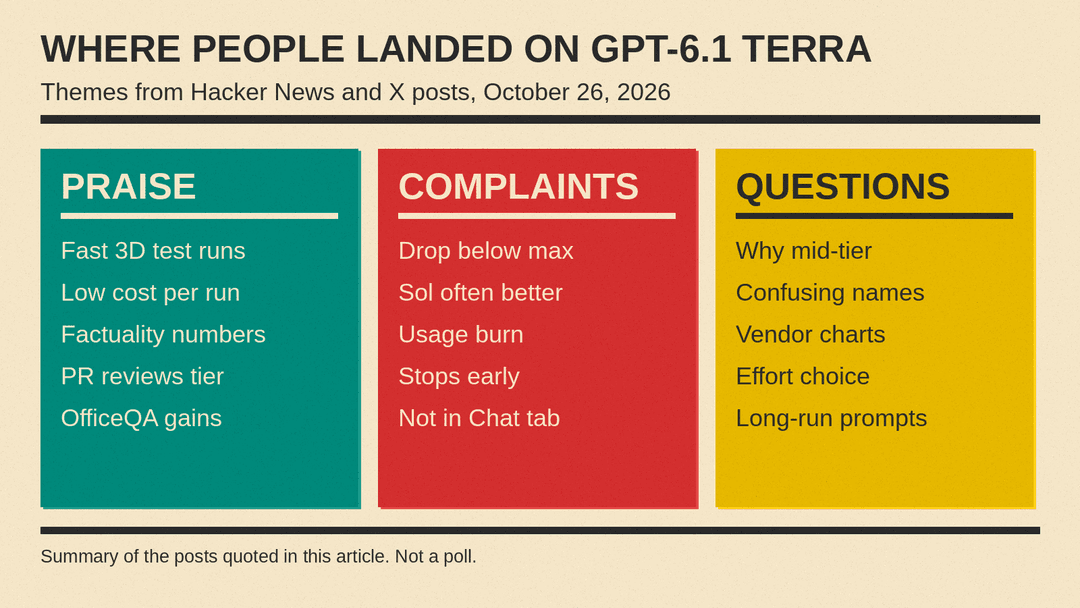
The short version: the price and the speed won the most praise, and several people posted side-by-side tests where Terra finished in minutes for well under a dollar. The biggest complaints were that its coding scores drop sharply below max effort, that GPT-6.1 Sol often looks like the better buy, and that OpenAI's model naming keeps getting harder to follow. A few early users also reported runs that burned through usage or stopped early.
Most of the discussion below comes from a Hacker News thread that had 534 points and 335 comments as of 8:20 PM PT on October 26, plus posts on X.
What OpenAI shipped
Per OpenAI's announcement, standard API pricing is $1 per million input tokens, $0.05 per million cached input tokens and $5 per million output tokens. OpenAI says that is 50% lower than GPT-5.6 Terra and GPT-6.1 Sol.
OpenAI's own numbers:
- On Agents' Last Exam, a computer-use benchmark, Terra at medium effort scores 15 percentage points higher than GPT-5.6 Terra at about one-third the cost, and performs on par with GPT-6 Astra at one-tenth its price per token.
- At max effort, OpenAI says Terra is over three times as token efficient as Claude Opus 5.5 and one-fourth its price per token, for about 9x lower cost per task.
- On Terminal-Bench 4.0, Terra at max effort solves 50.3% of tasks, up from GPT-5.6 Terra's published 21.5%. OpenAI says GPT-6.1 Sol and GPT-6 Astra "remain the better choice" for the most complex coding tasks.
- On an internal set of error-inducing prompts, the error rate at low effort fell from 53.6% to 16.7%, and to 4.3% at max effort.
All of these come from OpenAI's own test setup. For how Terra fits next to the other GPT-6 models, see our GPT-6 model comparison.
Praise: cheap, fast runs
Several posts were hands-on speed and cost tests.
- @MrTacticalX gave Terra and Claude Opus 5.5 the same Blender prompt, both on Extra High, and reported "GPT-6.1 Terra (5 min, ~$0.32)" against "Opus 5.5 (1 hr 41 min, $30.23)". In an earlier test against Claude Haiku 5.5, a three.js snow globe, they reported Terra at 2 minutes and about $0.13 and Haiku at 9 minutes and about $0.32.
- @EnvolDev ran one Eiffel Tower prompt through four models and listed Terra at $0.44 and 5m 33s, GPT-6.1 Sol at $1.10 and 22m 28s, and Kimi K3.1 Pro Max at $3.12 and 40m 30s. "Honestly, Terra blew me away," they wrote, while still praising details in the Sol and Kimi results.
- @trypalomino ran four one-shot 3D tests and said Terra "produced 45% more output (47.9K vs 33.1K tokens)" and "was 38% cheaper ($0.30 vs $0.49)" than GPT-5.6 Terra.
- Databricks said that on its OfficeQA Pro v2 benchmark Terra "shows a large quality improvement and sits on the quality-cost pareto frontier."
On Hacker News, A_D_E_P_T wrote: "If those charts are true, this effectively matches GPT-6-Astra at a fraction of the cost, and is neck-and-neck with 6.1-Sol." mehdizare saw a clear job for it: "This tier is what I'd actually point opencode at for PR reviews. The top models are too slow and expensive to run on every diff."
The factuality numbers stood out to bob1029, who runs a company agent on the previous Terra: "The results for factual error rate on "difficult" prompts is staggering to me." @argofowl summed up a common middle view: "better than i thought it would be, but obviously nothing close to opus 5.5".
Complaints: effort levels and the Sol question
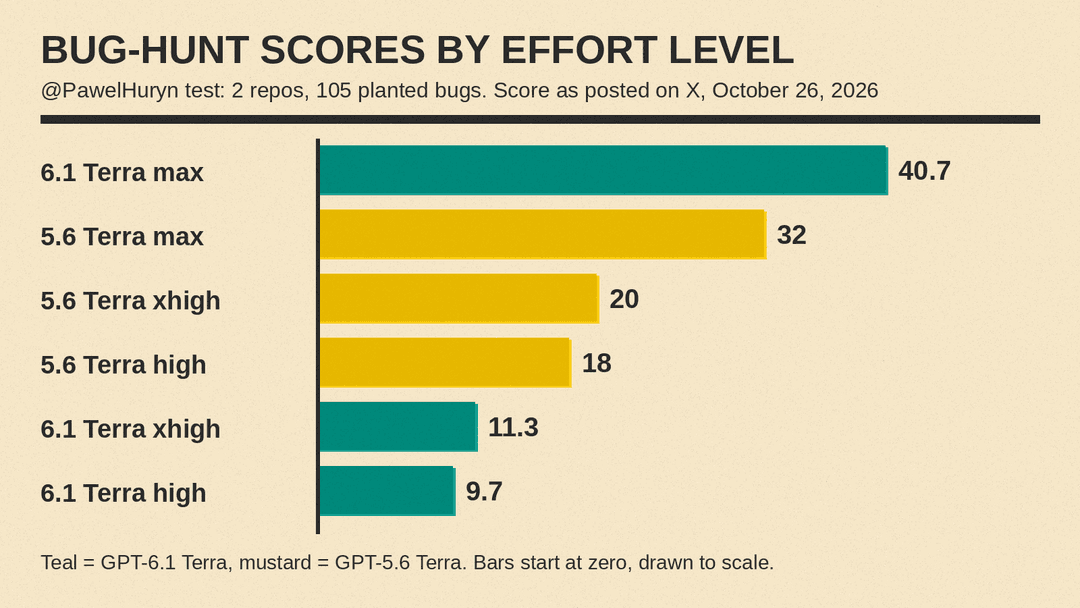
One independent test was mixed. @PawelHuryn planted 105 bugs across two repos and scored each model on finding and fixing them. Terra at max effort scored 40.7, ahead of GPT-5.6 Terra at max (32). But Terra at xhigh scored 11.3 and at high 9.7, below GPT-5.6 Terra at the same levels. "It's cost and time effective. But right after max, its performance drops dramatically - far below Haiku 5.5 (xhigh)," they wrote. They posted per-run scores of 34, 42 and 46 at max.
Several people said GPT-6.1 Sol looks like the better deal at the high end:
- ralusek, citing Artificial Analysis: "According to this, Sol 6.1 x-high is both cheaper and smarter than Terra 6.1 max."
- XCSme: "in my tests, on max effort, it's worse than 6.1 sol and 2x more expensive". They added that medium effort "seems to be the best use-case" and is cheaper than Sol.
- Starlevel004 on OpenAI's coding chart: "Terra XHigh more expensive than Sol Low and still does worse."
- @Syntax_Serrano read OpenAI's OSWorld figures as Sol at $1.15 per task and 78.0% accuracy against Terra at $1.19 and 74.2%.
minimaxir called Terra "a weird middle child" between Luna and Sol and wrote that "The TerminalBench 4.0 cost-per-task results are a bit confusing and I'm not sure why you would pick Terra over Sol in that case." Silagi asked the same question of mid-tier models in general: "Virtually every task I give to either is better served by going up a tier and down a reasoning level, or down a tier and up a reasoning level."
Artificial Analysis also drew attention. A Hacker News post and @HarshithLucky3 reported that Terra scored 48 on its Intelligence Index.
Usage burn and early stops
Two Hacker News users reported problems in real agent runs. wellthatsinsa wrote that it "drained my usage SO FAST" and "used lots of unnecessary skills and read through way more memory files needed." agluszak said it "will stop at an earliest excuse and no amount of prompting not to stop until X is done will convince it otherwise." @trypalomino, while positive overall, noted that "longer runs require a different approach to prompting and harness design."
@JoonGTP tried a 3D modeling prompt, said OpenAI's own tram example worked better than expected, and decided to pass, calling the model "very 5.6 Sol coded."
Naming and where it is available
The lineup itself confused people. Someone1234 walked through how Luna, Terra, Sol and Astra shifted between releases and concluded: "Now they're re-introduced Terra, as a 6.1 release, making this even more confusing." xnx asked why Anthropic and OpenAI need four model tiers when Google has two.
Some users wanted Terra in regular chat. @diegocabezas01 noted it is "not available in the Chat tab", and @TJeparskis asked OpenAI to add it to the Chat mode model picker because of its writing claims.
Benchmarks people ran
Simon Willison (simonw) ran an SVG pelican test across reasoning levels and posted a grid for OpenAI's full lineup. They noted that "both "none" and "low" reasoning levels appeared not to spend any reasoning tokens at all," and that low cost less than none in that run. One reply, from drewbitt, noted "12 seconds for a pelican on low."
causal pushed back on the format of OpenAI's charts: "These "Pareto frontier" performance vs price graphs have become very popular and I find them mostly uninformative."
What it means
Terra's pitch is cost per task, and the testers quoted here mostly found it fast and cheap on visual and 3D work. The open question is effort level. Pawel Huryn's bug-fixing test found big gains only at max effort, and several developers found Sol at similar or lower cost per task once effort rises. If you run high-volume agent work, test Terra at medium and max on your own tasks and compare the full cost per finished task, not the token price. Our mid-tier model comparison covers the Sol and Sonnet side of that choice.
Sources
- OpenAI: Introducing GPT-6.1 Terra
- Hacker News: GPT-6.1 Terra discussion
- Hacker News: GPT-6.1 Terra (Max) Scores 48 on Artificial Analysis
- @PawelHuryn bug-hunt results and per-run scores
- @MrTacticalX: Terra vs Opus 5.5 in Blender
- @MrTacticalX: Terra vs Haiku 5.5 snow globe
- @EnvolDev: Eiffel Tower test
- @trypalomino: Terra vs GPT-5.6 Terra 3D tests
- @databricks: OfficeQA Pro v2
- @Syntax_Serrano: OSWorld cost per task
- @argofowl
- @JoonGTP
- @HarshithLucky3
- @diegocabezas01
- @TJeparskis
