
Anthropic opened a research preview of Claude Duet on Wednesday, October 21, a separate app where Claude works as a proactive agent: it sends a morning brief, watches your connected apps, runs tasks in the background and asks before it acts. Access is by waitlist, starting with US Pro and Max subscribers. We covered the details in our Claude Duet explainer. This roundup covers what people said in the first few hours.
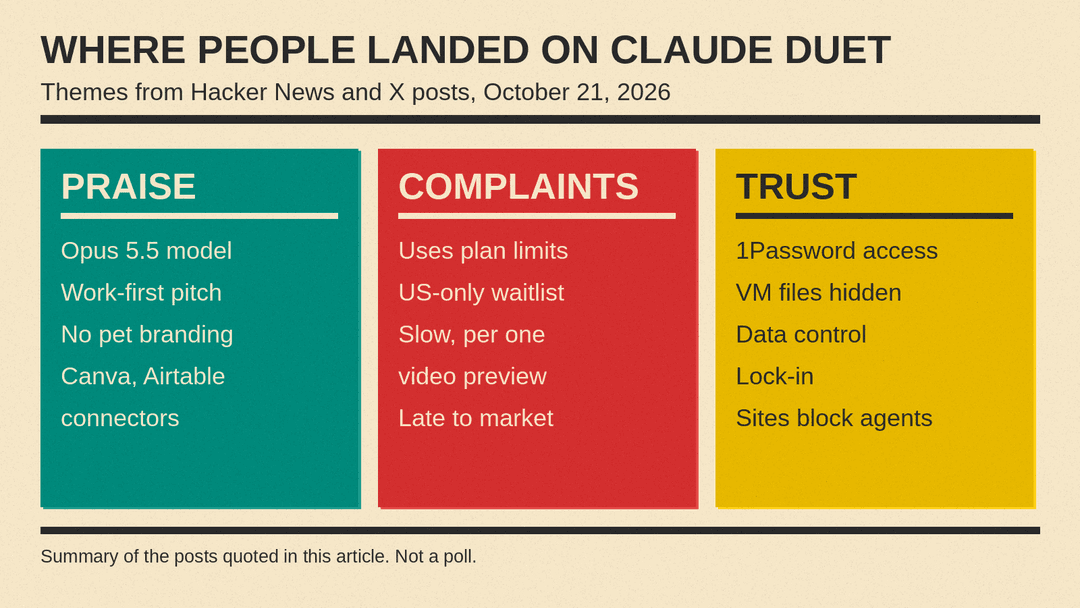
The short version: the Opus 5.5 model behind it and the work-first framing drew praise. The main complaints were that background checks use your normal plan limits, that the app is waitlisted and US only, and that Duet arrives after OpenAI's Dots and Meta Muse with little to set it apart. Security and data control questions came up often.
Most of the discussion below comes from a Hacker News thread that had more than 300 points and 260 comments by 6 PM PT on October 21, plus posts on X.
What Anthropic shipped
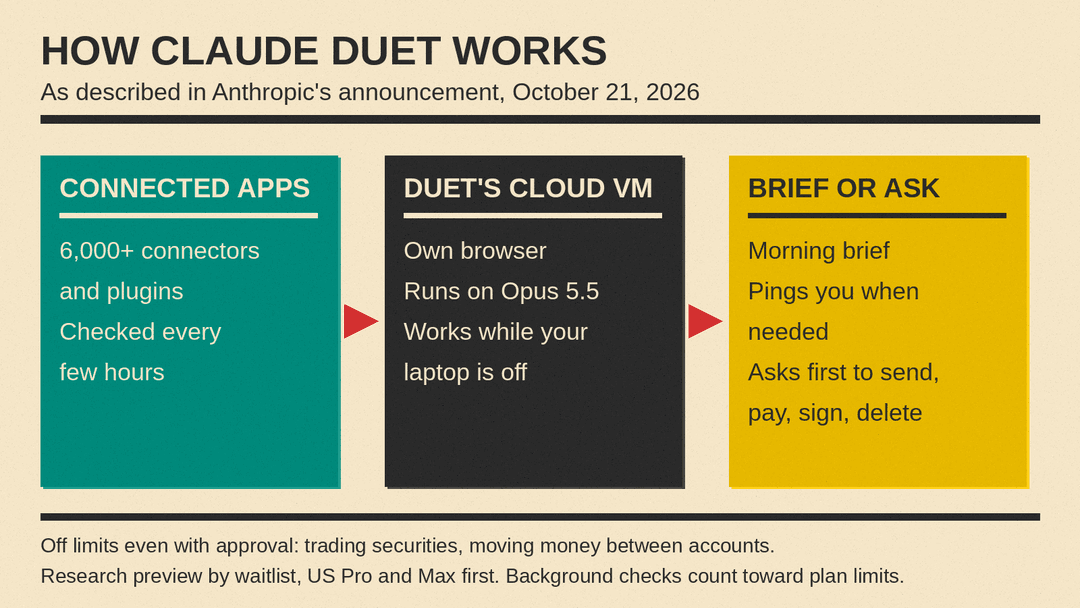
Per Anthropic's announcement, Duet is built around Claude Opus 5.5 and runs as a standalone app on iOS and Android and on claude.ai. It carries over memory, skills and connected apps from your Claude account. It has its own virtual machine with a browser, so your laptop and phone can be off while it works.
Anthropic writes: "Claude Duet checks your connected accounts every few hours, because checking nonstop would use up your plan’s limits much faster." Before it sends a message, makes a payment, signs a document or deletes anything, it shows you the action and waits for approval. Trading securities and moving money between accounts are off limits even with approval. It can use more than 6,000 connectors and plugins from the Claude Marketplace, buy things through Stripe's Link wallet with a virtual card, and check out with Shop Pay. Signing in with 1Password logins is listed as coming soon.
Anthropic is candid about the limits: "This is an early version of Claude Duet, and it still might misread a thread or miscalibrate what’s urgent." The post also says personal errands such as booking tickets are weaker than work tasks, and that Duet cannot yet show you its browser.
Praise: Opus 5.5 and a work-first pitch
The model was a common reason people gave for wanting to try Duet. On Hacker News, intenex wrote: "Powered by Opus 5.5 is incredible." The same commenter said that in the month since OpenAI's Dot came out, they had used it to buy a car and are now using it to buy a house in Kyoto, and added: "Going to try switching over as soon as I get off the waitlist."
joshstrange said Dots was weak at coding but useful for watching incoming messages, and wrote: "Looking forward to checking out Duet once it launches as I prefer Anthropic models over OpenAI and that's where I already have a bigger subscription."
minimaxir pointed to the branding: "A notable distinction between Duet and Meta Muse/OpenAI Dots is the lack of quirky anthropomorphic branding. As a result, the use cases are more clear/more professionally-oriented as they don't rely on you creating a magic pet/BFF that does whatever you want."
On X, @testingcatalog summarized the launch, including: "Memory, skills, and connected apps are taken from your Claude account." @TimJayas predicted: "there's no way gork bot and dots are surviving against claude duet".
Partners piled in as well. Canva posted: "Claude Duet asks before it sends anything." Canva says Duet can turn tasks and meeting notes into designs and presentations, and Airtable announced that it works with Duet. Karan Ahuja, who leads the Duet team, wrote on X: "Personally, the team and I use Claude Duet to build Claude Duet."
Complaints: limits, the waitlist and speed
Usage limits drew pushback. Computer0 wrote: "I really have no interest in this if it's going to use my plan's regular limits." On X, @nagasankey put it this way: "The assistant keeps working. So does the meter." And @SiEdgeGeek warned: "Just know its background checks burn your regular Claude limits."
The rollout frustrated some. @TJeparskis wrote: "But I really don’t like how they’re rolling it out". They continued: "First, you have to join a waitlist and just… wait. And apparently, it’s only available in the US for now."
Speed came up second hand. robgough said a How I AI YouTube preview made the point that "The Duet agent is so slow that it's not actually particularly pleasant to use, even if it is smart." They added: "I tend to agree, and think speed is a key feature here."
Some saw nothing new. ZeroCool2u wrote: "Doesn't really seem to differentiate itself meaningfully at first glance." paxy was blunter: "A full 3 weeks behind on launching their own persistent agent." alberth asked: "Shouldn't this just be native to Claude, not a separate app/UX, as well as using the latest model (not Opus)?"
Trust, passwords and who owns the data
The 1Password plan set off a long sub-thread. roarcher asked: "Am I hopelessly out of touch in this brave new AI world, or is giving an LLM access to your password manager the mother of all bad ideas?" In reply, doctoboggan wrote: "If done correctly, the agent will only be able to request that passwords be filled, but the secrets will only be handled by the password manager and browser extension, which will be able to set some security boundaries and make checks on which domains are allowed." Anthropic's own launch post on X says: "It never directly sees your passwords, a new classifier guards against sharing sensitive information, and the important decisions stay with you."
Transparency was another sore point. russellbeattie said they got access, asked Duet to list the files in its VM, and it refused. They contrasted that with Meta's Muse, which they said has a button in its phone app that shows all of its system files. Their conclusion: "But still, Anthropic should open up."
juanre argued against handing life admin to any lab: "Do not subcontract the managing of your life to Facebook, Anthropic or OpenAI (or to anyone else for that matter)." jesse_dot_id wrote: "Love LLMs, use them extensively, but they cannot intuit what actions they can take on my behalf that I will or will not approve of, and therefore I will never use one of these things."
Reliability on the open web worried others. BoppreH wrote: "Performing actions online is even worse, with CAPTCHAs and whatnot." suhdonghwi questioned the premise: "I'm not sure more integrations and more context are necessarily the answer."
The business angle
A few commenters looked past the product. ttul wrote: "I suspect that Dots and Duet are very high margin drivers for the labs." Their reason: assistant sessions do not need real-time answers, so the work can fill low-priority inference batches. Replying to that, lossolo pointed to lock-in: "With regular chat, you can simply switch to another provider, and with a harness or API, switching is pretty easy too but here, it's more difficult." bearjaws wrote: "You hear that? Sound of a few dozen venture backed companies dying instantly."
What to watch
Hands-on reports are still few, since access is by waitlist, and Anthropic writes: "We’re continuing to develop and strengthen these protections, and will share more details about how Claude Duet is designed for safety in the coming days." The open questions from today's threads are how fast Duet works in practice, how much of a Pro or Max plan its background checks use, and whether Anthropic lets users see more of what runs inside its VM.
