
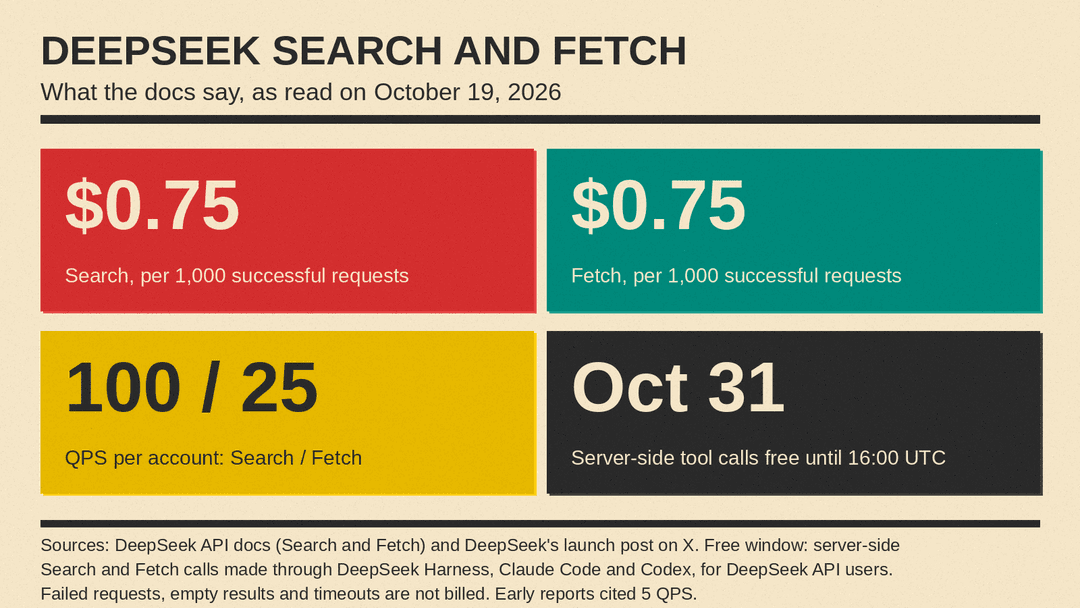
DeepSeek has turned its in-house search engine into two paid API calls. Search and Fetch went live on October 17: Search returns structured web results for a query, and Fetch returns a single page as Markdown. Each costs $0.75 per 1,000 successful requests, and failed calls, empty results and timeouts are not billed. DeepSeek announced it on X at 1:35 AM PDT on October 17, in the same thread as its V4.1-Flash-1017 model update.
The price got the headlines. The Hacker News thread passed 580 points and 270 comments by Monday morning PT, and much of it was not about price at all. Commenters argued about bot blocking, privacy and censorship, and a few people posted test results. Our columnist made the case that DeepSeek just made agent search a commodity. This roundup covers what developers said after trying it.
What DeepSeek actually shipped
The docs describe two endpoints on the existing API, with the same bearer key as the chat models. Search returns 1 to 50 results per call, each with a title, URL, short snippet, longer summary written "to be read by a model", optional full page content, a date and an "authority" tier. It accepts operators such as site:, lang:, after: and before:. Fetch takes one URL and returns a title and Markdown content.
DeepSeek's X post says Search and Fetch calls made through server-side tools in DeepSeek Harness, Claude Code and Codex "are currently free for DeepSeek API users. Billing starts Oct 31, 2026, at 16:00 UTC." That is 9:00 AM PDT on October 31.
One detail moved during the first weekend. Early write-ups, including Pandaily's, said both endpoints were "capped at 5 queries per second per account", and on Hacker News josteink asked: "The rate-limit given there seems really low. 5 requests per second?" When we read the docs on October 19, they listed 100 queries per second for Search and 25 for Fetch, per account, with an extra per-domain limit on Fetch.
Praise: the price, and one key for everything
Most of the positive reaction is a price table. @paarangatrai wrote that "deepseek just made web search for ai agents stupid cheap" and posted a list that puts Perplexity and Brave at $5 per 1,000 and Exa at $7. On Hacker News, thombles gave a shorter comparison: "that's $5 with Brave Search API and $12 with Kagi API." Those are the posters' figures, and they do not all agree with each other. Exa, for example, appears at $4 in some posts and $7 in others because it sells more than one tier.
@yangyang_2048 priced out 10,000 searches and added a caveat: "Two catches: billed only on successful calls, and 5 QPS per account. Great for agents, rough for chat at scale." The second catch is the limit the docs now list as higher.
Some developers had already built cheap search for their agents and were impressed anyway. suncemoje wrote that a homemade setup on third-party scraping providers "is about 15-20x more cost-effective than what OpenAI and Anthropic is offering with their integrated web search and fetch tools. Very impressive that DeepSeek has such a competitive offering today." tinyhouse went further: "All these companies like Parallel, Exa and others are gonna have hard time justifying their hefty valuations."
The tests people ran
The hands-on results are mixed, and they are small. None of them is a large, independent benchmark.
- ggnore7452 on Hacker News: "Ran a few quick tests on my web-fetch bench. As much as I like DeepSeek, its search and fetch aren't very good (is quite cheap tho)." They pointed people to Jina for free use, or Parallel, Firecrawl, Tavily and Exa if paying.
- ilya-bogin, replying, said Keenable measured DeepSeek search on its open-sourced NEEDLE benchmark: "its better than Jina, Firecrawl and Tavily but worser than Parallel and Exa in terms of quality".
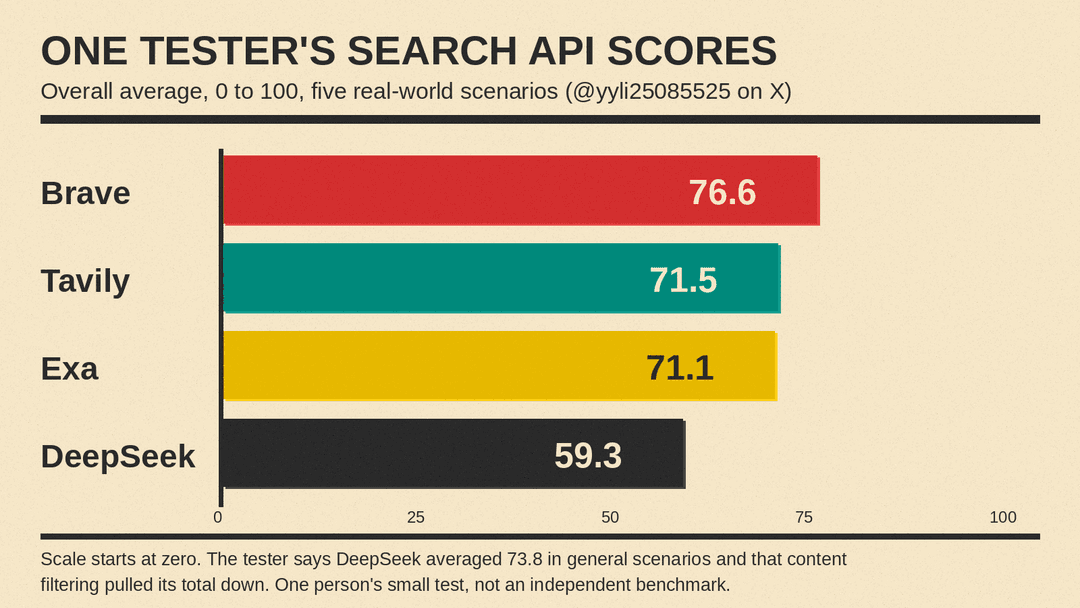
- @yyli25085525 posted, in Chinese, a weighted 0 to 100 test across five real-world scenarios and four engines. Overall averages: Brave 76.6, Tavily 71.5, Exa 71.1, DeepSeek 59.3. The same post says DeepSeek averaged 73.8 in general scenarios and that content filtering pulled its total down. On one type of query that triggered its filter, it returned no relevant hits and fell back to unrelated results such as medical papers.
- @brucexu_eth had an agent call the official API and wrote, in Chinese, that all 7 first-round requests returned content, including the Ethereum website, an account profile page and a single post by Vitalik. Three searches took about 0.8 to 0.9 seconds and two fetches about 4.5 to 5.4 seconds. The catch was freshness: the first post on a fetched profile page was nearly two days old, with 15 newer posts and replies missing.
- @Arcadia_Bao ran it as a search MCP server in Claude Desktop and concluded, in Chinese, that it cannot replace Exa or Tavily but works well alongside Exa. It could not search WeChat or Xiaohongshu, but fetched WeChat, Douyin and Bilibili pages well when given the link.
Not everyone got what they expected from Fetch. shaunpud wrote: "I "fetched" a website with hyperlinks and it only returned the text, which makes it a bit irrelevant?"
Complaints: censorship, privacy and data paths
The sharpest single comment came from czk: "as expected, the typical "politically sensitive" search queries return 0 results". The same comment said Fetch egress "looks to be huawei cloud in hong kong" and that the fetch tool "uses a linux firefox 149 user agent with lang set to china. it runs js." @brucexu_eth reported a similar result in Chinese: several queries on sensitive topics, limited to sources outside China, returned nothing.
Privacy came up next. apwheele, who runs a citation checker that needs search at volume, wrote that "the fact DeepSeek API is not zero data retention I cannot get over." hobofan, who builds a chat platform, said: "I personally also wouldn't trust Deepseek with companies secrets." Late in the thread, jstrasner raised the deployment problem: "the search call becomes a new data path to China even if the model runs in the EU."
That concern now has a policy edge in the US. Separately, the Department of Homeland Security has ordered DeepSeek products removed from federal civilian agency systems. Teams that sell to those agencies will need to check whether a search tool in their agent stack counts.
The bigger fight: who gets to read the web
The longest part of the thread was not about DeepSeek. It started with Doohickey-d asking: "What happens if I attempt to retrieve a page protected by the cloudflare checkbox or by Anubis?" Replies split between developers who say agents fetch pages on a user's behalf and site owners who are tired of crawler traffic.
thisismyanon2 answered a developer who described building a scraping setup, with sarcasm: "Thank you for escalating the arms race that's currently destroying the internet." MintsJohn said the bots that finally pushed them to install Anubis were "anthropic/openai/perplexity according to the headers they sent". On the other side, senordevnyc wrote: "Don't put your shit on the public internet if you're going to try and micromanage how people consume it." tyre suggested an index could ease the problem: "If Deepseek scrapes once every few hours, that helps the website owner with the traffic problem while allowing access."
That debate is the same one behind why AI agents keep getting blocked by sites such as Amazon and Delta. A cheap fetch API does not settle it. It moves the request from your machine to DeepSeek's.
What to take from it
The price is real and documented, and so is the free window for server-side Search and Fetch calls that DeepSeek API users make through Claude Code, Codex and DeepSeek Harness, until October 31. The quality case is thinner. The small tests posted so far put DeepSeek behind Exa and Parallel and, in one test, behind Brave and Tavily too, with a clear gap on filtered or very fresh content. One tester described it as a second source to pair with Exa rather than a replacement. If you are weighing it against Tavily, Exa, Brave or Firecrawl, our comparison of agentic search and retrieval APIs covers how those services work. Test it on your own queries, and check the data path before you send it anything sensitive.
Sources
- DeepSeek API Docs: Search and Fetch
- DeepSeek on X: Search and Fetch launch post
- Hacker News: DeepSeek search and fetch, $0.75 per 1000 successful requests
- Pandaily on X
- @paarangatrai on X
- @yangyang_2048 on X
- @yyli25085525 on X (search API test, in Chinese)
- @brucexu_eth on X (in Chinese)
- @Arcadia_Bao on X (in Chinese)
