
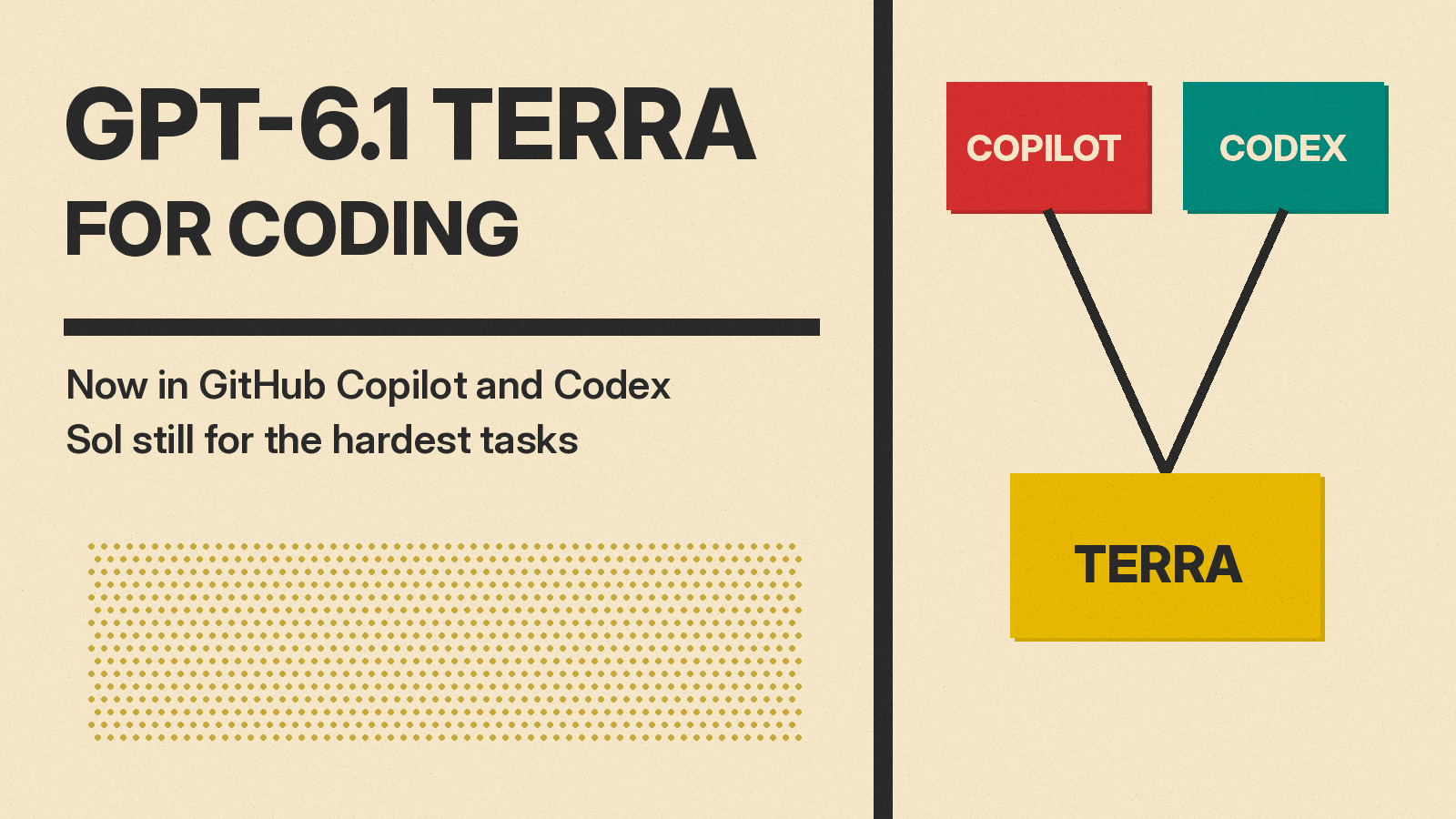
OpenAI released GPT-6.1 Terra on October 26, and the same day GitHub made it generally available in Copilot. For people who write code with agents, that means a lower-cost model to consider in two places: OpenAI's Codex and GitHub Copilot. This post covers where Terra runs, what it costs in each, and what both companies say about when to use a bigger model instead.
If you want the reaction side of the launch, we collected it in what people are saying about GPT-6.1 Terra. For OpenAI's full set of claims on price, computer use and safety, see our GPT-6.1 Terra explainer.
What OpenAI says Terra is for
OpenAI's launch page pitches Terra as "a fast, efficient model" built around visual reasoning, computer use and clearer writing. Coding gets its own section on the page.
On Terminal-Bench 4.0, which OpenAI describes as a test of "how well coding agents solve problems from the command line", OpenAI says Terra solves 50.3% of tasks at maximum reasoning effort. It compares that with GPT-5.6 Terra's published score of 21.5%. These are OpenAI's numbers, not independent results.
OpenAI also draws a clear line on scope. In its words: "For the most complex coding tasks, GPT-6.1 Sol and GPT-6 Astra remain the better choice." Terra is positioned as a lower-cost model for everyday agent work, not as the top coding model.
One safety note matters for coding agents in particular. OpenAI says Terra "meets the Critical threshold in cybersecurity under our Preparedness Framework" and keeps the protections it built for GPT-6 Astra. The same page says Terra showed "strong resistance" in OpenAI's prompt-injection tests, which is relevant to agents that read untrusted files and web pages. We covered one real example of that risk in our post on a planted AGENTS.md file that hijacked Codex.
Terra in Codex
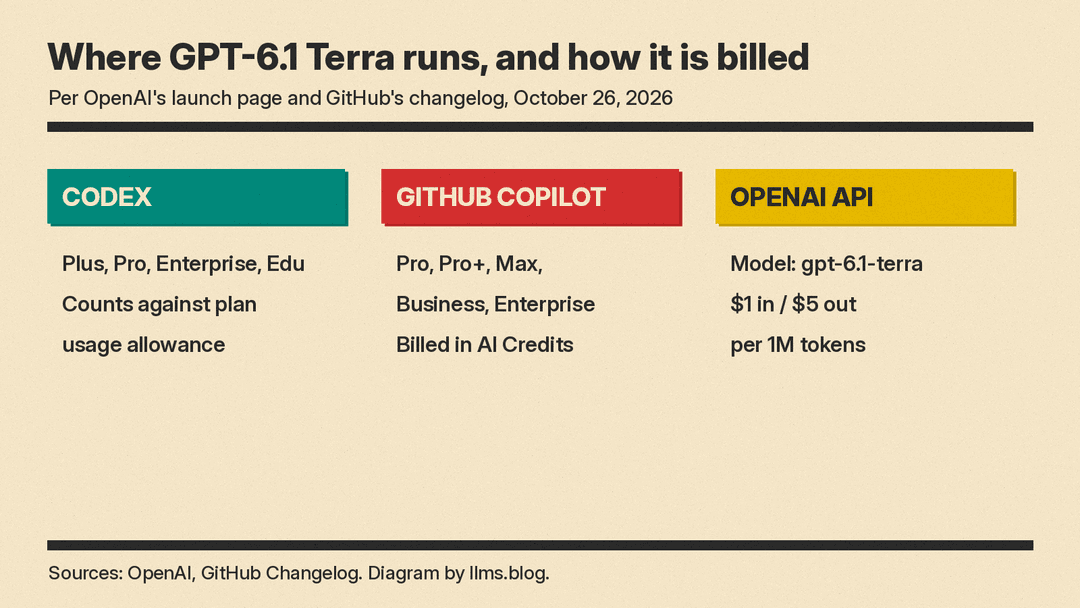
Per the launch page, Terra is available "to all Plus, Pro, Enterprise, and Edu users in ChatGPT Work and Codex" starting October 26. In Codex, Terra use counts against your plan's usage allowance. OpenAI gives no exact number, but says the same allowance "covers more tasks than with GPT-5.6 Terra and substantially more than with GPT-6.1 Sol or GPT-6 Astra."
For developers who call the model directly, the API name is gpt-6.1-terra. OpenAI's standard API pricing is pay-as-you-go per token: $1 per million input tokens, $0.05 per million cached input tokens and $5 per million output tokens. OpenAI says those standard API prices are 50% lower than GPT-5.6 Terra and GPT-6.1 Sol.
Terra in GitHub Copilot
GitHub's changelog post says Terra "is designed for everyday agentic coding and terminal work at a lower cost than GPT-6.1 Sol." GitHub adds its own early-testing claim: Terra "solved noticeably more terminal and C# coding tasks than GPT-5.6 Terra" and "works in focused, consolidated steps on well-scoped tasks." GitHub gives no figures for that test.
Who gets it, per the same post:
- Plans: Copilot Pro, Pro+, Max, Business and Enterprise. Copilot Free is not on the list.
- Where: the model picker in Visual Studio Code, Visual Studio, Copilot CLI, Copilot cloud agent, the GitHub Copilot app, github.com, GitHub Mobile on iOS and Android, JetBrains IDEs, Xcode and Eclipse.
- Rollout: gradual. GitHub says to "check back soon" if the model is not in your picker yet.
- Admins: Business and Enterprise admins control access through the model policy in Copilot settings. Under default model enablement, new models are on unless an admin turned off the global default or disabled this model.
GitHub's supported models page lists GPT-6.1 Terra as GA. Its table of minimum IDE versions for Terra still reads "TBD" for every editor at the time of writing.
If you are new to choosing models inside Copilot, our VS Code 1.143 explainer shows how the editor now lets you compare models side by side.
How Copilot bills Terra
GitHub says Terra "is billed at provider list pricing under usage-based billing." Its models and pricing page explains the mechanics: each request is priced per token for the model used, and the total is converted into GitHub AI Credits, where 1 AI credit equals $0.01. Paid plans include an allowance of AI Credits (pooled per billing entity for Business and Enterprise), and usage past that allowance is billed in AI Credits at the listed per-token rates. Code completions and next edit suggestions are not billed in AI Credits.
GitHub's listed rates for GPT-6.1 Terra, per 1 million tokens:
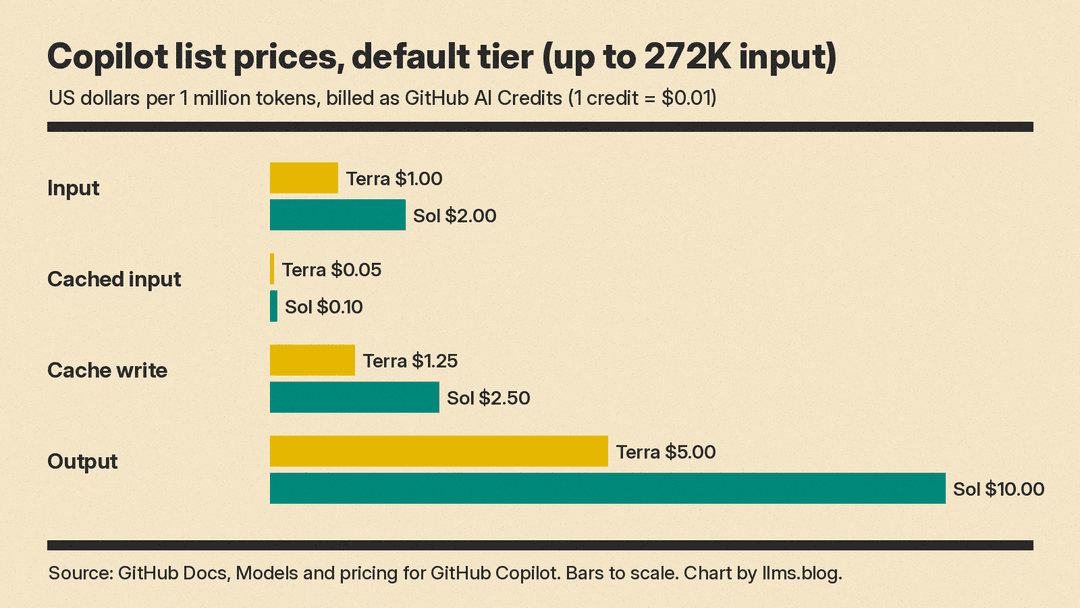
- Default tier (up to 272K input tokens): $1.00 input, $0.05 cached input, $1.25 cache write, $5.00 output.
- Long context tier (above 272K input tokens): $2.00 input, $0.10 cached input, $2.50 cache write, $7.50 output.
For comparison, the same page lists GPT-6.1 Sol's default tier at $2.00 input, $0.10 cached input, $2.50 cache write and $10.00 output. GitHub also notes that recent OpenAI models, Terra included, carry a cache write cost on top of cached input, which earlier OpenAI models did not.
What this means in practice
Terra gives coding-agent users a cheaper option for everyday, well-scoped work, and both vendors frame it that way. OpenAI says Sol and Astra remain better for the hardest coding tasks, and GitHub describes Terra as suited to "well-scoped tasks."
In Copilot, the choice has a direct cost effect, since output tokens on Terra are listed at half the Sol rate in the default tier. In Codex, the effect shows up as more tasks per plan allowance instead of a per-token bill. For a broader look at how Codex compares with other coding agents on price, see our Cursor vs Claude Code vs Codex guide.
A sensible way to try it: set Terra as the model for routine agent sessions, keep Sol or Astra one click away for hard bugs, and compare results on your own repository before you switch a team default.
