
Meta wants to sell up to $95 billion of new stock to pay for its AI build-out. The company announced the plan on Monday, and said Nvidia, AMD and Broadcom have shown interest in buying up to $5 billion of the shares. Reuters called it Meta's largest-ever equity fundraising.
What Meta is selling
Meta's press release lists two pieces:
- About $35 billion, launched now, in two underwritten public offerings run by Morgan Stanley and Goldman Sachs:
- about $22.5 billion of Class A common stock
- about $12.5 billion of "depositary shares" that represent a new mandatory convertible preferred stock
- About $60 billion later, through an "at-the-market" (ATM) program. With an ATM, a company sells shares into the open market a little at a time instead of all at once.
$22.5 billion plus $12.5 billion is $35 billion. Add the $60 billion ATM and the total is $95 billion.
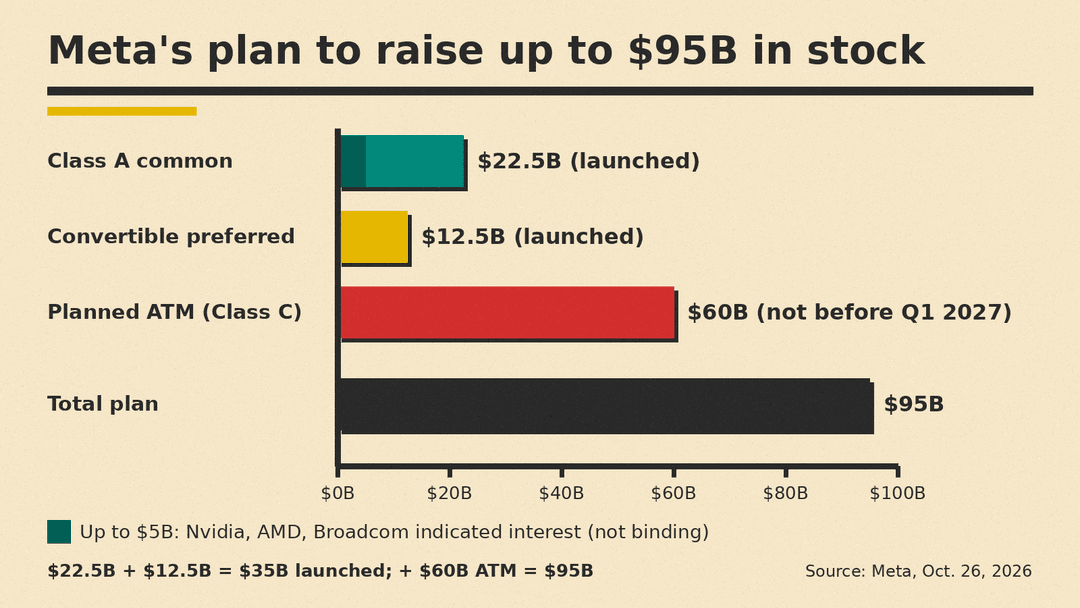
The ATM will sell Meta's new nonvoting Class C shares, which Meta announced with its third-quarter results. Meta says the program is not expected to start until the first quarter of 2027, after Class C trading begins. It has not signed any agreement for it yet, and its timing, size and terms "have not been determined."
The fine print
The common stock part uses forward sale agreements with Morgan Stanley and Goldman Sachs. Meta does not expect to get any cash from that sale at first. Instead, it can deliver new shares and collect the money on one or more dates up to November 19, 2027. Meta expects to grant the underwriters a 30-day option to buy up to an additional $3.375 billion of common stock.
The preferred part is 250 million depositary shares, each representing a 1/20th interest in one preferred share. Each preferred share is expected to have a $1,000 liquidation preference. Unless converted earlier, each preferred share converts automatically into Class A common stock, or into the new Class C stock once it is issued and other conditions are met, for settlement on or about August 15, 2029. The dividend rate and conversion terms will be set at pricing, so they are not public yet. Meta intends to apply to list the depositary shares on Nasdaq as "METAM." It also expects to grant the underwriters a 30-day option to buy up to 37.5 million more of them.
The chipmakers on the cap table
Nvidia, AMD and Broadcom are named as "cornerstone investors." Acting separately, not jointly, they indicated interest in buying up to a combined $5 billion of the Class A common stock, at the same price as other buyers. Meta stresses these are not binding commitments. The three could buy more, fewer or no shares. Up to $5 billion would be about 22% of the $22.5 billion common offering.
Reuters noted that this "adds to concerns about an increasingly circular flow of capital in the AI industry, as chip suppliers help finance the expansion of one of their biggest customers." The same day, banks and lenders lined up $63 billion to finance Broadcom chips for Anthropic.
Why Meta needs the money
Meta expects $135 billion to $145 billion of capital expenditures in 2026. The press release says Meta owns data centers in 23 US states, is building four superclusters of more than one gigawatt each, and is on track to nearly double its total infrastructure capacity in 2026 compared with 2025.
Meta says it will pay for this with a mix of operating cash flow, investment-grade debt, partnerships and stock. It generated $97 billion of operating cash flow in the first three quarters of 2026 and had about $82 billion in cash and marketable securities at the end of September.
In the third quarter, spending outran cash. Per Reuters, Meta burned $2.12 billion of free cash flow in the third quarter, its first negative free cash flow in over a decade, against positive free cash flow of $10.63 billion a year earlier. Reuters also reports Meta has committed to spend about $825 billion in the future, and carried $80.92 billion of long-term debt at September 30.
What Meta says it gets for it
Meta listed its AI results so far:
- More than 10 million Muse users in the US and Canada in the early weeks after launch. Shopping is the top use, with over 25% of weekly Muse users doing it. Meta also cited Muse Wonder, which it calls its first frontier model.
- More than 2 million businesses use its Business Agent each week, with over 30 million conversations a week.
- Third-quarter revenue of $64.6 billion, up 26% year over year, and net income of $9.9 billion.
How investors took it
Meta shares fell about 1.4% in morning trading, Reuters reported. William Blair analysts said in a note: "We expect investors to continue to question the financing and potential for future capital raises." They also said the raise "reinforces both Meta's confidence in the long-term returns from AI investment and the increasingly capital-intensive nature of pursuing that opportunity."
Meta is not alone. Reuters notes Alphabet raised the size of its own equity offerings to $84.75 billion earlier this year.
Why it matters
Reuters notes a shift among big tech companies, which previously relied on cash to fund AI infrastructure and are increasingly tapping debt markets and raising equity. AI spending is now large enough that Meta is asking stock buyers, and its own chip suppliers, to help fund it. The final size depends on pricing, the forward settlements and an ATM program that does not exist yet.
Sources
- Meta: Meta Announces Launch of Offering of Depositary Shares Representing Series A Mandatory Convertible Preferred Stock and Offering of Class A Common Stock in Connection with Forward Sale Agreements
- Meta free writing prospectus (SEC)
- Reuters via StreetInsider: Meta eyes record $95 billion equity raise to fund AI expansion
- CNBC: Meta launches plan for $95 billion stock offering to fund AI expansion
- Techmeme: Meta plans to raise $95B to finance its AI infrastructure
