
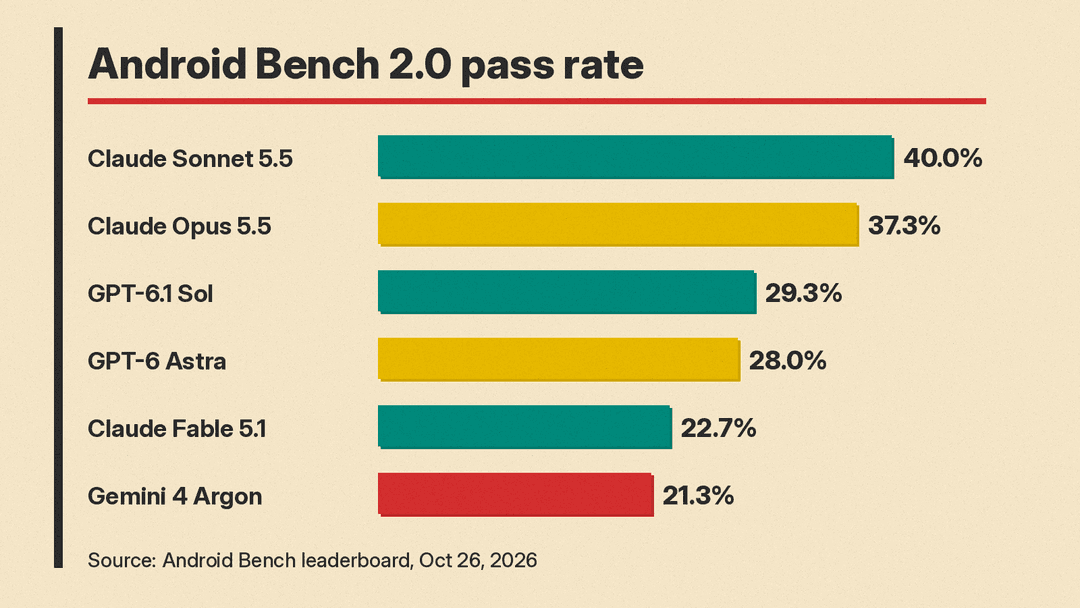
Google's own Android coding benchmark has Gemini 4 Argon in sixth place. In the October 26 update to Android Bench, Google's leaderboard for how well AI coding agents handle Android app work, Gemini 4 Argon fully solved 21.3% of tasks. Claude Sonnet 5.5 led with 40.0%, nearly twice that rate.
The update was covered by 9to5Google, which noted that Google's own frontier model "makes a rather underwhelming debut" on the list. Here is what changed, what the numbers mean, and where they need care.
What changed on October 26
The Android Bench changelog lists these changes for October 26:
- Results now show the reasoning effort used for each model (max, high or default).
- New Claude Code results for Claude Sonnet 5.5.
- New Antigravity SDK results for Gemini 4 Argon.
- New Codex results for GPT-6.1 Sol.
Claude Sonnet 5 and GPT-6 Sol results moved to the archive.
The top of the leaderboard
Android Bench 2.0 tests each model inside a coding agent, such as Claude Code, Codex or the Antigravity SDK. Here are the top six, with pass rate (the share of runs that fully solved a task) and the reasoning effort the leaderboard lists:
- Claude Sonnet 5.5 (max), Claude Code: 40.0%
- Claude Opus 5.5 (max), Claude Code: 37.3%
- GPT-6.1 Sol (max), Codex: 29.3%
- GPT-6 Astra (high), Codex: 28.0%
- Claude Fable 5.1 (high), Claude Code: 22.7%
- Gemini 4 Argon (high), Antigravity SDK: 21.3%
Below Gemini 4 Argon, the list continues with Qwen3.8 Max at 12.5%, Kimi K3 at 12.0%, GPT-6 Luna at 10.7%, Gemini 3.8 Flash at 8.0% and Gemini 3.7 Flash at 7.3%.
Claude Opus 5.5 also has a new line. The October 6 table in the archive showed it at 32.7%. The current leaderboard lists it at max effort with 37.3%.
What Android Bench actually tests
This is not a quick bug-fix test. Google's methodology page says version 1.0 was saturated, with frontier models reaching a pass rate of about 90% on small fixes. Version 2.0 uses 30 long-horizon tasks across four streams: building a new app, migrating libraries and architecture, adding platform features, and converting Flutter or React Native apps to native Android. Google says these are tasks that typically take mid-level to senior developers days or weeks.
Some details that matter for reading the scores:
- Each task runs 5 times, and the scores are averages.
- A run passes only with a perfect score: all functional tests pass, the screens match, and no rules are broken.
- The dataset is private, and Google says it uses a private codebase and migrations that do not exist upstream, so models cannot copy a known answer.
- Screens are checked by a Gemini 3.5 Flash visual judge, alongside deterministic tests.
That last point is worth knowing: a Google model helps grade the visual part of every run, including runs by rival models.
Pass rate versus completion rate
The gap looks smaller on Google's second metric. Completion rate scores how much of a task an agent got done, even on runs that fail. Gemini 4 Argon's completion rate is 81.8%. The top five range from 80.9% (Claude Sonnet 5.5) to 85.6% (Claude Opus 5.5).
So in this test, Gemini 4 Argon's average completion rate is close to the leaders', but it fully solves fewer tasks.
The leaderboard also shows a statistical range for each pass rate. Gemini 4 Argon's range is 10.0% to 33.3%, which overlaps the ranges of all five models above it, including Claude Sonnet 5.5 at 24.0% to 56.0%. With 30 tasks, the ranking is not cleanly separated.
Cost and time
The leaderboard reports the average cost of one full benchmark run:
- Claude Sonnet 5.5: $1,574.90
- Claude Opus 5.5: $1,150.30
- GPT-6.1 Sol: $99.50
- GPT-6 Astra: $375.70
- Claude Fable 5.1: $492.60
- Gemini 4 Argon: $267.60
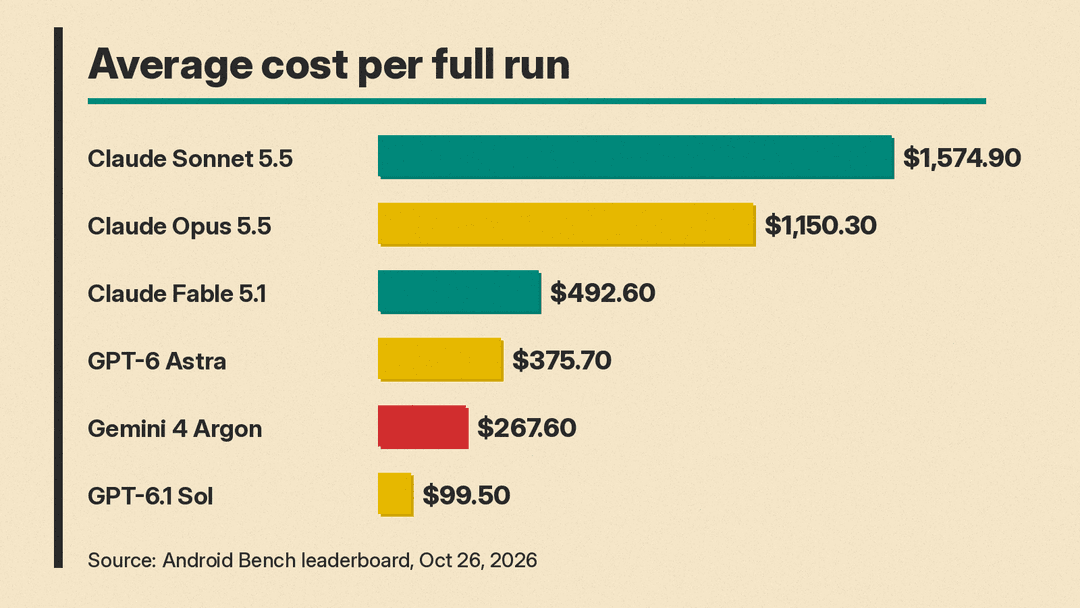
GPT-6.1 Sol is third on pass rate at well under a tenth of the leader's cost. Average time to work through the 30 tasks was 70.7 hours for Claude Sonnet 5.5, 52.8 hours for Gemini 4 Argon and 26.6 hours for GPT-6.1 Sol.
Google adds two caveats. Summed cost and time favor models that fail early, since a model that gives up sooner spends less. And costs use each provider's prices at the time of the run, so they are not directly comparable across benchmark releases.
Why it matters
Google is publishing a result that does not flatter its own flagship. For Android developers, the practical reading is that the agent and model pairing matters, and that Gemini 4 Argon with the Antigravity SDK trails the Claude Code and Codex pairings, as of the October 26 results, on clean task completion in this test.
It also adds context to earlier reporting. 9to5Google notes that shortly after the Gemini 4 Argon launch, some internal voices said the model "struggles to handle certain coding tasks," though Google stood by the model's capabilities. For more on the model itself, see our Gemini 4 Argon explainer and our Gemini 4 Argon vs GPT-6 Astra vs Claude Opus 5.5 comparison. If you are choosing a mid-tier model, our Claude Sonnet 5.5 vs GPT-6.1 Sol vs Gemini 3.8 Flash guide covers the trade-offs.
One benchmark is one view. Android Bench measures long, Android-specific work with each lab's own agent, and its results will shift as Google adds models and archives others.
